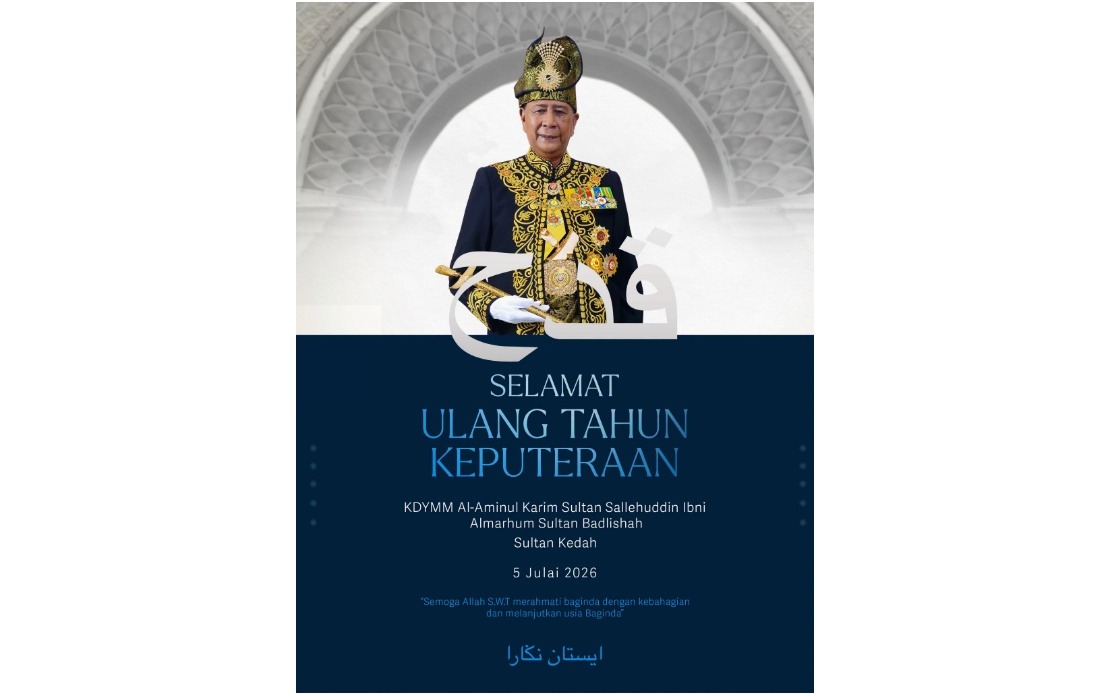
His Majesty Sultan Ibrahim, King of Malaysia, has marked the 84th birthday of the Sultan of Kedah, Al-Aminul Karim Sultan Sallehuddin Sultan Badlishah, with official greetings conveyed through the palace's social media channels. The gesture reflects the tradition of interreligious and inter-state courtesy within Malaysia's constitutional monarchy, where the reigning monarch publicly recognises significant occasions among the country's nine royal households. The Sultan of Kedah holds particular constitutional importance as one of the elder statesmen within the Conference of Rulers, which serves as an advisory body on matters of national significance.
In his message shared on the official Facebook page of Sultan Ibrahim Sultan Iskandar, His Majesty expressed prayers for the Kedah ruler's continued wellbeing and longevity. The King invoked divine blessings, asking Allah SWT to grant Sultan Sallehuddin happiness, good health, and a long life. Such formal acknowledgements carry deeper ceremonial weight in Malaysia's system of governance, where the monarchy maintains symbolic and constitutional authority across multiple tiers of administration. The public nature of these greetings reinforces the bonds between the federal crown and the state sultanates, each playing complementary roles in Malaysia's decentralised governance structure.
Prime Minister Datuk Seri Anwar Ibrahim similarly extended heartfelt birthday wishes to Sultan Sallehuddin, demonstrating the customary coordination between the executive branch and the institution of royalty. The Prime Minister's message, also shared via Facebook, extended prayers not only to the birthday celebrant but encompassed the entire Kedah royal household, including the Sultanah Maliha Tengku Ariff and members of the extended family. This inclusive approach reflects the protocol governing formal state interactions, where recognition of one member of a royal family traditionally extends to acknowledging the collective institution and its support systems.
The Prime Minister's benediction—"Daulat Tuanku. Dirgahayu Tuanku"—employs traditional Malay court language that acknowledges both the spiritual and temporal authority associated with Kedah's ruling house. The phrase carries historical resonance, harking back to centuries of sultanate governance in the Malay peninsula before the colonial period and continuing through Malaysia's modern constitutional arrangement. By invoking wishes for "enduring sovereignty," the Prime Minister's statement subtly reinforces the state's autonomous status within the federal framework, a delicate balance that defines Malaysia's complex relationship between national unity and regional princely authority.
Kedah's position within Malaysia's political landscape carries particular significance given its historical prominence as one of the oldest sultanates in the region, with roots extending into medieval Southeast Asian statecraft. Sultan Sallehuddin has presided over this important northern state during periods of considerable economic and demographic change, witnessing Kedah's evolution from primarily agricultural pursuits to increasing industrialisation and service sector development. At 84 years of age, the Sultan represents a continuity of institutional memory and governance experience that spans multiple decades of Malaysia's post-independence development.
The celebration of the Sultan of Kedah's birthday holds implications beyond ceremonial courtesies, as it underscores the ongoing relevance of Malaysia's monarchical institutions in an era of rapid social and political transformation. Within Southeast Asia's diverse political landscape, where forms of governance range from republics to constitutional monarchies, Malaysia's particular arrangement has maintained relative stability through its dual-source legitimacy system—democratic electoral processes combined with inherited royal authority. The public acknowledgement of milestone birthdays for senior royalty reinforces public awareness of these constitutional arrangements and their importance to national cohesion.
The interchange of birthday greetings between federal and state leadership also reflects Malaysia's success, despite periodic tensions, in maintaining functional working relationships between different levels of government. While federalism in Malaysia has occasionally produced friction—particularly regarding revenue distribution, land rights, and religious authority—these ceremonial exchanges demonstrate continuities of protocol and mutual respect that facilitate more substantive policy discussions. The courtesy extended to Sultan Sallehuddin exemplifies the institutional framework that enables the Conference of Rulers to function as a forum for addressing matters affecting the collective interest of the sultanates and the nation.
Regional observers noting Malaysia's political dynamics often point to the continued vitality of traditional institutions as a stabilising factor in periods of partisan competition. The birthday acknowledgements offered by both the King and Prime Minister, coming from different political constituencies within the national leadership structure, demonstrate how ceremonial functions transcend partisan divisions. Such moments of institutional consensus, however symbolic, provide platforms for reinforcing national unity narratives that can otherwise become fractured along factional or geographical lines during periods of political contestation.
For Malaysian citizens and observers across Southeast Asia, these exchanges remind of the distinct character of Malaysia's constitutional arrangements, where the nine sultans retain formal and substantive powers that differ markedly from the ceremonial roles of monarchs in some other Commonwealth nations. The Sultan of Kedah's continued prominence at an advanced age also highlights the question of succession planning and generational transition within state-level leadership structures. As demographic changes reshape Malaysia's political demographics, the experience and institutional knowledge embodied by long-serving rulers like Sultan Sallehuddin remain valuable reserves of continuity during periods of broader institutional adaptation.

