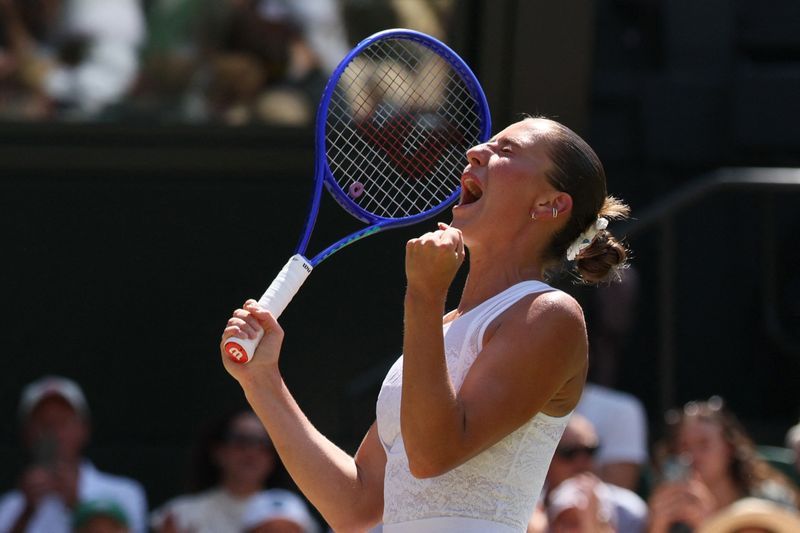
Marta Kostyuk of Ukraine has advanced to the semi-finals of Wimbledon after a dominant quarter-final performance against Italy's Jasmine Paolini, the 2024 runners-up, on Wednesday. Playing on Centre Court in sweltering conditions, the 12th seed delivered a one-sided victory with a scoreline of 6-3 6-2, dismantling her higher-ranked opponent with aggressive baseline play and clinical execution.
Kostyuk's intensity was apparent from the opening moments, setting an unrelenting pace that left Paolini struggling to find rhythm and momentum. The Ukrainian claimed the opening set in just 36 minutes, breaking serve twice to establish early dominance. By reaching 3-2, Kostyuk had signalled her intent, and she extended her advantage to 5-3 before securing the set with another break. The speed with which she completed the first set suggested a player operating at a level above her opponent on the day.
The 24-year-old's appearance on Centre Court represented a significant milestone in her career. This was her debut on the famous grass court, and it also marked her first outing in a Wimbledon singles quarter-final. Despite the magnitude of the occasion, Kostyuk showed no signs of being overawed by the environment or the scale of the challenge. Instead, she channelled her focus into executing the gameplan that would ultimately prove decisive.
Paolini's pedigree as a Grand Slam finalist could not overcome Kostyuk's superior performance on the day. The Italian had won their last two encounters, giving her some psychological advantage heading into this match. However, Kostyuk turned the tables decisively, making excellent use of her powerful forehand to dictate rallies and keep her opponent on the back foot. The weapon proved instrumental in breaking Paolini's serve repeatedly and in claiming offensive positions from which she could finish points.
In the second set, Kostyuk's dominance intensified. She broke Paolini immediately to establish a 3-1 lead, and crucially, the Italian failed to manufacture a single break point opportunity throughout the encounter. This statistical detail underscores the thoroughness of Kostyuk's victory. Without any realistic chance to apply pressure on her opponent's serve, Paolini was reduced to holding her own games defensively while Kostyuk pressed forward.
The atmosphere on Centre Court remained engaging despite the match's one-sided trajectory. Queen Camilla watched proceedings from the Royal Box, lending regal presence to the occasion. The crowd attempted to rally behind Paolini as the underdog in a match where the top-ranked player was struggling, yet these efforts could not reverse the fundamental gulf in performance that had opened between the two competitors.
Kostyuk closed out the victory remorselessly, finishing the match in 69 minutes with a second match point as Paolini's serve failed to hold firm in the closing stages. This swift conclusion reflected the overall pattern of the encounter, in which the Ukrainian had controlled proceedings from start to finish without ever allowing her opponent to mount a meaningful comeback or competitive pressure.
For Malaysian and Southeast Asian tennis enthusiasts, Kostyuk's advancement carries significance for the Asian sporting calendar. While Ukraine sits geographically outside the region, the victory of an Eastern European player at Wimbledon reflects the increasingly global nature of elite women's tennis, with talent emerging from diverse corners of the world. Kostyuk's powerful baseline game and aggressive court positioning represent a contemporary style that contrasts with more traditional grass-court approaches.
Kostyuk's semi-final berth represents reward for her commitment and development as a player. Reaching this stage at a Grand Slam demands consistency, mental resilience, and technical excellence. Her display against Paolini demonstrated all three qualities in abundance. The question now turns to who she will face in the semi-finals and whether she can maintain this level of performance against whatever opponent awaits.
The narrative of this quarter-final illustrates how tennis at the highest level can sometimes deliver lopsided contests, particularly when form and confidence converge favourably for one competitor. Kostyuk's commanding victory also serves as a reminder that seeding positions do not always dictate outcomes on grass, where serve-and-volley traditions and surface-specific adaptation play significant roles. Her emergence as a serious Wimbledon contender adds another compelling layer to this year's tournament narrative as the championship moves deeper into its concluding stages.

