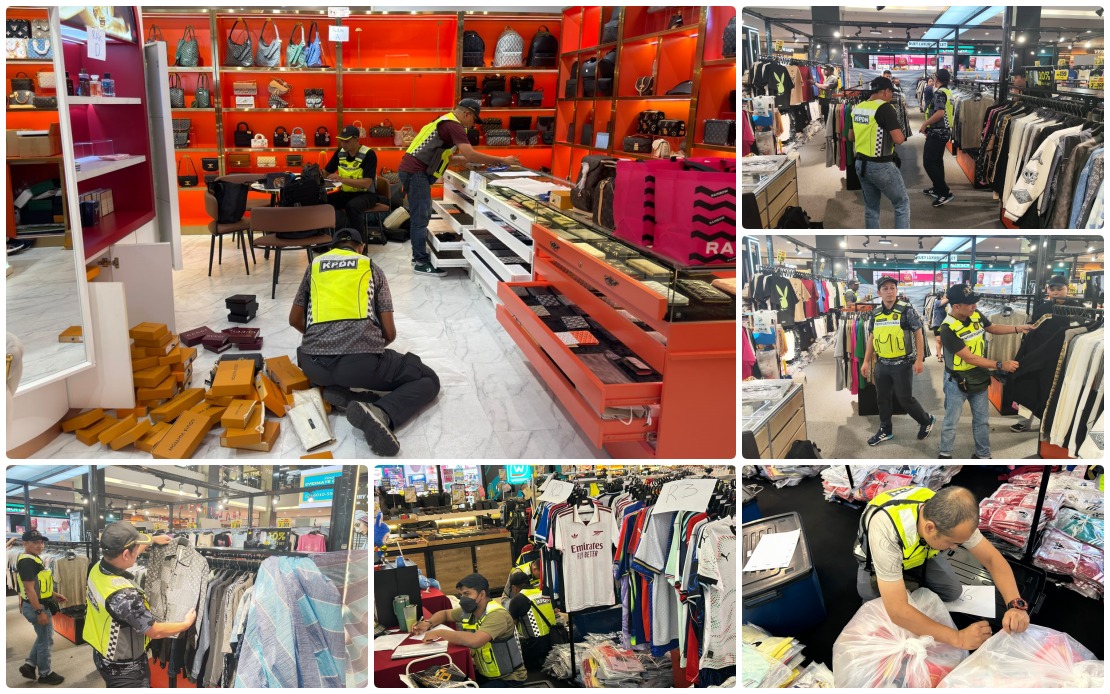
Malaysia's Ministry of Domestic Trade and Cost of Living (KPDN) has dismantled a sophisticated counterfeit operation spanning three locations in Johor Bahru, recovering approximately RM600,000 worth of illicit branded merchandise. The coordinated enforcement action, conducted on June 15 and announced on June 19, represents an escalation in authorities' fight against intellectual property infringement and consumer fraud that has flourished across the region's commercial networks.
Datuk Azman Adam, enforcement director-general at KPDN, revealed that the Putrajaya Enforcement Division executed simultaneous raids on premises suspected of systematically distributing counterfeit items bearing unauthorized trademarks of internationally recognised brands. The operation culminated from sustained intelligence gathering spanning an entire month, during which investigators tracked networks of traders operating through major supermarket channels whilst simultaneously supplying secondary retailers. This two-tiered distribution model suggests an organised operation rather than isolated vendor activity, indicating the scale at which counterfeit goods penetrate Malaysian retail ecosystems.
The seized inventory encompassed a diverse range of products including clothing, handbags, wallets, belts, and perfumes—all bearing applied trademarks without authorization from legitimate trademark proprietors. Such diversity in counterfeit merchandise categories demonstrates how these operations exploit consumer demand across multiple luxury segments, from fashion accessories to personal care items. The inclusion of supporting business documentation in the seizure provides authorities with critical evidence tracing supply chains and operational structures, potentially enabling investigators to dismantle upstream manufacturing and distribution networks feeding these retail outlets.
Authorities arrested four individuals comprising the premises owner and caretaker alongside two additional suspects believed instrumental in managing daily operations. Their detention enables investigative teams to extract operational intelligence, map the commercial networks sustaining this enterprise, and potentially identify upstream suppliers and affiliated distributors. Such personnel typically possess detailed knowledge of procurement sources, pricing structures, and customer networks—information crucial for dismantling larger counterfeit ecosystems rather than merely addressing individual retail outlets.
The investigation proceeds under Section 102(1)(c) of the Trademark Act 2019, which specifically criminalizes possession, custody, or control of goods bearing wrongfully applied trademarks intended for commercial distribution. This legislation establishes graduated penalties calibrated to offense severity and recidivism patterns. Individual offenders face maximum penalties of RM10,000 per item or three-year imprisonment for initial convictions, escalating to RM20,000 per item or five-year imprisonment for repeat offenses. Corporate entities confront steeper financial liability, with initial penalties reaching RM15,000 per item and subsequent offenses attracting RM30,000 per item fines, reflecting legislative intent to render corporate counterfeiting economically unviable.
Counterfeit operations inflict multifaceted economic damage extending beyond trademark owners and legitimate retailers. Consumers purchasing counterfeit goods receive substandard products failing basic quality and safety standards, particularly problematic for personal care items where manufacturing protocols remain unregulated. The proliferation of fake merchandise undermines legitimate retail sectors, distorts market competition, and erodes consumer confidence in purchasing channels. For Malaysia specifically, as manufacturing hubs increasingly integrate into premium supply chains and luxury retail networks expand across Southeast Asia, counterfeit operations threaten brand reputation and investor confidence in the region's intellectual property protection frameworks.
The operation highlights how counterfeit networks exploit retail infrastructure, particularly relationships with established supermarket chains providing legitimizing veneer to illicit operations. Distribution through major retail venues substantially multiplies consumer exposure, obscuring counterfeit origins behind ostensibly reputable commercial addresses. This retail penetration distinguishes organized counterfeit operations from street-level vendors, indicating sophisticated commercial understanding and established relationships enabling sustained distribution. The month-long intelligence phase preceding enforcement reflects authorities' recognition that effective action requires dismantling operational infrastructure rather than reactive responses to isolated suspicious transactions.
Regional implications merit consideration as Southeast Asian economies experience accelerating retail integration and cross-border commerce expansion. Counterfeit networks leverage regional trade flows, porous borders, and inconsistent enforcement across jurisdictions to distribute illicit merchandise. Malaysia's position as a regional commerce hub means counterfeit operations here potentially supply downstream markets throughout Southeast Asia. Conversely, regional sources of counterfeit goods—including manufacturing clusters in certain neighboring economies—funnel products through Malaysian distribution networks utilizing established logistics infrastructure and retail relationships. Effective enforcement therefore demands regional cooperation, harmonized legal frameworks, and intelligence sharing across ASEAN jurisdictions.
Datuk Azman Adam's statement reaffirming KPDN's commitment to intensifying enforcement operations suggests escalating resource allocation and investigative sophistication. The ministry recognizes that occasional enforcement actions provide insufficient deterrence without demonstrable consistency and escalating consequences. Sustained pressure on distribution networks, particularly targeting organized operations rather than marginal vendors, gradually increases operational costs for counterfeit enterprises, potentially rendering certain distribution channels uneconomical. This strategy acknowledges that counterfeit operations fundamentally respond to financial incentive structures—rising enforcement risks and operational costs eventually exceed profit margins, particularly for organized enterprises operating established infrastructure.
Consumer awareness represents a critical complementary element to enforcement-focused strategies. Counterfeit operations flourish partly through consumer indifference regarding product authenticity, particularly when price differentials prove substantial. Educational campaigns highlighting quality deterioration, health and safety risks inherent in unregulated manufacturing, and ethical implications of supporting illicit networks could gradually shift consumption patterns. Malaysian consumers increasingly sophisticated regarding product authentication and brand protection might prove less vulnerable to counterfeit operations than markets where brand consciousness remains nascent.
The RM600,000 seizure value provides only partial quantification of this operation's economic scope. Seized merchandise represents inventory present during enforcement action; ongoing sales pipelines, distributed inventory across additional venues, and supply chain stockpiles likely multiples of recovered quantities. Calculating actual economic impact requires estimating total throughput, wholesale replacement costs versus retail values, and lost legitimate sales across affected brand categories. Such analysis would substantially magnify the operation's documented scale, demonstrating why organized counterfeit operations attract capital investment and professional management despite legal risks.
Moving forward, enforcement momentum requires translation into sustained investigative pressure and prosecution demonstrating meaningful consequences. Public disclosure of convictions, penalties imposed, and asset forfeitures would strengthen deterrent signaling, particularly among organized criminal enterprises conducting cost-benefit analysis regarding illicit commerce ventures. Malaysia's position within international intellectual property protection frameworks and ASEAN trade architecture creates diplomatic incentives for demonstrating effective enforcement, signaling to trading partners and multinational enterprises that intellectual property rights enjoy meaningful legal protection. For consumers and legitimate businesses, such enforcement represents fundamental infrastructure supporting fair competition and product authenticity assurance essential for retail market integrity.

%22%2F%3E%3C%2Fpattern%3E%3C%2Fdefs%3E%3Crect%20width%3D%22100%25%22%20height%3D%22100%25%22%20fill%3D%22url(%23ph2nm9dg)%22%2F%3E%3Crect%20width%3D%22100%25%22%20height%3D%22100%25%22%20fill%3D%22url(%23ph2nm9dp)%22%2F%3E%3Ctext%20x%3D%2250%25%22%20y%3D%2250%25%22%20text-anchor%3D%22middle%22%20dominant-baseline%3D%22central%22%20fill%3D%22rgba(255%2C255%2C255%2C0.95)%22%20font-family%3D%22Georgia%2C%20'Times%20New%20Roman'%2C%20serif%22%20font-weight%3D%22700%22%20font-size%3D%22272%22%20letter-spacing%3D%22-0.02em%22%3EZahid%3C%2Ftext%3E%3C%2Fsvg%3E)