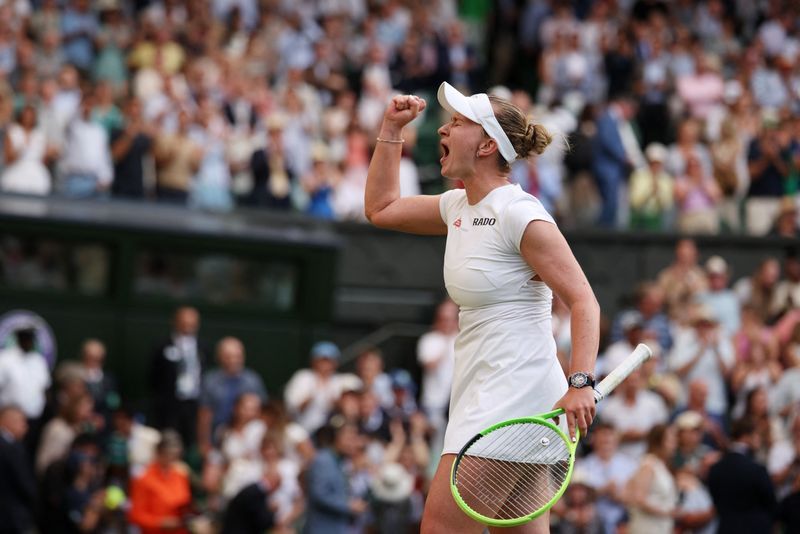
Barbora Krejcikova demonstrated the mental resilience that has defined her career by storming back from a set deficit to eliminate fifth seed Mirra Andreeva on Wednesday at Wimbledon, securing a 4-6 7-5 6-4 victory that sends the former champion into the third round. Playing on Centre Court, the Czech player faced an uphill battle after surrendering the opening set, but ultimately proved too experienced and composed for her younger opponent, showcasing the kind of match intelligence that separates elite performers from rising talent at the sport's grandest stages.
Krejcikova's opening performance suggested the match might be a one-sided affair. The reigning Wimbledon champion, who claimed the French Open title in the same season, began with aggressive intent against the 19-year-old Russian prodigy, racing to a 3-0 advantage in the first set. However, this rapid start proved deceptive. Rather than building on her early momentum, Krejcikova's execution faltered noticeably, allowing Andreeva to mount a steady comeback that culminated in the Russian claiming the set 6-4. The lapse underscored a recurring challenge for players at Wimbledon: maintaining intensity and focus across multiple sets on grass, where rhythm and concentration prove as vital as raw talent.
Andreeva, fresh from capturing her maiden Grand Slam title at Roland Garros weeks earlier, arrived at the All England Club as one of the tournament's most intriguing storylines. At just 19 years old, she represents the new generation of players threatening to reshape women's tennis hierarchy. Yet her maiden major success at the French Open, while extraordinary, offered limited insight into how she would perform on grass—a surface that demands different tactical approaches and physical adaptations. Krejcikova's initial struggles suggested the young Russian possessed the skills to trouble even the most accomplished competitors.
The narrative shifted decisively in the second set as Krejcikova recalibrated her approach. Rather than attempting to overwhelm Andreeva with the same aggressive baseline power that had proved ineffective in the opening set, the Czech player adopted a more measured strategy that emphasised court positioning, variety, and tactical adjustments. This methodical dismantling of Andreeva's game proved far more effective, forcing the Russian into uncomfortable positions and errors. Krejcikova's experience and tennis intelligence became increasingly evident as the set progressed, ultimately forcing the match to a deciding third set after Krejcikova claimed the second 7-5.
The decisive set witnessed mounting frustration from Andreeva as Krejcikova's superior poise and execution continued to accumulate. At one critical juncture, the fifth seed saved six match points through sheer determination and some opportune shot-making, yet these reprieves only delayed the inevitable. Krejcikova's relentless consistency and refusal to allow Andreeva any momentum proved decisive; the Czech competitor crossed the finish line to secure only her second victory against the accomplished youngster across their five meetings.
Following the victory, Krejcikova offered generous praise for her opponent while reflecting on the competitive nature of their encounters. "This is the fifth time I've played Mirra I think and it's always been a huge fight," she observed, acknowledging that Andreeva has established herself as a formidable competitor despite her tender years. The four-time Grand Slam champion recognised her opponent's exceptional potential and multifaceted skillset, noting that Andreeva possesses "everything in front of her." Yet Krejcikova also emphasised the significance of her own performance, expressing satisfaction at delivering quality tennis before the Centre Court audience.
Krejcikova's emotional connection to Centre Court provided additional context for her performance. The world-renowned venue represents tennis's pinnacle, hosting some of sport's most historic moments across more than a century. Playing there carries intangible weight—the grass, the traditions, the expectations—that distinguishes Wimbledon from other tournaments. For established champions like Krejcikova, success on Centre Court validates their status among the game's elite. Her explicit acknowledgment of pride at winning on "the best court in the world" reflected both genuine affection for the venue and the elevated satisfaction that accompanies victory in such a distinguished setting.
Andreeva's reaction to defeat revealed the emotional toll of coming so close to advancing. Her frustrated gesture—throwing her racket toward her chair—provided visible evidence of her frustration at narrowly missing an opportunity to progress further at a Grand Slam where she had arrived as a genuine threat. For a young player just weeks removed from her maiden major triumph, the loss represents both disappointment in the immediate moment and a learning experience that will likely strengthen her resolve for future encounters against similarly accomplished opponents. Her Paris breakthrough had suggested she might challenge established players with immediate effect; this Wimbledon exit offers a more sobering reminder that success on one surface does not automatically translate across different competitive environments.
Krejcikova's next challenge pits her against fellow Czech Nikola Bartunkova, setting up an intriguing all-Czech encounter in the third round. This matchup carries additional resonance given the historical strength of Czech women's tennis and the current generation's continued excellence. The pairing demonstrates the depth of talent within Czech tennis, with both players capable of performing at elite levels on the sport's biggest stages. For Krejcikova, the third-round meeting offers a familiar competitive dynamic, though Bartunkova will enter the match with nothing to lose and the opportunity to create what would rank among the tournament's most dramatic upsets.
Andreeva's early exit from Wimbledon raises broader questions about the consistency requirements for modern Grand Slam tennis. While her French Open triumph demonstrated genuine quality and tactical maturity, this loss to Krejcikova suggests that one major success does not automatically establish dominance across different surfaces and competing styles. Elite players must develop comprehensive skillsets that transcend surface specialisation—a challenge that has derailed many promising young talents throughout tennis history. Andreeva's journey from French Open champion to third-round Wimbledon victim within weeks encapsulates the relentless demands of professional tennis at the highest level.

