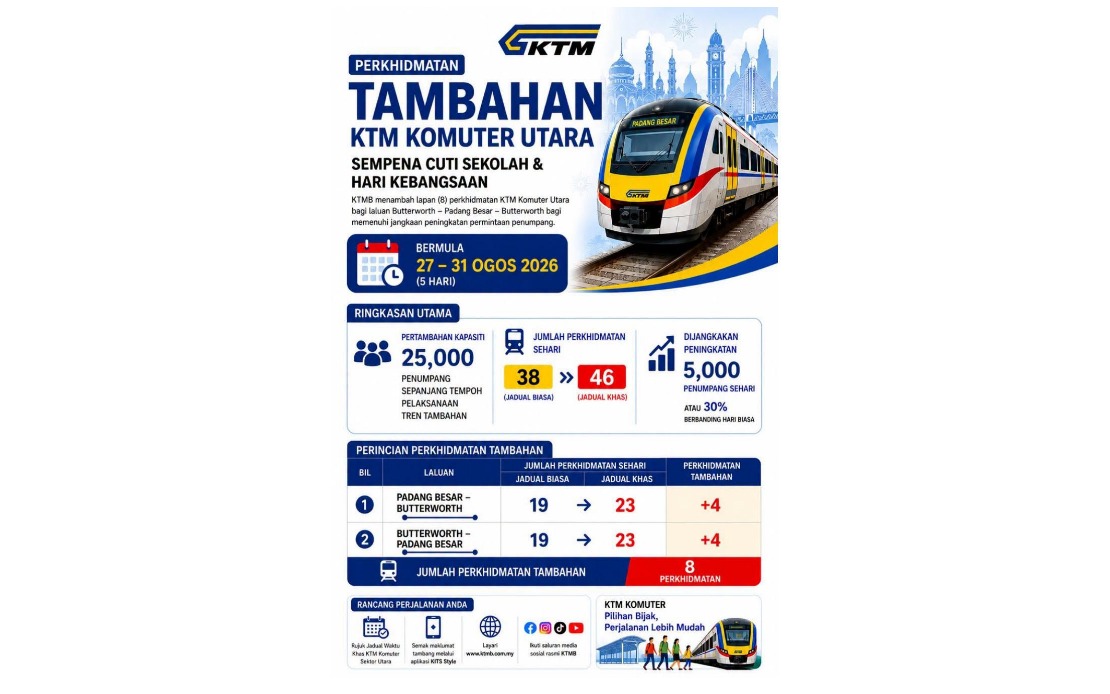
Keretapi Tanah Melayu Berhad (KTMB) is bolstering rail transport capacity along the northern corridor by introducing eight extra Komuter Utara train services between Thursday and Monday next week, coinciding with the school holidays and National Day festivities. The temporary expansion of the Butterworth-Padang Besar route represents a significant operational response to anticipated travel demand, reflecting KTMB's commitment to managing congestion during peak holiday periods across Penang, Kedah and Perlis.
The railway operator's decision to activate a special northern sector timetable underscores a broader strategy to accommodate seasonal spikes without permanent infrastructure investment. By increasing daily departures on the Butterworth-Padang Besar corridor from the standard 38 services to 46 services—a 21 per cent boost—KTMB aims to distribute passenger load more evenly across the day and reduce platform crowding at key stations. This modular approach allows the operator to respond flexibly to known demand patterns while maintaining operational stability during regular periods.
The distribution of new services reflects careful route management. Four additional trains will run northbound from Padang Besar toward Butterworth, bringing that directional total to 23 daily services compared with the usual 19. An identical arrangement applies to southbound services from Butterworth to Padang Besar, also reaching 23 daily departures. This balanced allocation ensures comparable capacity expansion in both directions, minimising uneven congestion and allowing passengers greater scheduling flexibility regardless of travel direction.
KTMB projects a 30 per cent rise in overall passenger numbers during the five-day implementation window, translating to approximately 5,000 additional daily travellers across the augmented services. Over the entire holiday period, this represents potential accommodation of 25,000 extra journeys—a meaningful increase for a regional transport corridor that serves as a vital link between three northern states. Such figures highlight the latent demand for rail travel during school closures and public holidays, when family visits, holiday trips and leisure travel typically spike.
The capacity addition arrives as Malaysia's public transport sector faces growing scrutiny over adequacy during peak demand periods. The northern rail corridor, serving commuters and leisure travellers across Penang, Kedah and Perlis, experiences particularly acute pressures during school breaks and national celebrations when road congestion around urban centres drives passengers toward rail alternatives. KTMB's intervention demonstrates recognition that planned, temporary capacity adjustments can effectively manage demand surges while avoiding the structural costs of permanent fleet expansion or infrastructure overhaul.
From a passenger perspective, the initiative prioritises journey planning and accessibility. KTMB is directing travellers to consult the KTM Komuter Northern Sector Special Timetable in advance, available through the KITS Style mobile application, the company's official website and social media channels. This multi-channel information strategy reflects contemporary expectations for real-time transport data, ensuring passengers can schedule trips efficiently and select departure times that suit their itineraries. The emphasis on advance consultation also implicitly encourages staggered travel rather than concentrated peak-hour surges.
The timing of this initiative merits consideration within Malaysia's broader transport policy environment. With rising traffic congestion in major urban corridors and government commitments to modal shift toward public transport, temporary capacity expansions on existing rail networks offer cost-effective demonstrations of demand responsiveness. The success or otherwise of this five-day experiment could inform future decisions regarding permanent service expansion on the northern corridor, particularly if passenger uptake exceeds projections or satisfaction metrics remain elevated.
For commuters across northern Peninsular Malaysia, the announcement provides practical relief during a typically fraught holiday period. The school break and National Day overlap create a compressed window of concentrated leisure travel, transforming ordinary weekday rail services into congested bottlenecks. By pre-emptively deploying eight additional trains, KTMB signals that such demand surges warrant proactive operational response, contrasting with reactive approaches that often emerge only after service failures accumulate passenger complaints.
The broader regional context underscores the importance of rail connectivity between Penang, Kedah and Perlis. This corridor serves not only commuters but also leisure travellers exploring the natural attractions, cultural heritage and culinary offerings across the three northern states. Enhanced rail capacity during holiday periods can stimulate regional tourism and domestic travel by making train travel a more attractive alternative to driving, thereby reducing road congestion and emissions while supporting the tourism economy across these states.

