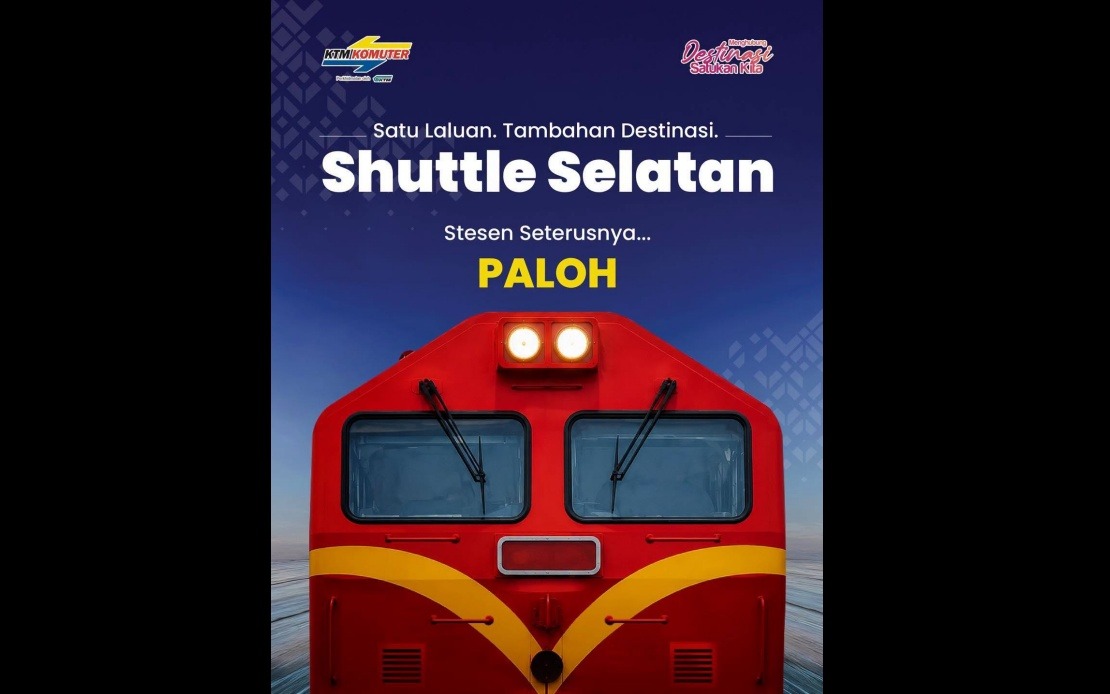
Keretapi Tanah Melayu Berhad (KTMB) will begin operating an extended Southern Shuttle service linking Paloh directly to Johor Bahru Sentral from August 8, marking a significant expansion of rail connectivity in the southern Johor corridor just three months after the service's initial launch. The new route will serve seven stations — Paloh, Kluang, Renggam, Layang-Layang, Kulai, Kempas Baru and JB Sentral — with the complete journey spanning approximately two hours, designed to provide suburban communities with convenient access to major employment and commercial centres.
The extension represents a strategic initiative by Malaysia's Transport Ministry to address mobility challenges in central Johor and reduce dependence on private vehicles in the region. By tapping into existing infrastructure from the Gemas-Johor Bahru Electrified Double-Track Project, KTMB has managed to deploy the service efficiently without requiring substantial additional investment. This pragmatic approach demonstrates how the government's previous heavy rail investments can be maximised to deliver immediate public benefit while long-term modernisation efforts continue.
Operational scheduling reflects the needs of Johor's diverse commuter base, with service commencing at 3.55 am from Paloh to accommodate workers heading to the Iskandar Malaysia zone and cross-border travellers bound for Singapore via the Johor Bahru checkpoint. The final departure from JB Sentral at 8.30 pm ensures evening commuters can return home after work shifts. Each train will accommodate up to 400 passengers, providing substantial capacity for daily movement along this increasingly important economic corridor.
The service will run 10 trips daily, comprising five journeys in each direction throughout the operating day. This frequency offers commuters genuine flexibility and reduces waiting times, making the option competitive with private transport for time-conscious workers. The morning and evening concentration of services aligns with peak commuter patterns, a scheduling strategy born from demand analysis that recognises the distinctive travel rhythms of this workforce.
Promotional pricing plays a crucial role in the launch strategy. KTMB has slashed the Paloh-JB Sentral fare from RM15.30 to RM7.70 one-way, effectively cutting the cost in half. This aggressive pricing will remain in effect until new electric trains arrive, providing a window for the public to experience the service at subsidised rates before standard commercial fares resume. For cost-conscious commuters, particularly those making daily journeys, the savings accumulate meaningfully over time.
The government has extended the MyRailLife Pass scheme to encompass Southern Shuttle from August 8 through December 31, guaranteeing free travel for children aged four to six, primary and secondary students from Year One through Form Six, and persons with disabilities subject to conditions. This targeted subsidy reflects policy priorities around inclusivity and reducing financial barriers to mobility for vulnerable populations, while simultaneously building ridership among younger users who may become habitual rail travellers.
Connectivity represents another advantage of the expansion. At Kempas Baru Station, passengers can transfer to the Kempas Baru-Pasir Gudang-Kempas Baru route, creating a hub that links the Paloh-Kluang-Kulai-Johor Bahru corridor with the Pasir Gudang industrial area. This interchange potential transforms the Southern Shuttle from a point-to-point service into part of a broader network, enabling workers and logistics flows to reach the heavy industrial zone that anchors Johor's manufacturing economy.
Early response suggests genuine demand exists for this service. Since launching its initial routes, the Southern Shuttle has attracted 3,209 passengers, demonstrating that once rail alternatives are provided with convenient schedules and competitive pricing, commuters will embrace them. This metric, though modest in absolute terms, represents encouraging take-up for a newly launched service and suggests the expanded Paloh route will capture additional market share once awareness spreads through commuter networks.
The extension explicitly aims to catalyse the Johor-Singapore Special Economic Zone, a bilateral development framework requiring enhanced people and goods mobility between the two jurisdictions. By improving rail connectivity from suburban Johor to the major employment centres of Kulai and JB Sentral, KTMB facilitates the human capital flows essential to making this economic zone functional. Workers can live in outer suburbs with lower housing costs and commute efficiently to jobs in the SEZ, potentially improving workforce economics for businesses and housing affordability for employees.
Beyond immediate commuting functions, this service expansion reflects a broader strategic direction within KTMB to utilise electrified rail infrastructure for frequent, high-capacity urban transit rather than limiting it to intercity services. The Southern Shuttle model, once stabilised, could provide a template for similar services along other electrified corridors in Malaysia's major urban regions. Success in Johor may encourage replication in the Klang Valley or other conurbations seeking to improve public transport while building ridership for rail networks.
The timing of this expansion during Malaysia's post-pandemic economic recovery phase carries significance. As businesses in Kulai and surrounding zones rebuild operations and hire workers, reliable commuting options become competitive advantages in talent acquisition. Employers can market improved transportation to potential hires, while workers gain assurance about affordable, predictable journeys to work. This infrastructure-employment nexus demonstrates how transport policy translates into tangible economic outcomes beyond simple modal shift.
Success metrics beyond passenger numbers will matter as the service matures. KTMB and the Transport Ministry will likely monitor fare revenue, service reliability, safety incidents, and expansion to adjacent routes. Should the extended service maintain strong growth and operational performance, ministerial investment in comparable services elsewhere becomes more justified, potentially unlocking new capital appropriations for rail modernisation nationwide. Conversely, operational challenges or disappointing uptake could dampen enthusiasm for similar initiatives, making this Paloh expansion a test case with implications across Malaysia's transport policy landscape.

