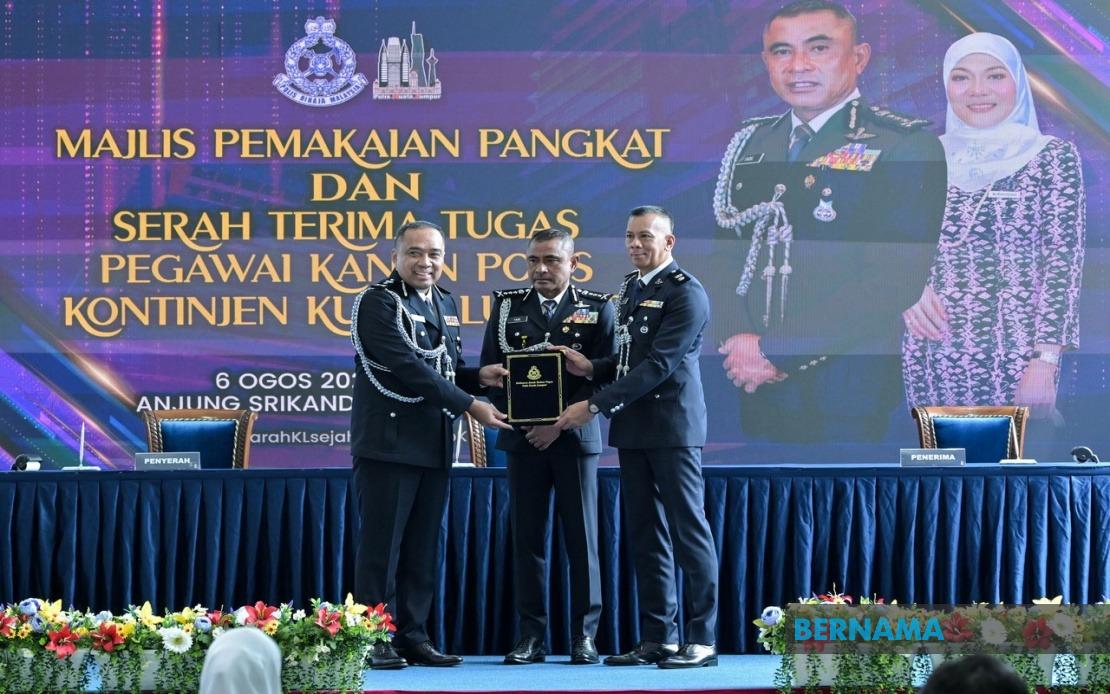
Kuala Lumpur police chief Datuk Fadil Marsus presided over a formal handover ceremony on Wednesday involving six senior appointments across the city's police contingent, marking a significant shift in the command structure of one of Malaysia's most critical security operations. The event, held at Kuala Lumpur police contingent headquarters, reflects ongoing efforts by the Royal Malaysia Police to refresh leadership while maintaining operational continuity in a rapidly evolving security landscape.
The restructuring touched critical functions within the city's policing apparatus, beginning with the Criminal Investigation Department, where SAC Zulkarnain Samsudin stepped down to allow SAC Sazlee Adam to assume the top role. This transition in the CID represents a crucial moment for the department, as it handles investigations into serious crimes that directly impact public safety and the city's reputation as a secure destination for residents and tourists alike. The shift in the Narcotics Crime Investigation Department proved particularly significant, with SAC Haslah Bachok passing responsibilities to ACP Kee Hang Kee as Malaysia continues to grapple with drug trafficking challenges that extend far beyond Kuala Lumpur's boundaries.
District-level changes underscore the police force's commitment to operational excellence at the grassroots level. Supt Nuzulan Mohd Din assumed command of the Dang Wangi district police operations, taking the post from SAC Sazlee Adam, while Supt Jasni Zolpa moved into the Sentul district chief role previously held by SAC Basri Sagoni. These district commands represent the frontline of community policing, handling everything from traffic enforcement to neighbourhood security concerns that directly affect quality of life for residents across these central Kuala Lumpur areas.
The reshuffle extended to specialized intelligence and counterintelligence functions within the force. The Special Branch deputy chief position for Intelligence and Operations transferred from SAC Kamaruzaman Md Alib to ACP Saefuddin @ Mohd Fitri Abdul Rahman, while SAC Zulkarnain Samsudin relinquished the CID deputy chief role in Intelligence and Operations to Supt Ong Seng Keong. These positions carry particular weight in Malaysia's contemporary security environment, where intelligence gathering and inter-agency coordination have become increasingly important for countering transnational criminal networks and security threats.
In his remarks at the ceremony, Fadil emphasized that promotions and reassignments within the police force transcend mere recognition of individual achievement. Instead, he framed these moves as manifestations of heightened institutional confidence and the commensurate obligation of officers to demonstrate unwavering integrity, professional excellence and genuine dedication to their duties. His message resonated with a broader theme within the PDRM about ensuring that leadership transitions strengthen rather than disrupt the organization's capacity to serve the public.
The police chief articulated a vision of these changes as essential to maintaining institutional vitality and forward momentum. He stressed that leadership succession represents far more than a routine administrative function—it embodies the PDRM's commitment to introducing fresh perspectives, accumulated experience from different postings, and innovative approaches to policing challenges. Critically, Fadil emphasized that these organizational adjustments must never come at the expense of service quality that citizens depend upon, a concern that resonates particularly in a federal territory where police operations touch the lives of over 1.8 million residents daily.
The ceremony attracted Kuala Lumpur deputy police chief Datuk Mohd Azani Omar, underscoring the significance of the occasion within the city's police hierarchy. The presence of senior command reinforced that these were not routine transfers but carefully considered strategic appointments intended to position the force for upcoming challenges. For Malaysian readers familiar with police operations, such formal ceremonies signal institutional seriousness about continuity and competence during leadership transitions.
Fadil's appeal to all Kuala Lumpur police personnel crystallized the contemporary security imperatives facing Malaysia's capital. He called for intensified commitment to traditional policing priorities—combating crime and drug abuse—while simultaneously addressing emerging demands. His mention of improving investigation capabilities speaks to the growing sophistication required in a jurisdiction where transnational criminal syndicates operate alongside domestic crime networks. The emphasis on operational readiness acknowledges that security threats have become more complex and potentially more dangerous than ever before.
The community engagement dimension highlighted by Fadil deserves particular attention for regional observers. In an era when public-police relations face strain in many countries, the Kuala Lumpur police chief's emphasis on building stronger community ties suggests recognition that sustainable security requires partnership between enforcement agencies and residents. This approach becomes increasingly vital as Kuala Lumpur's population grows more diverse and as digital connectivity creates new challenges around misinformation and coordinated criminal activity.
These appointments occur against the backdrop of Malaysia's broader efforts to modernize its law enforcement capabilities. The PDRM has faced mounting pressure to improve investigative standards, reduce crime rates, combat organized trafficking operations, and enhance public confidence in police integrity. By rotating senior officers into new positions, the force signals commitment to knowledge-sharing and preventing institutional stagnation that can occur when individuals remain too long in single postings. Effective intelligence operations, for instance, often benefit from leadership that has served across multiple departments and understands interconnections between different criminal threats.
For the incoming officers, their appointments represent both opportunity and considerable responsibility. SAC Sazlee Adam's transition from Dang Wangi district chief to head of the CID suggests the PDRM identifies him as capable of managing complex investigations while maintaining large department operations. Similarly, ACP Kee Hang Kee's appointment to lead narcotics investigations signals confidence in his ability to coordinate drug enforcement efforts that routinely intersect with federal-level operations and international law enforcement cooperation.
Looking forward, these changes will require careful observation regarding their impact on investigative success rates, crime statistics, and public satisfaction with police services in Kuala Lumpur. The effectiveness of these leadership transitions will ultimately be measured by whether the city's police operations become more responsive, more professional, and better integrated with community expectations. For regional security analysts, the Kuala Lumpur police restructuring exemplifies the ongoing challenge all Southeast Asian nations face in building law enforcement institutions capable of addressing 21st-century crime while maintaining public trust and institutional integrity.

