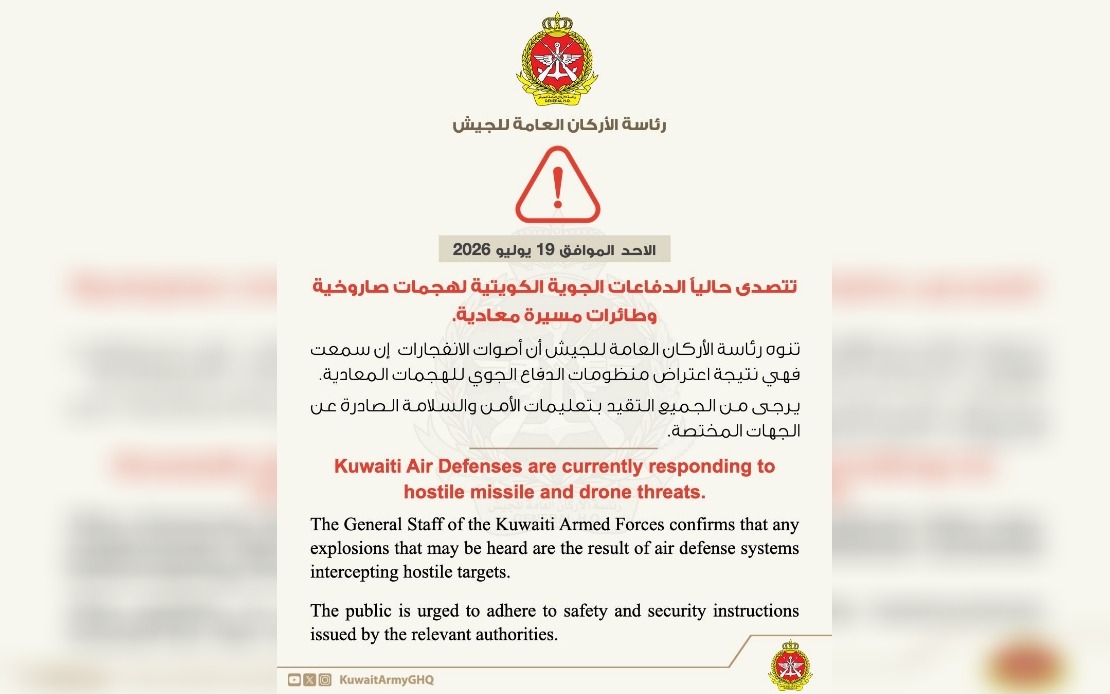
Kuwait has mobilised its air defence systems to counter a wave of hostile missile and drone threats, marking a dangerous escalation in regional military tensions centred on the US-Iran conflict. The Kuwaiti army announced on Sunday that the nation's armed forces were engaged in active defensive operations, with the military issuing a statement urging the public to remain calm and follow official security guidance as explosions echoed across the country.
The defensive response comes as part of a broader cycle of military exchanges between Washington and Tehran that has drawn regional allies and hosts of US military infrastructure into the crossfire. Over the past week, the United States has conducted successive waves of strikes targeting locations inside Iran, while Tehran has retaliated by launching attacks against what it characterises as American military facilities and installations across multiple countries in the Middle East and beyond. Kuwait, which hosts significant US military presence including forward operating bases and personnel, has become an unavoidable participant in this escalation despite its preference to remain peripheral to direct confrontation.
The Kuwaiti military explicitly stated that any explosions heard by residents throughout the country were attributable to their air defence systems actively intercepting incoming hostile targets. This public messaging served both to reassure civilians that defensive measures were functioning and to signal to adversaries that Kuwait possesses operational capability to challenge airborne threats. The military's communication via social media reflected modern crisis management approaches, attempting to prevent panic and maintain public confidence in state security mechanisms during an unsettling period.
For Malaysian observers, the Kuwait situation highlights the vulnerability of smaller Gulf states caught between two powerful adversaries. While Kuwait maintains formal relationships with both the United States and Iran, its geographic proximity to Iran and its hosting of American military assets create a precarious position. The country lacks the military capacity of larger regional powers and cannot independently deter attacks, relying instead on American security guarantees that themselves become a target for Iranian retaliation. This dynamic mirrors concerns that smaller Southeast Asian nations might face should major power conflicts intensify in adjacent regions.
The current military exchanges represent a continuation of hostilities despite diplomatic efforts aimed at de-escalation. In June, a Pakistan-brokered memorandum of understanding was signed with the explicit intention of terminating the protracted conflict between the United States and Iran and establishing foundations for a sustainable peace agreement. However, the resumption of military strikes in recent days demonstrates how fragile such agreements can be when underlying tensions and strategic objectives remain fundamentally misaligned. Neither side appears to have committed fully to the diplomatic framework, with each interpreting the other's military actions as provocation justifying further response.
The geographic scope of this conflict extends well beyond Iran's borders and American territory, making it a distinctly regional phenomenon with implications across the Gulf and beyond. Iran has targeted not only its own territory but also directed or supported attacks on US-affiliated installations in multiple countries, effectively internationalising what might appear on the surface as a bilateral dispute. Kuwait's inclusion as a strike location indicates that Tehran is willing to accept collateral risks to regional stability in pursuit of its military objectives against American power projection capabilities.
The escalation pattern demonstrates how security relationships with distant great powers can transform smaller nations into conflict zones. Kuwait's development of air defence capabilities, though necessary for national protection, ultimately reflects the reality that it cannot resolve the underlying Washington-Tehran dispute through military means. The country remains dependent on American security commitments while simultaneously exposed to Iranian retaliation, a position that many regional governments understand intimately but from which there are few practical escape routes.
For Southeast Asian nations closely watching great power dynamics, Kuwait's experience offers important lessons about the risks of becoming entangled in conflicts between major powers. The Gulf state's situation illustrates how hosting foreign military facilities, while potentially providing security benefits, can simultaneously increase vulnerability to attacks directed at those external partners. Countries across Asia that maintain security relationships with multiple major powers must carefully calibrate their commitments to avoid becoming battlegrounds for proxy conflicts or collateral targets in larger strategic competitions.
The broader context of US-Iran tensions has evolved significantly over recent years, with military incidents, economic sanctions, diplomatic ruptures, and proxy conflicts creating layers of mutual distrust that prove difficult to unwind. The June memorandum, while representing diplomatic progress, has not fundamentally altered the underlying strategic rivalry or the military posturing on both sides. Each party continues to demonstrate military capability and resolve, suggesting that genuine de-escalation may require more substantial shifts in strategic perception and interest alignment than current initiatives have achieved.
Kuwait's call for citizens to follow official security instructions reflects the reality that civilian life must adapt to the presence of military conflict, even when that conflict is not directly initiated by Kuwait itself. The nation's economy, dependent significantly on oil exports and international commerce, faces disruption whenever regional security deteriorates. Extended periods of military tension can deter foreign investment, complicate business operations, and create uncertainty that undermines economic confidence, imposing costs on civilian populations far removed from the strategic calculations driving the conflict.
Regional observers note that the current escalation differs from previous cycles in that the military exchanges appear more frequent and sustained, suggesting hardening positions rather than de-escalation. If the pattern continues without renewed diplomatic breakthrough, the cumulative effect on regional stability could be substantial, with implications for energy security, trade flows, and the broader geopolitical environment throughout the Middle East and into Asia. For Malaysia and other Southeast Asian nations dependent on Gulf stability and freedom of navigation in adjacent waters, developments in Kuwait and across the region warrant close attention.

