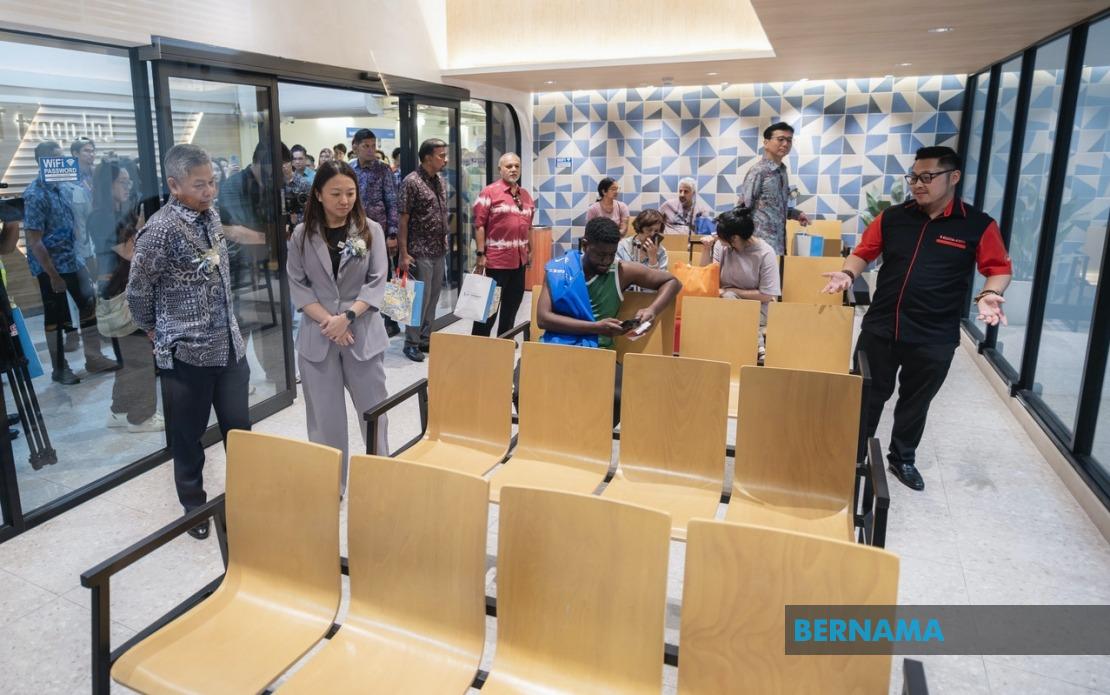
Kuala Lumpur has taken a significant step forward in modernising its urban transport infrastructure with the official opening of the LaLaport Transportation Hub, a purpose-built integrated terminal designed to serve as a central nexus for the city's multi-modal transport network. The facility, positioned strategically beside the Hang Tuah LRT and Monorail interchange, is expected to process approximately 10,000 passengers daily, substantially easing congestion and improving journey efficiency across the city's sprawling transport corridors. Minister in the Prime Minister's Department (Federal Territories) Hannah Yeoh unveiled the hub today, emphasising its role in addressing the mounting pressures on Kuala Lumpur's transport systems as the capital continues to grow as a regional economic and tourism hub.
The hub's significance extends beyond mere passenger throughput numbers. Kuala Lumpur experiences extraordinary daily movement patterns, with approximately 1.2 million individuals entering and exiting the city on any given day, translating to roughly 5.5 million individual journeys. These figures underscore why transport infrastructure investment has become a pressing priority for the city's administration and federal authorities. The LaLaport facility represents a deliberate response to this challenge, offering a consolidated boarding and departure point that eliminates the fragmentation that previously characterised intercity and regional travel arrangements. By consolidating express bus services, rail connections, e-hailing platforms, conventional taxis, and shared mobility solutions under a single roof, the terminal promises unprecedented convenience for commuters and intercity travellers alike.
The physical design of the transportation hub reflects contemporary best practices in passenger comfort and operational efficiency. Situated on the LG1 level of the East Atrium, the fully enclosed facility incorporates 11 dedicated bus parking bays, climate-controlled waiting areas, staffed ticketing counters, and automated self-service kiosks that reduce queuing times. A Passenger Information Display System provides real-time schedule updates, eliminating the uncertainty that often characterises transport hub experiences in Southeast Asia. These elements combine to create an environment that prioritises passenger dignity and information accessibility, critical factors for encouraging adoption of public transport among private vehicle users.
Connectivity between Kuala Lumpur and Singapore represents another vital dimension of the hub's strategic importance. The facility will anchor a 24-hour express bus service linking Malaysia's capital with the island nation, positioning it as a crucial gateway for the growing cross-border business and leisure travel market. This connection reflects the deepening economic integration within the Malaysia-Singapore corridor and acknowledges the practical reality that many workers, students, and tourists traverse this route routinely. The hub's capacity to handle approximately 150 bus movements daily, with dedicated focus on cross-border services, strengthens Kuala Lumpur's position as Southeast Asia's primary intercity transport hub.
The operational framework supporting the hub demonstrates evolving governance approaches to urban transport management. Kuala Lumpur City Hall has implemented a three-year operating licence system for transport terminals, replacing the previous annual renewal regime. This structural shift provides terminal operators with greater operational certainty and investment security, encouraging professional management standards and service quality improvements. The regulatory change reflects learning from international best practices regarding transport infrastructure governance, prioritising long-term stability over short-term revenue maximisation from licensing fees.
Safety and security considerations permeate the hub's operational design. The city administration is simultaneously deploying approximately 10,000 operational closed-circuit television cameras across Kuala Lumpur, with the transportation hub receiving comprehensive surveillance coverage. This investment acknowledges security concerns that frequently inhibit public transport adoption, particularly among female commuters and vulnerable populations. By coupling physical safety infrastructure with professional facility management, authorities aim to establish the hub as a secure transit point.
Asia Success Resource Sdn Bhd, the hub's operator under chief executive officer Aaron Chuah, has developed an ecosystem extending beyond the terminal itself. The Boleh-Boleh Ride on-demand van shuttle service connects passengers to multiple city centre destinations, while dedicated shuttle services link the hub to Kuala Lumpur International Airport Terminals 1 and 2. These integrated services acknowledge that modern passenger expectations encompass seamless end-to-end journey experiences rather than point-to-point connectivity alone. Approximately 30 bus operators are expected to utilise the facility as their primary city centre transit hub, indicating substantial industry adoption and competitive validation.
The hub's opening carries implications extending beyond transport logistics. International partnerships have catalysed the project, with Japanese Ambassador Noriyuki Shikata's presence signifying bilateral cooperation in sustainable urban development. Japan's expertise in integrated transit systems, developed through decades of managing dense urban populations across Tokyo, Osaka, and other metropolitan centres, has clearly influenced the facility's design and operational philosophy. The ambassador highlighted that Prime Minister Datuk Seri Anwar Ibrahim's recent Japan visit reaffirmed Malaysia-Japan commitment to deepened cooperation across multiple sectors, including urban infrastructure and energy security, with both nations preparing to commemorate 75 years of diplomatic relations.
Kuala Lumpur Mayor Datuk Seri Fadlun Mak Ujud and Land Public Transport Agency deputy director (development) Azrin Borhan represented local administration and federal transport authorities, indicating this represents collaborative governance rather than isolated municipal initiative. Their joint participation underscores recognition that transport challenges require integrated responses across multiple administrative jurisdictions and regulatory bodies.
The broader context frames the hub as part of Kuala Lumpur's gradual transition toward multimodal transport culture. Malaysian cities have historically been designed around private vehicle ownership, reflecting postwar development patterns and middle-class aspirations. However, accelerating congestion, environmental concerns, and real estate constraints are shifting development paradigms toward compact, transit-oriented urban design. The LaLaport hub exemplifies this transitional moment, providing infrastructure that makes public transport genuinely competitive with private vehicles for time-sensitive, distance-appropriate journeys.
Regional transport observers will monitor whether the hub achieves its projected passenger volumes, as actual performance will indicate whether integrated terminal design effectively converts existing demand into captured ridership. The 10,000 daily passenger projection implies capturing approximately 0.18 per cent of the city's daily journeys, a modest target that should prove achievable given the hub's strategic positioning and comprehensive service offerings. Success would vindicate continued investment in similar facilities throughout Southeast Asia's emerging megacities, where transport infrastructure constraints increasingly constrain economic productivity.
The facility opens at a moment of heightened infrastructure consciousness within Malaysia, with the Kuala Lumpur-Singapore High-Speed Rail project advancing separately and various urban regeneration initiatives reshaping the capital's physical and economic landscape. The LaLaport hub, while modest in scale compared to these megaprojects, addresses immediate operational challenges while demonstrating that intermediate-scale transport improvements can generate tangible improvements in urban livability and economic efficiency. Its performance trajectory will likely influence transport planning decisions across Malaysia's other major urban centres grappling with similar mobility challenges.

