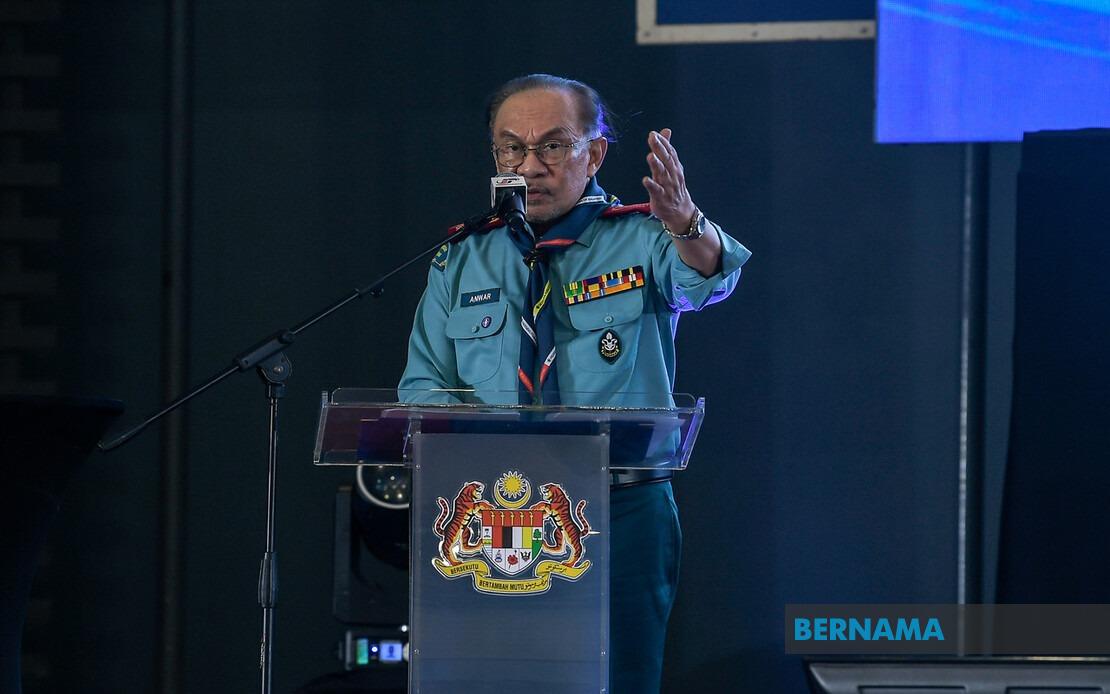
Prime Minister Datuk Seri Anwar Ibrahim has moved to clarify a sensitive issue in Malaysia's ongoing language policy debate, asserting that efforts to strengthen the Malay language should not be construed as an attack on proficiency in other tongues. Addressing an audience at Universiti Teknologi MARA in Permatang Pauh during the Ambang Merdeka Sahabat MADANI 2026 programme, Anwar sought to reframe the discussion around language acquisition as complementary rather than competitive, a nuanced position that reflects Malaysia's complex linguistic landscape and the political sensitivities surrounding the national language.
The Prime Minister's remarks come at a time when Malaysia continues to grapple with questions about how to balance its constitutional commitment to Malay with the practical demands of an increasingly globalised economy. Anwar's formulation—that all citizens should possess strong command of the national language regardless of ethnic background—upholds the constitutional settlement while simultaneously acknowledging that exclusive focus on a single language would ill-serve Malaysia's diverse population. This approach attempts to thread a needle between nationalist sentiment and pragmatic multilingualism that younger Malaysians increasingly demand.
Anwar placed particular emphasis on English, which he characterised not as a rival to Malay but as an essential complement to it. His acknowledgment that English has evolved into a dominant global language reflects recognition among Malaysian policymakers that excluding English from education and commerce would handicap Malaysian students and workers in international contexts. The formulation—that the educational system should "embrace" English rather than "replace" Malay with it—represents a deliberate rhetorical choice designed to satisfy both those concerned with national language preservation and those advocating for functional multilingualism.
Equally significant was Anwar's elevation of Mandarin Chinese to a position of economic importance within the Malaysian context. By describing Mandarin as "one of the region's major economic languages," the Prime Minister acknowledged the gravitational pull of China's economic influence across Southeast Asia and the practical advantage that Mandarin proficiency confers on Malaysian business professionals and entrepreneurs. This recognition carries particular weight given Malaysia's substantial ethnic Chinese population and the country's deep commercial ties to Greater China, making Mandarin competency a matter of individual economic mobility and national competitiveness rather than purely cultural concern.
The inclusion of Tamil within this multilingual framework, though treated more briefly, signals Anwar's commitment to addressing the educational and economic interests of Malaysia's Indian community. While Tamil-language education remains less economically dominant than Mandarin or English, Anwar's explicit mention that Malaysians wish to strengthen Tamil proficiency reaffirms that language policy discussions encompass all major ethnic communities and their legitimate aspirations for maintaining ancestral languages.
Anwar's invocation of "zero-sum game" terminology proves particularly revealing about the underlying political tensions he seeks to defuse. By explicitly rejecting the premise that advancing one language necessarily requires diminishing another, the Prime Minister attempted to move beyond what he perceives as false dichotomies that have historically complicated language policy discourse in Malaysia. This framing suggests that contemporary policymakers increasingly recognise languages as tools for various purposes—national cohesion, international commerce, cultural preservation—rather than as symbols whose relative status must be jealously guarded.
The economic imperative that Anwar articulated—learning multiple languages as a pathway to personal advancement and national prosperity—represents a shift in how language acquisition is justified within Malaysia's political rhetoric. Rather than grounding language policy primarily in constitutional obligation or cultural nationalism, Anwar positioned multilingualism as enlightened self-interest. This approach potentially resonates with younger, economically-minded Malaysians who view language competency as a competitive advantage rather than as a site of identity conflict.
Beyond the strictly linguistic dimensions, Anwar's speech contained warnings about communal harmony that contextualised his language remarks within broader concerns about social cohesion. His reminder that national unity cannot be assumed permanent and requires consistent effort reflects an understanding that language questions, while seemingly technical or educational, often carry symbolic weight in multiethnic societies. By linking language policy to broader questions of interethnic relations, Anwar suggested that how Malaysians approach linguistic pluralism matters not merely for economic reasons but for the very fabric of social harmony.
The emphasis on "sharing, caring and helping one another" and the call for inclusive development reflects a leadership perspective that views language policy not as a zero-sum competition between ethnic groups but as part of a broader social contract. Anwar's assertion that benefits of national development should accrue across racial lines positions language competency as both a means to individual advancement and a marker of shared citizenship in a diverse nation.
For Malaysian stakeholders in ongoing debates about education policy, this intervention from the Prime Minister signals official endorsement of bilingualism or multilingualism as the default expectation for Malaysian citizens. Whether this rhetorical position translates into concrete educational investment and curriculum reform remains to be seen, but Anwar's framing establishes that future language policy discussions will occur within a paradigm that assumes complementarity rather than competition among languages. This stance may prove consequential for how Malaysia's next generation acquires and deploys linguistic skills in an increasingly interconnected region.

