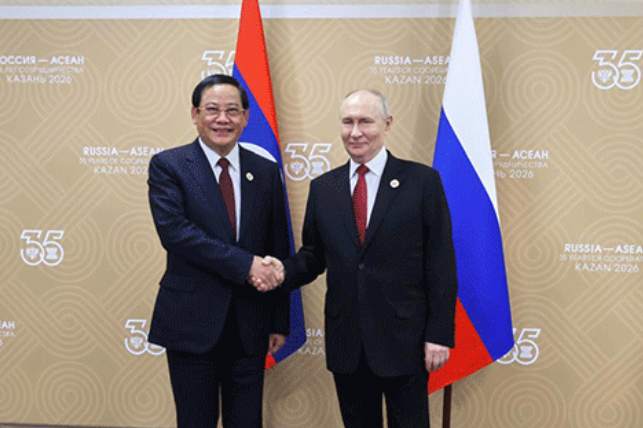
Laos and Russia have taken significant steps to deepen their longstanding bilateral relationship, with Prime Minister Sonexay Siphandone and Russian President Vladimir Putin meeting on the margins of the Russia-ASEAN Summit in Kazan to discuss mutual priorities and collaborative opportunities. The encounter marked a notable moment in recent Lao foreign policy, coming as Prime Minister Sonexay completed his inaugural official visit to Russia since assuming office in August 2023. The timing and venue of these discussions underscore the importance both capitals place on maintaining strong ties and coordinating positions on regional and global matters of mutual concern.
Prime Minister Sonexay's visit, conducted at the invitation of Russian Prime Minister Mikhail Mishustin from June 14-17, represented a deliberate effort to reinvigorate engagement and explore fresh avenues for partnership. President Putin's remarks emphasised Russia's continued valuation of relations with Laos, framing the connection as rooted in enduring principles of friendship, reciprocal respect, and genuine consideration of each nation's strategic interests. This language reflects a broader pattern in Kremlin diplomacy toward Southeast Asian partners, particularly those maintaining historical ties to Russia dating back to Soviet-era cooperation.
The nuclear energy agreement stands out as perhaps the most consequential outcome of these talks, with both sides viewing the deal as a watershed moment in technological partnership. The accord establishes the legal framework necessary for constructing a small-scale nuclear power plant on Lao territory using Russian technology and expertise. For Laos, an energy-hungry developing nation seeking to diversify its power generation sources beyond hydroelectric facilities, this development carries substantial implications for long-term energy security and industrial development. The project also signals Russian confidence in Laos's commitment to peaceful nuclear development and represents a deepening of technological transfer arrangements between Moscow and Southeast Asian capitals.
Beyond the headline-grabbing nuclear initiative, the two governments identified substantial cooperation opportunities spanning multiple economic sectors critical to Laos's development agenda. Discussions encompassed energy infrastructure, industrial projects, agricultural development, mining operations, emerging digital economy initiatives, financial services, transport networks, tourism promotion, and educational exchange programmes. This breadth demonstrates that bilateral engagement extends far beyond traditional Cold War-era security arrangements into contemporary economic interdependencies essential for both nations' prosperity.
Educational cooperation emerged as a particularly valued dimension of the relationship, with Prime Minister Sonexay publicly recognising Russia's consistent provision of scholarships and training opportunities for Lao nationals, including government officials and technical personnel. These human capital investments produce long-term strategic dividends by creating constituencies within Laos favourably disposed toward Russia and fostering professional networks that transcend political cycles. The forthcoming completion of the Laos-Russia Friendship School in Vientiane symbolises this commitment to institutional building that will shape educational trajectories for Lao youth across generations.
The symbolic gesture of gifting two elephants to the Kazan Zoo—presented by Prime Minister Sonexay in commemoration of 65 years of diplomatic relations and Russia Day—reflected the cultural and ceremonial dimensions of state relations that extend beyond purely transactional interactions. Such gestures, while seemingly ceremonial, carry diplomatic weight in demonstrating goodwill and the personal investment of political leadership in maintaining warm bilateral ties. The elephants themselves became travelling ambassadors of sorts, embodying Lao cultural heritage within Russia and serving as tangible reminders of the relationship to Russian audiences.
Political symbolism also featured prominently in discussions of military and historical commemoration. President Putin explicitly thanked President Thongloun Sisoulith for attending Russia's Victory Day celebrations in May and acknowledged the Lao People's Army's participation in last year's parade marking the 80th anniversary of Soviet victory in World War II. These references situate contemporary cooperation within a longer historical narrative of shared sacrifice and mutual respect, drawing upon Soviet-era solidarities to legitimise current partnerships.
Prime Minister Sonexay's separate engagement with Russian Prime Minister Mikhail Mishustin resulted in parallel affirmations of expanding cooperation grounded in mutual trust and reciprocal support. These premier-level discussions typically address more technical aspects of bilateral relations, including trade mechanics, investment frameworks, and implementation of previously agreed initiatives. The emphasis on steadily expanding ties suggests both governments view their relationship as one requiring continuous attention and incremental deepening rather than one already optimised.
For Malaysia and the broader Southeast Asian region, these Laos-Russia developments merit careful observation. The expanding technological partnerships, particularly in nuclear energy, represent an alternative pole of influence and technical expertise within the region, potentially affecting regional dynamics around infrastructure development and energy security. The prominence of ASEAN in Russian diplomatic messaging—with 2026 marking the 35th anniversary of Russia-ASEAN relations—indicates Moscow's broader strategy of maintaining relevance in Southeast Asian affairs through both multilateral and bilateral channels.
The business forum convened during Prime Minister Sonexay's visit to promote trade and investment cooperation signals both governments' recognition that strategic partnerships require substantive economic underpinnings to remain durable. Private sector engagement transforms official declarations into concrete commercial relationships that create constituencies within each nation benefiting from continued cooperation. Such mechanisms help insulate bilateral relations from fluctuations in the broader geopolitical environment.
Laos's alignment with Russia on regional and global issues, as acknowledged in official statements, reflects the smaller nation's multi-aligned foreign policy approach. Laos maintains strategic partnerships with Russia while simultaneously engaging with China, Vietnam, Thailand, and Western nations, attempting to balance great power competition without becoming excessively dependent on any single partner. This balancing act requires skilled diplomacy, particularly as regional geopolitical tensions intensify. The explicit reference to Laos and Russia maintaining close cooperation at the United Nations and sharing similar perspectives on major international questions underscores how bilateral relationships extend into multilateral institutional frameworks where voting patterns and diplomatic positions matter considerably.
Looking forward, the initiatives discussed during these June talks—particularly the nuclear energy project and expanded educational exchanges—will require sustained bureaucratic attention and financial commitment from both governments. The success of such partnership-building efforts depends ultimately on implementation capacity and continued high-level political will to prioritise these relationships amid competing domestic and international pressures. For Laos, deepening ties with Russia provides diversification benefits in an international system increasingly characterised by great power competition and regional realignments.