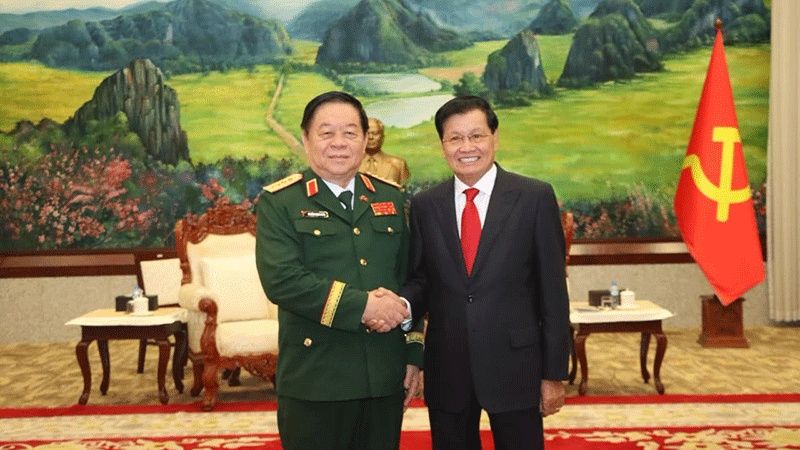
A senior Vietnamese military official's three-day visit to Laos this week has resulted in renewed pledges to deepen defence cooperation between the two neighbours, reflecting the enduring strategic importance of their bilateral relationship in Southeast Asia. General Nguyen Trong Nghia, who heads the General Department of Politics of the Vietnam People's Army, was received by Lao President Thongloun Sisoulith on Thursday, culminating a visit that emphasised military-to-military engagement as a cornerstone of ties between Vientiane and Hanoi.
The visit, which ran from August 5 to 7, came amid broader regional shifts and demonstrated how Laos and Vietnam continue to prioritise their defence partnership despite the changing geopolitical landscape across Southeast Asia. President Thongloun's warm reception of the Vietnamese delegation underscored Laos's commitment to maintaining strong links with its larger neighbour, whom it has historically relied upon for security and development assistance. The Lao leader characterised the visit as a natural progression in the evolution of bilateral relations, describing it as yet another milestone in what both nations describe as a relationship characterised by special solidarity and comprehensive strategic cooperation.
At the heart of the discussions lay the fortification of practical military cooperation between the Lao People's Army and the Vietnam People's Army. The talks, which involved senior defence officials from both capitals, focused on several specific areas aimed at modernising and deepening institutional connections. These included discussions on political education frameworks within their respective militaries, mechanisms for personnel exchange and training initiatives, management of their shared border, and capacity-building programmes designed to strengthen the professionalism of both armed forces. Such cooperation carries particular significance given the extensive frontier the two countries share and the necessity of coordinated approaches to regional security challenges.
General Khamlieng Outhakaisone, Laos's Deputy Prime Minister and Minister of National Defence, separately met with his Vietnamese counterpart to reinforce these commitments at the highest levels of political and military leadership. This parallel engagement structure ensured that discussions occurred across multiple institutional channels, reflecting the depth and formality with which both governments approach their defence relationship. The fact that both civilian and military leadership participated in the meetings demonstrated that defence cooperation remains integrated within broader strategic frameworks rather than operating in isolation.
One particularly significant focus of the talks involved younger generation education and historical consciousness. Both nations emphasised the importance of ensuring that coming generations of Lao and Vietnamese understand the foundations of their countries' friendship and the historical experiences that have shaped their bond. This educational dimension reveals how both governments view their relationship not merely as a practical military arrangement but as something rooted in shared historical narrative and enduring cultural affinity. By investing in historical education and consciousness-raising among younger populations, both countries seek to ensure that their strategic partnership remains culturally embedded and socially legitimised.
The talks between Lieutenant General Vongsone Inphanphim, who directs the General Department of Politics of the Lao People's Army, and General Nguyen Trong Nghia highlighted Party-to-party and political cooperation as equally important as strictly military matters. This reflects how both Laos and Vietnam, as Communist-led states, integrate military cooperation with broader political coordination between their respective ruling parties. The emphasis on Party work cooperation underscores the ideological and political dimensions of their alliance, which extends beyond conventional defence relationships found in other regional partnerships.
For Malaysia and other Southeast Asian nations, the strengthening of Laos-Vietnam defence ties carries broader implications for regional stability and the balance of power within the Association of Southeast Asian Nations bloc. Laos, as a landlocked nation with limited military capacity, has traditionally depended on Vietnam for security guarantees and military modernisation assistance. The formalisation and deepening of this partnership through high-level visits and institutional mechanisms reinforces Vietnam's position as a dominant regional military power and signals to other ASEAN members the strength of bilateral relationships that exist beyond multilateral ASEAN frameworks.
The timing of General Nguyen Trong Nghia's visit also reflects the broader patterns of great power competition affecting the region. Both Vietnam and Laos have sought to balance their relationships with major powers while maintaining their traditional alliance. This visit, by emphasising bilateral military cooperation, demonstrates how smaller Southeast Asian nations continue to invest in bilateral partnerships as a counterweight to broader geopolitical pressures and uncertainties in the region.
Border management cooperation, explicitly mentioned as a focus area, deserves particular attention given the complexities of frontier administration in mainland Southeast Asia. Laos and Vietnam share an extensive border that has historically presented both opportunities and challenges for bilateral relations. Enhanced cooperation in border management—including personnel training, joint patrols, and administrative coordination—reflects practical efforts to address security concerns while preventing disputes that could undermine their broader strategic partnership.
The visit demonstrates that despite rapid transformations in Southeast Asian geopolitics, including increased engagement from major powers and evolving ASEAN dynamics, traditional bilateral military partnerships remain central to how regional nations approach security. For Vietnamese strategists, maintaining robust relationships with neighbours like Laos provides multiple benefits: a friendly border environment, access to Lao territory for strategic depth, and cultural-historical influence. For Laos, the partnership offers security assurances and military modernisation support that it could not easily obtain through alternative arrangements or multilateral channels.
Looking forward, the commitments made during this visit will likely translate into concrete military exchanges, training programmes, and institutional coordination mechanisms that will deepen over coming months and years. Such visits, while routine in diplomatic terms, carry significant weight in the bilateral relationship and signal to domestic and international audiences the enduring commitment of both governments to maintaining and strengthening their alliance. For Southeast Asia more broadly, the stability and cooperation exemplified by the Laos-Vietnam relationship provides a foundation for wider regional stability, even as broader geopolitical competitions create pressures and uncertainties elsewhere in the region.

