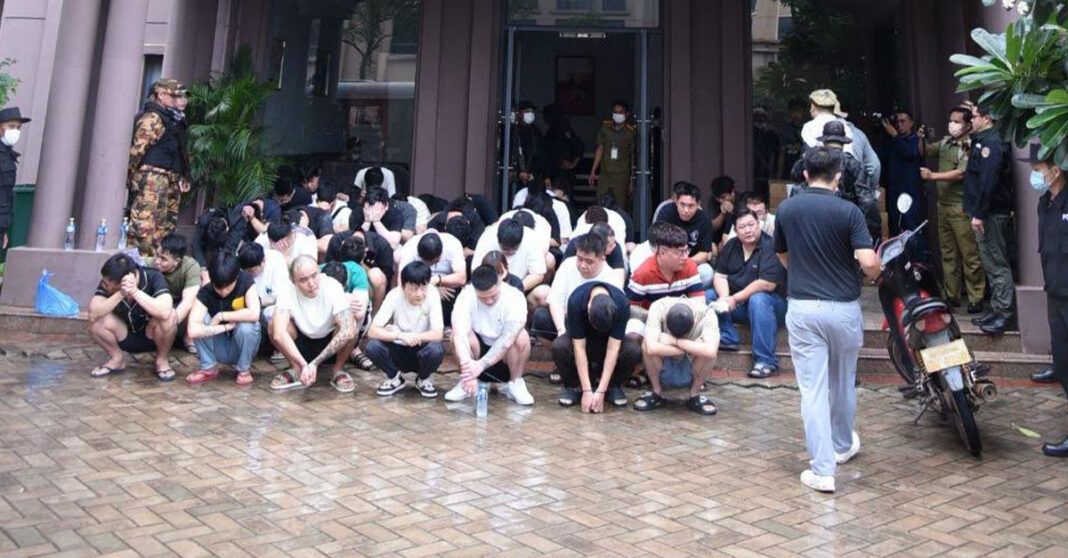
Laotian police conducted a significant enforcement operation on 8 August at a building within Vientiane's Thatluang Lake Special Economic Zone, targeting what authorities identified as an organised telecommunications fraud and online gambling network. The raid resulted in the detention of 261 suspects representing a diverse cross-section of nationalities, underscoring how such criminal enterprises have attracted participants from across Southeast Asia and East Asia. The scale of the operation reflects the growing sophistication and international reach of scam networks operating from Laos, which has emerged as a regional hub for such illicit activities in recent years.
The composition of those arrested reveals telling patterns about transnational criminal operations in the region. Chinese nationals dominated the detainee list with 153 individuals, suggesting either direct involvement from organised crime groups based in China or significant recruitment of Chinese-speaking operatives. Vietnamese nationals formed the second-largest group at 61 persons, followed by 36 Thai nationals. Smaller contingents included five Taiwanese, two Malaysian, two South Korean, and two Myanmar nationals. This multinational character demonstrates how such networks recruit operatives across borders, leveraging linguistic capabilities, technical expertise, and established criminal connections to maximise operational reach and evade detection.
The material seized during the raid illustrates the technological infrastructure required to sustain large-scale fraud operations. Police confiscated nearly 500 desktop computers and laptops alongside 2,355 mobile phones—equipment essential for managing customer communications, processing transactions, and orchestrating social engineering attacks that constitute the backbone of modern scam enterprises. Such concentrations of computing hardware, when combined with international telecommunications capabilities, enable operators to target victims across multiple countries simultaneously, scaling their criminal activities far beyond what individuals or small groups could accomplish.
Authorised investigations confirmed that the building belongs to Lao Thatluang Investment Development Co., Ltd., suggesting that scam operators exploit legitimate corporate structures to obscure their activities and maintain operational continuity. This practice of registering fraudulent operations under registered companies highlights a systemic vulnerability in how business registration and oversight functions within Special Economic Zones, where regulatory oversight sometimes lags behind operational activity. Laotian authorities indicated they are pursuing investigations to identify the masterminds and accomplices orchestrating the scheme, a critical step since those detained are typically operatives rather than architects of such networks.
The Thatluang Lake raid represents part of a broader enforcement escalation by Laotian authorities against international scam networks. Within the same month, authorities conducted additional operations targeting similar criminal enterprises, demonstrating a sustained commitment to disrupting these operations. On 10 August, authorities deported 41 Thai suspects to their home country via the 1st Lao-Thai Friendship Bridge, continuing collaborative efforts with neighbouring Thailand. This handover followed an earlier deportation of 32 Thai nationals through the same crossing on 6 August, bringing the cumulative total of Thai nationals repatriated to at least 73 individuals in mid-August alone.
These deportations followed an earlier, even larger enforcement action conducted on 18 July targeting the ST Vegas complex located in Dongphosy village, Hatsayfong district, Vientiane. That operation netted 589 suspected scammers, predominantly Thai nationals but also including Lao, Vietnamese, and Cambodian individuals. The ST Vegas operation represents one of the most significant raids on scam infrastructure in recent memory, suggesting either a dramatic scaling up of criminal activity or intensified police focus on dismantling established operations that had previously operated with relative impunity.
For Malaysian readers, these developments carry particular relevance given Malaysia's status as both a source of scam victims and, in some cases, a location where scam operations target Malaysian residents. The arrest of two Malaysian nationals suggests that some Malaysians have become operatives within international fraud networks, whether through coercion, deception about their actual roles, or deliberate participation. Malaysian authorities have increasingly recognised the cross-border nature of scam threats, with victims regularly targeted by operators based in Cambodia, Laos, and Myanmar—countries where regulatory capacity, rule of law, and international cooperation remain inconsistent.
The concentration of scam operations within Vientiane's Special Economic Zones raises fundamental questions about the governance frameworks governing these designated areas. SEZs are intended to attract legitimate investment and facilitate trade, yet their relative autonomy from standard regulatory oversight can inadvertently create permissive environments for criminal enterprises. The discovery that a company registered as Lao Thatluang Investment Development Co., Ltd. housed such an operation suggests that registration verification and ongoing compliance monitoring require strengthening across the region.
International cooperation appears increasingly central to disrupting these networks, as demonstrated by the Thai-Lao deportations. However, sustainable solutions require harmonising legal frameworks, establishing mutual legal assistance protocols, and building capacity among law enforcement agencies to investigate and prosecute organisers rather than merely arresting operatives. The recurring pattern of large raids followed by deportations suggests that while enforcement disrupts individual operations, it has not yet fundamentally dismantled the criminal ecosystems enabling such enterprises to establish themselves.
Laotian authorities face mounting pressure to address scam networks that damage the country's international reputation and create friction with neighbouring states. The August 2024 operations demonstrate escalating enforcement activity, yet the continued emergence of large, well-equipped operations suggests that criminal networks adapt rapidly to enforcement pressures. Moving forward, authorities across Southeast Asia will need to combine sustained enforcement with investment in digital forensics capacity, international information-sharing systems, and border management technologies to identify and interdict operatives before they establish new operations.

