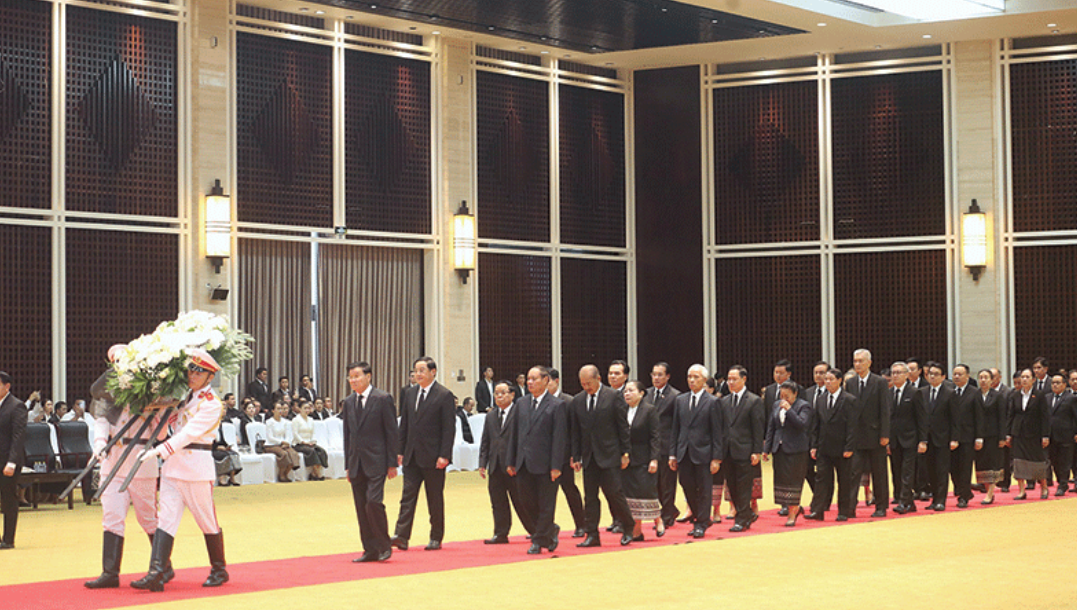
Laos held a formal state tribute on Sunday for National Assembly President Xaysomphone Phomvihane, marking the nation's loss of one of its most senior political figures. President Thongloun Sisoulith led senior party and state leadership in laying wreaths at the National Convention Hall, where hundreds of officials, legislators, and representatives from civil society gathered to pay their final respects. The ceremony underscored the gravity with which the Lao People's Revolutionary Party and government treated the passing of a figure whose influence shaped decades of institutional development.
Xaysomphone, a member of the party's Politburo and president of the National Assembly, represented a generational link to Laos's revolutionary past and its modern governance structures. His death on Saturday sent ripples through the political establishment at a moment when the nation faces considerable economic and geopolitical pressures. The attendance of Vietnam's National Assembly Chairman Tran Thanh Man and delegations from Hanoi's Ministry of Public Security and Ministry of National Defence illustrated the significance of bilateral ties and Vietnam's symbolic recognition of Xaysomphone's standing within the broader communist bloc in Southeast Asia.
The scale and choreography of the wreath-laying ceremony reflected institutional protocol and the tight hierarchies within Lao leadership. The Central Committee of the Lao People's Revolutionary Party initiated proceedings, followed sequentially by the Sisoulith family, the National Assembly's Standing Committee under Vice President Sounthone Xayachack, and the government delegation headed by Prime Minister Dr Sonexay Siphandone. Each delegation's composition and order conveyed messages about rank, family connections, and political alignment within the elite—a language of power familiar to observers of Southeast Asian communist systems where family dynasties and factional politics often intertwine with formal state structure.
Xaysomphone's family lineage placed him at the heart of Lao's post-revolutionary establishment. Born on 12 December 1956, he was one of six sons of the late President Kaysone Phomvihane, whose leadership during the Indochinese Wars and the construction of the Lao People's Democratic Republic defined the nation's modern trajectory. His brothers occupied or occupy positions of considerable influence, including Deputy Prime Minister Santiphab Phomvihane and other senior officials. This family constellation meant that Xaysomphone's death held implications beyond the loss of a single administrator; it represented a shifting of the guard within one of Southeast Asia's most insular political establishments.
The National Assembly presidency that Xaysomphone held is a consequential position within Laos's one-party system, though it operates within constraints that distinguish it from legislative chambers in pluralist democracies. As the nominal head of the assembly, Xaysomphone presided over debates on policy, development initiatives, and constitutional matters while remaining subordinate to the party's Politburo in substantive decision-making. Nevertheless, the assembly's role in ratifying legislation, approving the budget, and providing a forum for inter-ministerial discussion means that its leadership carries real institutional weight. During his tenure, Xaysomphone navigated sessions concerning land reform, foreign investment frameworks, and alignment with Vietnam and China—issues central to Laos's precarious economic model.
The declaration of five days of national mourning from 8 to 12 August transformed state functions and public life across Laos. Government offices, enterprises, and cultural institutions adjusted their routines to reflect the observance. The wreath-laying ceremony at the National Convention Hall remained open to party cadres, state officials, diplomatic corps members, and the general public throughout this period, providing multiple constituencies an opportunity to participate in the ceremonial marking of his passing. Foreign diplomats from embassies throughout Vientiane made visits, a diplomatic courtesy that also reinforced the international dimension of Lao political life and the regime's place within regional and global hierarchies.
Vietnam's parallel declaration of two days of national mourning on 10-11 August demonstrated the depth of Laos-Vietnam ties and the communist regimes' coordinated approach to state ritual and symbolic communication. The presence of Hanoi's senior figures at ceremonies in Vientiane exemplified the entanglement of the two nations' political systems—a relationship rooted in the Indochinese Wars, sustained through party-to-party ties, and reinforced through defence agreements and economic interdependencies. For Malaysian observers, this regional dynamic reveals how Southeast Asian communist states maintain institutional cohesion and project stability through carefully managed succession transitions and mutual validation among leadership echelons.
Xaysomphone's cremation at the That Luang esplanade on 12 August, the nation's most sacred Buddhist site, blended religious observance with state ceremony. Full honours for the cremation of a senior leader reflects the interweaving of Buddhist practice and communist state ritual that characterises contemporary Laos. The That Luang, a symbol of national identity and religious heritage, provided the appropriate setting for marking the departure of a figure whose life encompassed the revolutionary transformation and socialist consolidation of the Lao state. This convergence of secular authority and spiritual tradition illustrates how communist systems in Buddhist-majority nations navigate legitimacy through cultural synthesis.
The absence of designated succession announcements in the immediate aftermath of Xaysomphone's death raises questions about the mechanisms through which Lao leadership manages continuity. Unlike more institutionalised systems, transitions at the highest levels in Laos often unfold with deliberate opacity, with decisions crystallizing over weeks or months rather than through predetermined mechanisms. Senior figures such as Prime Minister Dr Sonexay Siphandone and other Politburo members hold positions that could accommodate reshuffling, but publicly available information offers limited insight into behind-the-scenes negotiations. This opacity reflects the party's historical preference for consensus-building and factional accommodation rather than codified succession rules.
For the broader Southeast Asian context, Xaysomphone's passing invites reflection on generational transitions within Vietnam and Laos as aging revolutionary cohorts gradually cede authority to successors educated in different circumstances. Unlike the tumultuous leadership changes that marked earlier decades, contemporary successions in communist states typically unfold as managed processes, with predecessors retaining influence through party positions or ceremonial roles. The tributes to Xaysomphone underscored his enduring standing despite the eventual passage of executive authority to others. Such patterns contrast sharply with leadership crises in other regional nations and suggest that institutional consolidation within the communist bloc has created mechanisms for orderly, if opaque, transitions.
The international outpouring of condolences and the coordinated mourning rituals extending across Laos and Vietnam reflected Xaysomphone's significance not merely as a national figure but as a link within a regional political architecture. Malaysian officials and observers monitoring developments in Indochina recognize such ceremonies as windows into the functioning of these regimes, revealing hierarchies, family structures, and the terms on which regional powers coordinate. Xaysomphone's life and death exemplified the continuity of post-war communist governance in Southeast Asia and the ways in which personal networks, ideological commitment, and revolutionary heritage remain foundational to political authority in nations where competitive elections and constitutional constraints on executive power remain absent.
The five days of national mourning provided space for institutional reflection on Xaysomphone's legacy within the National Assembly and broader governance structures. His decades of service contributed to legislative processes that, despite the absence of genuine opposition, managed resource allocation, policy debate, and the articulation of factional perspectives within the party framework. Successor leadership will inherit an assembly with established procedures and a roster of experienced members, though the concentration of authority within party structures and the limited transparency of decision-making mean that formal institutional change may be minimal. The ceremonies honoured not only Xaysomphone as an individual but also the institutional continuities he embodied and the state structures that persist beyond individual actors.

