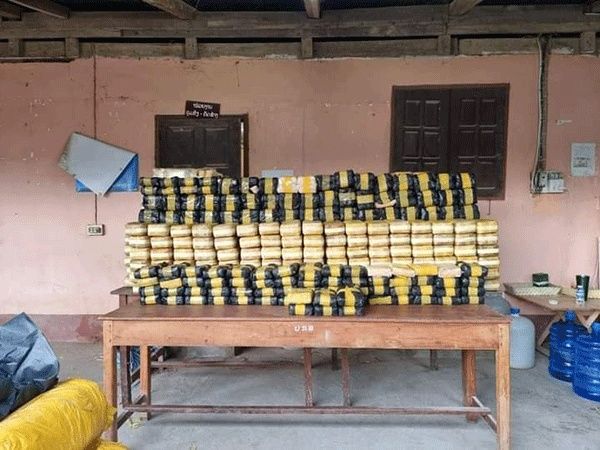
Drug-related offences have become the dominant criminal concern in Laos's central Xaysomboun province, accounting for nearly 44 per cent of all recorded crimes during the first half of 2024. The provincial security authorities are now calling for substantially tougher action to address the scale of the problem, which has emerged as a critical security priority for the region.
The statistics underscore the severity of the challenge facing law enforcement. Out of 54 total offences recorded by the Xaysomboun Provincial Public Security Force between January and June, 24 involved drugs or related activities. Only two of these cases have been concluded and referred for prosecution, leaving the vast majority—22 cases—still under active investigation. This backlog illustrates the resource constraints facing provincial police as they attempt to process the volume of drug-related cases while simultaneously managing other criminal matters.
The broader crime picture in Xaysomboun reveals a security landscape under considerable strain. Across all categories of offence, police have managed to settle six cases, conclude four more for prosecution, and achieve full resolution on 15 cases. However, nearly half of all reported crimes—29 cases—remain in investigative limbo, suggesting that the provincial security apparatus is stretched thin across multiple fronts. This logjam has drawn the attention of national security leadership, prompting a high-level intervention from the capital.
Police Brigadier General Ouday Insouvanh, head of the provincial security command, presented these figures during an August 7 meeting with Police Lieutenant General Vanthong Kongmany, Laos's Minister of Public Security. The visit signalled the importance placed on Xaysomboun's security situation at the highest levels of government. While Brigadier General Ouday acknowledged efforts to maintain political stability and social order during the first half of the year, the drug figures clearly indicated that existing approaches require reinforcement.
The national context makes this provincial crisis particularly significant. According to a report delivered by Prime Minister Sonexay Siphandone to an Extraordinary Session of the National Assembly last month, Laos as a whole processed 1,786 drug-related cases in the same six-month period, resulting in 4,025 arrests including 93 foreign nationals. Large quantities of narcotics and related assets were seized. This national campaign reflects a government designation from five years ago that placed drug suppression on the national agenda, making Xaysomboun's experience part of a broader struggle that has become embedded in state policy.
The Minister's visit resulted in direct instructions to intensify and broaden security operations. Police Lieutenant General Vanthong specifically urged the provincial force to strengthen its efforts against drug trafficking and the emerging challenge of new drug types. However, his emphasis extended well beyond narcotics. He called for escalated action against smuggling operations, human trafficking networks, theft and burglary, illegal mining activities, and illegal gambling establishments. This multi-pronged approach reflects an understanding that Xaysomboun faces not a single security crisis but a constellation of interconnected challenges requiring coordinated responses.
Cybercrime and online activities now form part of this expanded security agenda. The minister instructed the provincial command to strengthen oversight of social media use and develop capabilities to combat cybercrime, implementing ministry directives at the local level. This instruction suggests that even in a province where traditional crimes like drug trafficking dominate statistics, digital crime vectors are recognised as emerging threats requiring preemptive attention.
Road safety emerged as another significant concern during the meeting, revealing how security challenges extend beyond criminal activity into public safety more broadly. During the six-month period, 60 traffic accidents were recorded in Xaysomboun, resulting in four deaths, 80 injuries, and damage to 109 vehicles with financial losses exceeding 2.56 billion kip. These figures illustrate the human and economic toll of inadequate enforcement and public safety infrastructure, with impacts felt directly by families and communities across the province.
Immigration and the supervision of foreign nationals represent additional operational priorities. During the first half of the year, provincial officers inspected 1,698 tourists staying in Xaysomboun, including 396 foreign nationals. While the numbers appear manageable, the minister emphasised the need for professional, expertise-based management of immigration matters with clearly assigned responsibilities. This attention to visitor flows suggests concerns about potential linkages between tourism, drug trafficking, and other transnational crimes.
The minister's broader message to provincial leadership emphasised accountability and operational improvement. He called for strengthened political and ideological education among officers and personnel, insisting on compliance with party policies, state laws, and disciplinary standards within the security forces. Critically, he urged personnel to acknowledge weaknesses, avoid passive compliance with orders, and take direct responsibility for operational outcomes. This framing suggests potential frustration with existing performance levels.
Operational procedures also received attention, with the minister stressing that investigations, detention practices, and rehabilitation work must strictly follow legal protocols. This emphasis on procedural correctness may reflect concerns about investigative quality or potential abuse, particularly given the large number of cases still under investigation and the speed with which cases are typically concluded. The instruction that the provincial command be fully prepared to respond to emerging security challenges further underscores concern that current capabilities may be insufficient for evolving threats.
For Malaysia and other Southeast Asian countries, Xaysomboun's drug crime surge and Laos's national response carry regional implications. Laos's position in Southeast Asia's drug trafficking landscape, combined with its porous borders and limited enforcement capacity, means that narcotics problems in central Laos can have cross-border consequences. The national campaign's intensification may redirect trafficking patterns, potentially affecting supplies or routes in neighbouring countries. Regional security cooperation mechanisms will be crucial in addressing the transnational dimensions of drug crime that provincial and national enforcement alone cannot resolve.

