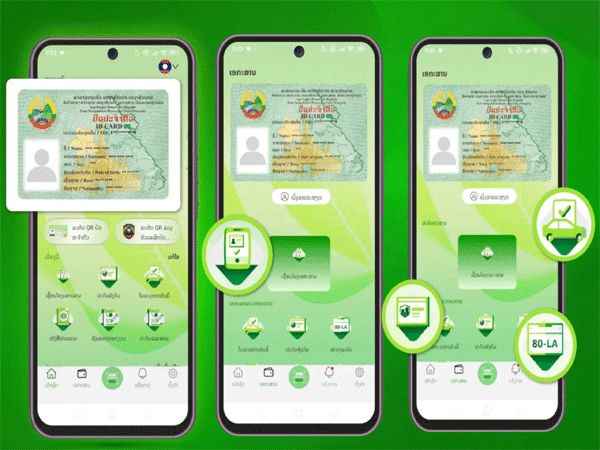
Laos has taken a decisive step toward digital governance by retiring its traditional paper-based identity system in favour of the LAeID mobile application, a centralized digital identity platform designed to streamline citizen interactions with government agencies. The Ministry of Public Security formally launched the rollout following an official notice, bringing an end to the era of white and green physical identity cards and paper household registration documents that have served the Southeast Asian nation for decades. This transition marks a significant milestone in Laos' broader push to modernise its public administration infrastructure and reduce bureaucratic friction for its population.
The phased implementation began on July 18, when the old identity cards ceased to be valid for conducting official transactions across all government ministries and agencies nationwide. Citizens are now required to register for digital identity credentials and establish electronic identification accounts through the LAeID system to maintain legal proof of identity. The transition is not instantaneous; the government has communicated the changes to all relevant ministries, government bodies, private organisations, and individual citizens to ensure a coordinated rollout and minimize disruption to essential services.
At its core, the LAeID application functions as a digital consolidation mechanism, eliminating the practical inconvenience of carrying multiple physical documents to different administrative offices. Rather than presenting separate paper certificates, registration books, and identity cards at various government counters, citizens can now authenticate themselves through a single smartphone application. This fundamental shift addresses a persistent pain point in Southeast Asian bureaucracies, where citizens often must navigate fragmented government systems requiring repetitive document verification and time-consuming office visits.
The digital identity system is engineered to reduce administrative burdens for ordinary citizens while simultaneously lowering operational costs for government agencies. By centralising identity verification and household information within the LAeID platform, both public institutions and residents benefit from decreased paperwork generation, simplified authentication procedures, and faster transaction processing. The system also strengthens data management practices by replacing physical records susceptible to loss or damage with secure digital repositories maintained by the Ministry of Public Security.
The LAeID application operates as an expansive digital wallet with substantial room for growth. Currently, the initial phase provides only the core digital identity card functionality, yet the architecture supports integration with numerous official government databases. The long-term vision encompasses embedding birth certificates, marriage certificates, health insurance documentation, social security records, vehicle registration papers, driving licences, and passport information within the unified platform. This progressive integration approach allows Laos to deploy the system incrementally while technical teams work on connecting disparate government databases.
Registration for the digital identity system is administratively straightforward, accessible through district and provincial public security offices across the country. Each citizen's account utilizes their national identity number as the primary username or identifier. The authentication mechanism employs a password-based system, with credentials either sent via SMS following account approval or created directly during the registration process. This dual-option approach accommodates varying levels of digital literacy among Laos' diverse population, ensuring accessibility across age groups and educational backgrounds.
The LAeID initiative represents a calculated response to challenges endemic to developing Southeast Asian nations attempting to modernise governance infrastructure. By consolidating disparate identity and administrative systems into a single mobile-accessible platform, Laos aims to reduce opportunities for document fraud, improve the accuracy of government databases, and enhance service delivery efficiency. The system particularly benefits rural populations previously requiring arduous travel to provincial centres to conduct administrative transactions, as mobile connectivity increasingly extends across Laos.
From a regional perspective, Laos' digital identity transition aligns with broader Southeast Asian trends toward e-governance and digital transformation. Neighbouring countries including Thailand and Vietnam have pursued similar centralised digital identity initiatives, recognising that modernised authentication systems generate competitive advantages in economic competitiveness and administrative efficiency. The LAeID system positions Laos within this regional movement while addressing specific domestic needs for streamlined public administration.
The transition does present implementation challenges typical of large-scale digital systems in developing economies. Technical infrastructure must support potentially millions of concurrent users accessing the LAeID application, particularly during peak usage periods. Cybersecurity protections require robust encryption and data protection measures, as centralised digital identity systems concentrate sensitive personal information that becomes attractive to malicious actors. The Ministry of Public Security must maintain continuous system monitoring and regular security audits to safeguard citizen data throughout the platform's operational lifetime.
For Malaysian observers and regional analysts, Laos' experience provides instructive lessons regarding digital identity system deployment. Malaysia's own Mykad system and ongoing digital government initiatives can draw relevant insights from Laos' phased implementation strategy and the challenges inherent in transitioning entire populations from paper-based to digital-first administrative processes. The comparative success or difficulties Laos encounters during this transition will inform best practices for other Southeast Asian nations contemplating similar digital transformation projects.
Looking forward, the progression of the LAeID system will depend substantially on backend infrastructure development and the successful integration of various government databases. The Ministry of Public Security faces the considerable technical challenge of ensuring system reliability, managing cybersecurity threats, and maintaining public confidence in the digital platform's security and functionality. As additional government services migrate onto the LAeID infrastructure, citizens' willingness to embrace digital transactions will shape the initiative's ultimate effectiveness in reducing administrative burdens and improving governance outcomes across Laos.

