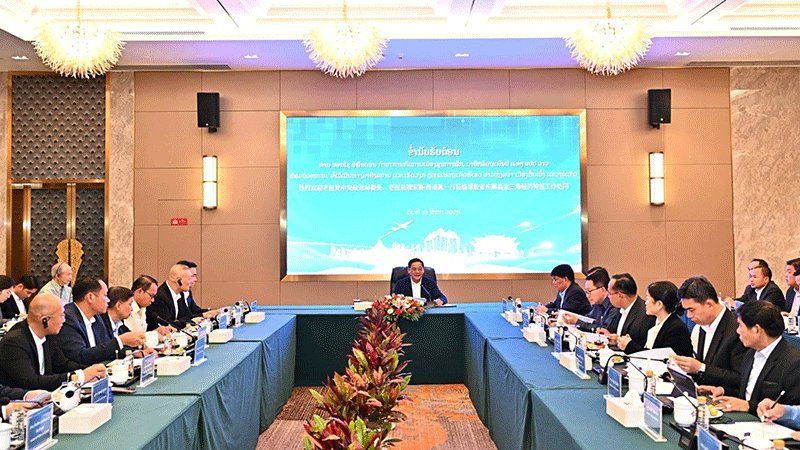
Prime Minister Sonexay Siphandone has signalled a significant tightening of governance at Laos's flagship Golden Triangle Special Economic Zone, demanding stricter regulation and more sustainable development practices at the sprawling 10,000-hectare complex straddling the border where Laos, Myanmar and Thailand converge. The directive came during an on-site inspection on Tuesday, August 18, where the premier outlined a comprehensive overhaul of management practices at a zone that has accumulated roughly US$10 billion in cumulative investment since its establishment in 2007 but has fallen short of realising its full potential.
The underperformance is stark. Despite nearly two decades of operation and substantial capital injection, the zone has achieved only 60 percent of the activities specified in signed investment contracts. This shortfall has prompted the government to recalibrate its approach, moving beyond the hands-off posture that characterised the early years of the zone's development. The gap between contractual commitments and actual implementation represents a significant drag on the zone's contribution to Laos's broader economic development agenda and has evidently prompted leadership to intervene more forcefully.
The Golden Triangle SEZ, situated in Tonpheung district of Bokeo province and strategically positioned on the Mekong River's banks, was designed to leverage its unique tri-border location and proximity to China's Yunnan province. The zone encompasses 3,000 hectares designated for commercial activities and 7,000 hectares of forested areas. Its geographical positioning theoretically grants operators access to vast consumer bases and labour pools across three countries, whilst also providing a gateway to China's southwestern frontier, making it theoretically one of mainland Southeast Asia's most promising investment corridors.
Diversification across multiple economic sectors has occurred, with companies now engaged in manufacturing, real estate development, hospitality, trade, banking, tourism and ancillary services. However, this breadth of activity has apparently created coordination and oversight challenges. The zone currently hosts more than 10,000 registered workers, with an additional 10,000 investors, operators, residents and tourists moving through regularly. The administrative footprint has also expanded considerably, with over 400 government officials from various agencies now stationed at the zone to manage day-to-day operations.
Prime Minister Sonexay's intervention signals frustration with the current trajectory and a determination to refocus development on higher-value sectors. He specifically highlighted tourism, manufacturing, processing, transport, education and healthcare as priority areas requiring intensified investment and support. This sectoral emphasis suggests the government believes the zone has spread itself too thinly and needs strategic concentration on activities that generate sustainable, broad-based economic benefits rather than purely speculative ventures.
A critical component of the renewed oversight regime involves formalising financial flows through Lao banking channels. The Premier instructed authorities to require all transactions related to commerce, investment, remuneration, services and operations to be processed via the domestic banking system—a move designed to enhance revenue collection, reduce informal economic activity and improve transparency. This reflects concerns about capital leakage and illicit financial flows that may have characterised earlier operations.
Border management has also emerged as a priority concern. The directive to strengthen entry and exit controls at the zone appears aimed at addressing irregular migration and transnational labour movement, which have evidently posed administrative and security challenges. Enhanced cooperation mechanisms with neighbouring countries, including expanded airline connections and formal bilateral labour arrangements, are intended to regularise cross-border mobility whilst maintaining order.
The one-stop-service system earmarked for improvement is meant to streamline the investment approval and operational licensing process, potentially reducing bureaucratic friction that may have discouraged or delayed project implementation. Paradoxically, whilst Sonexay has demanded tighter regulation, the call to improve service delivery suggests the government recognises that excessive red tape may have contributed to the implementation shortfall.
The Prime Minister also instructed a comprehensive review of the zone's concession agreements to ensure alignment with contemporary legislation, suggesting that some existing arrangements may have been negotiated under frameworks that are now considered inadequate. Strengthening the Management and Administration Committee's operational effectiveness appears central to the overhaul, implying that administrative capacity rather than policy clarity has been the limiting factor.
For regional investors, particularly those from Malaysia, Thailand and Vietnam, the policy shift carries mixed implications. Stricter financial oversight and labour regulation may increase compliance costs and reduce certain informal operational efficiencies. However, enhanced legal clarity, improved infrastructure coordination and more disciplined management could ultimately reduce business uncertainty and reputational risks associated with zones perceived as loosely regulated.
The strategic significance of the Golden Triangle SEZ extends beyond Laos itself. The zone functions as a crucial node in China's Belt and Road Initiative infrastructure, particularly the Kunming-Bangkok Economic Corridor. Enhanced governance and performance at this juncture could strengthen the broader subregional integration architecture that Southeast Asian economies increasingly depend upon for trade and investment diversification.
The government's intervention reflects a maturation of thinking about special economic zone administration. Rather than viewing SEZs as spaces requiring minimal state involvement, the Lao government is now positioning itself as an active stakeholder ensuring that development aligns with national development priorities and international standards. Whether this recalibration succeeds in unlocking the zone's dormant potential will significantly influence attitudes towards special economic zones across the wider Mekong region.

