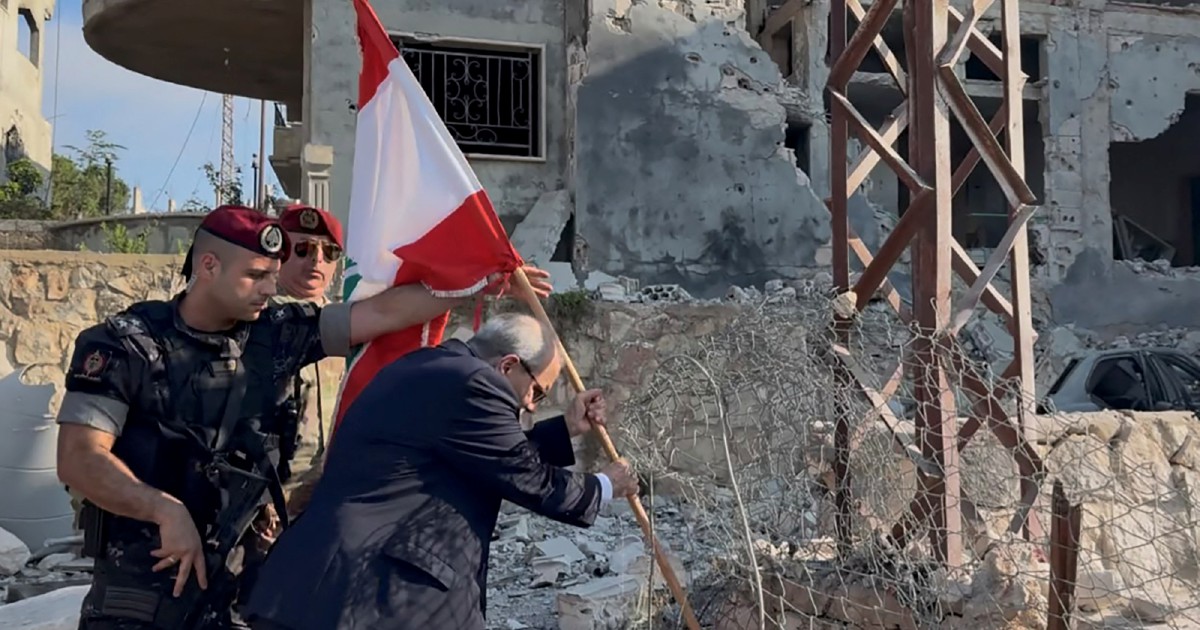
Lebanon's government has publicly reiterated its demand for total Israeli withdrawal from territories under occupation, with Prime Minister Nawaf Salam making the declaration during a visit to Zawtar al-Gharbiyah on Wednesday. The statement comes as Lebanon's military has recently begun establishing a presence in areas previously held by armed groups or Israeli forces, marking a symbolic assertion of Lebanese sovereignty over disputed border regions.
The timing of Salam's visit carries particular significance for understanding Lebanon's current strategic posture in the wider Middle Eastern conflict. The Prime Minister's journey to the southern village represented a deliberate show of confidence in the Lebanese Armed Forces' capacity to reassert state authority in traditionally volatile territory. This gesture underscores the government's attempt to project strength domestically while simultaneously communicating resolve to both Israeli and international observers regarding its territorial claims.
For Malaysian readers, this development reflects the complex geopolitical fault lines that continue to fracture the Middle East, with smaller nations like Lebanon caught between competing regional and international interests. The Lebanese crisis has particular resonance across Southeast Asia, where significant Shia Muslim communities maintain cultural and familial ties to the Levantine region. Lebanon's stability—or instability—therefore carries implications that ripple through diaspora networks and broader Muslim-majority countries' foreign policy calculations.
The deployment of Lebanese army units into previously contested zones represents an attempt by the civilian government to consolidate its control over the state's monopoly on force. For decades, Hizbollah and other militias have effectively controlled southern Lebanon and other regions, undermining the central government's writ. Any genuine assertion of Lebanese state authority would theoretically reduce the power of non-state actors and create conditions where purely governmental institutions manage border security and territorial administration.
Israeli military positions in Lebanese territory have existed since various conflicts spanning decades, with the most recent significant operations occurring in 2006. The occupation of Shebaa Farms and other disputed areas remains a focal point of regional tension. Israel justifies its military presence as necessary for security, citing cross-border attacks and threats emanating from Lebanese militant groups. Meanwhile, the Lebanese government views Israeli forces as illegitimate occupiers that undermine sovereignty and perpetuate regional instability.
Salam's remarks about pursuing complete Israeli withdrawal should be understood within the context of Lebanese state reconstruction and nation-building efforts. Following economic collapse and the devastating 2020 Beirut port explosion, the Lebanese government faces immense challenges in rebuilding state capacity and legitimacy. A successful military redeployment into southern regions, coupled with diplomatic pressure on Israel to withdraw, could provide the administration with much-needed nationalist credentials and public legitimacy.
The international dimension adds another layer to this situation. The United States and European powers maintain interest in Lebanese stability, while France historically maintained strong ties to the country. Any meaningful Israeli withdrawal would likely require diplomatic intervention and guarantees from major powers. The absence of a robust international mechanism to enforce territorial agreements, however, means that Lebanon's negotiating position remains inherently weak compared to the militarily superior Israeli state.
Regional actors including Iran and Saudi Arabia, locked in their own proxy competitions across the Middle East, also view Lebanon as a strategic chessboard. This external interference complicates the government's efforts to establish unilateral control over the state. Salam's emphasis on governmental rather than factional authority implicitly challenges the influence of groups that have historically received external patronage, presenting an ideological challenge that extends beyond simple territorial disputes.
For Southeast Asia, the Lebanese situation exemplifies how regional conflicts become transnationalized and create humanitarian consequences affecting diaspora communities. The potential for escalation or de-escalation in Lebanese-Israeli tensions influences international stability and could affect Malaysian foreign policy interests, particularly regarding Middle Eastern engagement and multilateral humanitarian initiatives. The Lebanese government's capacity to maintain civilian governance while managing powerful non-state actors remains a critical concern for international observers concerned with regional peace.
Salam's administrative background suggests a more technocratic approach to governance compared to previous Lebanese premiers. His emphasis on state reconstruction and institutional development, coupled with reassertions of territorial integrity, indicates a government attempting to rebuild legitimacy through competence rather than factional accommodation alone. This orientation creates both opportunities and risks, as it necessarily challenges entrenched power structures that may resist centralization.
The practical implications of securing full Israeli withdrawal remain uncertain and largely dependent on factors beyond Lebanese control. International pressure, Israeli strategic calculations, and the broader regional security environment will all influence whether such a goal proves achievable. Nevertheless, Salam's public commitment to this objective signals that the Lebanese government intends to pursue nationalist goals and restore state authority where possible, even if complete success remains elusive in the immediate term.

