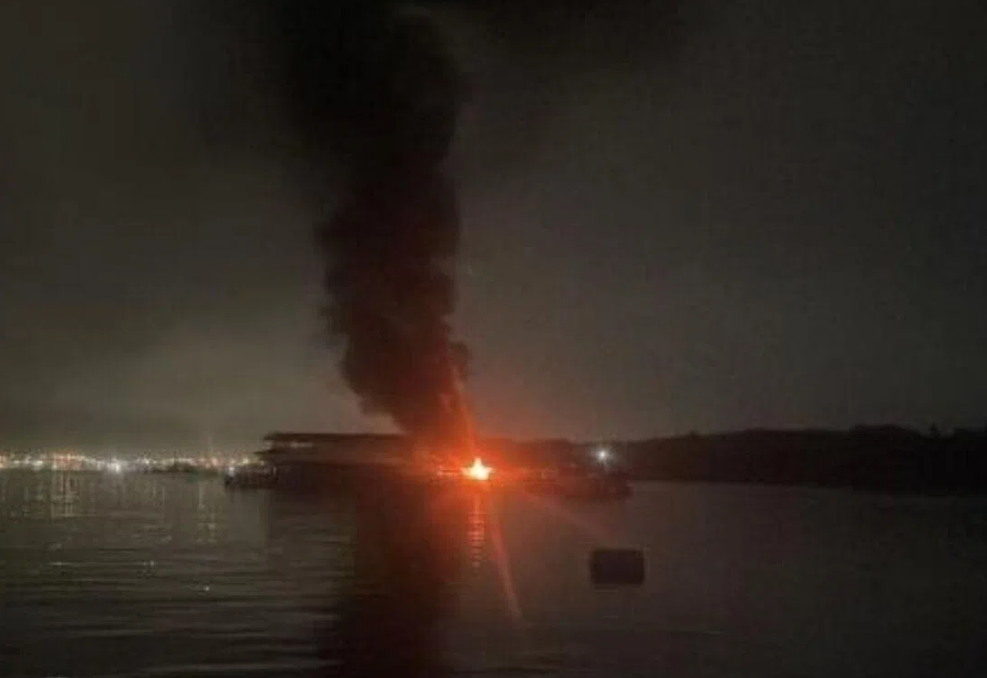
Firefighting crews engaged in an extended battle against flames consuming at least two floating fish farms positioned near Pulau Ubin on June 24, with the incident highlighting the vulnerabilities of aquaculture operations positioned in exposed coastal waters. The Singapore Civil Defence Force (SCDF) received an emergency alert shortly after 8.10pm and dispatched resources to combat the spreading blaze, which authorities suspect originated from a lightning strike striking the solar panel infrastructure at one facility before advancing to neighbouring operations. The rapid escalation underscores how quickly fire can propagate across multiple installations clustered in close proximity on the open water.
The farming installations occupy a strategic yet exposed position off the Lorong Halus jetty, situated in the vicinity of Pasir Ris between the islands of Pulau Ubin and Pulau Ketam. This location places the farms directly in the path of thunderstorm systems that regularly traverse the Straits of Johor and the waters surrounding the Singapore eastern coast during the monsoon seasons. The offshore positioning, whilst providing access to open water for cultivation, simultaneously exposes equipment to atmospheric electrical phenomena that land-based agricultural operations can mitigate through conventional lightning protection systems.
According to reporting from Lianhe Zaobao, the lightning appeared to have made direct contact with photovoltaic panels mounted on the affected farm, initiating the fire that subsequently spread to adjacent operations before personnel managed to contain and extinguish the flames. The involvement of solar panel systems introduces a particular vulnerability, as the electrical infrastructure associated with renewable energy installations can channel or amplify the energy from direct lightning strikes, potentially creating conditions conducive to fire initiation. This technical dimension represents an emerging challenge for aquaculture operators integrating green energy solutions into their maritime farming infrastructure.
One farm proprietor disclosed substantial financial consequences from the incident, estimating direct losses approaching S$120,000, encompassing damage to critical operational assets. The inventory of destroyed or compromised equipment reveals the comprehensive infrastructure required to maintain floating fish farms: solar photovoltaic arrays designed to power daily operations, diesel generators serving as backup power sources, fish feed storage supplies, fishing vessels essential for farm management and harvesting, and specialized traps integral to capture operations. The destruction of these interdependent systems renders farms temporarily or permanently non-operational, creating cascading economic impacts beyond the immediate material losses.
A particularly troubling aspect of the incident involves the escape of approximately half the fish stock from one affected farm, representing both a financial loss to the operator and a potential ecological complication. The release of farmed fish into natural waters introduces non-native or selectively bred aquatic organisms into local ecosystems, creating uncertainties regarding ecological impacts on wild populations. Such escapes have emerged as recurring concerns within the global aquaculture industry, prompting regulatory scrutiny and insurance complications that this farmer evidently encountered when attempting to pursue claims for the fire-related damages.
The farm operator emphasized that this represented the second occasion on which lightning had damaged the solar panel infrastructure, yet the earlier incident had transpired when personnel were physically present on-site and capable of responding with sufficient rapidity to prevent fire propagation. This observation highlights a critical distinction between managed responses to equipment damage and scenarios where automation or absence of immediate human intervention permits initial spark development to escalate into uncontrollable conflagration. The absence of workers during the June 24 incident fundamentally altered the trajectory of the emergency, allowing initial flame development to advance beyond intervention capacity before external emergency responders arrived.
Response coordination during the incident involved Maritime and Port Authority of Singapore vessels and Airport Emergency Service maritime units positioning themselves to deliver suppression efforts, demonstrating the interdepartmental mobilization required for offshore emergency response. Adjacent fish farm operators voluntarily participated in containment efforts, reflecting the close-knit nature of the aquaculture community and the mutual understanding that threats to one operation potentially endanger neighbouring facilities. This informal cooperation amongst industry participants complemented official emergency response mechanisms, illustrating how maritime communities often develop collaborative safety protocols preceding formal regulatory frameworks.
The incident raises substantive questions regarding insurance coverage for aquaculture operations exposed to atmospheric hazards. The proprietor's statement that he could not file an insurance claim merits closer examination, as it suggests either contractual exclusions for lightning-related incidents or gaps in policies covering floating installations. Such coverage limitations create scenarios wherein operators absorb catastrophic losses personally, particularly affecting smaller enterprises lacking financial reserves to weathering major incidents. This insurance dimension carries implications for the viability and scalability of offshore aquaculture as a food production strategy for densely populated, resource-constrained territories like Singapore.
Fishing nets sustained damage during the incident, and the operational interruption and stock losses compound into multi-dimensional economic consequences transcending immediate property destruction. The farm must now undertake comprehensive infrastructure reconstruction, restock aquatic inventory, and address potential ecological remediation if escaped fish populations establish themselves in surrounding waters. For Malaysian and Southeast Asian aquaculture operators observing this incident, the episode underscores the necessity for enhanced lightning protection specifications on offshore installations, redundant safety systems preventing fire propagation, and insurance policy architecture accommodating atmospheric phenomena in maritime agricultural contexts.
The broader implications extend to Singapore's food security strategy, which increasingly emphasizes domestic aquaculture production to reduce import dependence. Recurring incidents of this magnitude threaten production targets and operator confidence in the subsector's risk-return profile. Regional governments attempting to expand aquaculture capabilities must contend with comparable environmental and infrastructure vulnerability considerations, particularly across Southeast Asia where tropical weather patterns and monsoon systems create analogous atmospheric hazard exposure.
Investigations remain underway to establish the precise causation and contributing factors, yet the preliminary evidence strongly points toward meteorological phenomena as the primary trigger. This attribution, whilst providing clarity regarding root cause, simultaneously reveals the sector's exposure to natural hazard dynamics largely beyond operational control. Risk management strategies must therefore incorporate both technological hardening of infrastructure and operational protocols ensuring human presence capacity for rapid emergency response, elements that appear inadequately integrated in current aquaculture facility design standards operating within Singapore's territorial waters.

