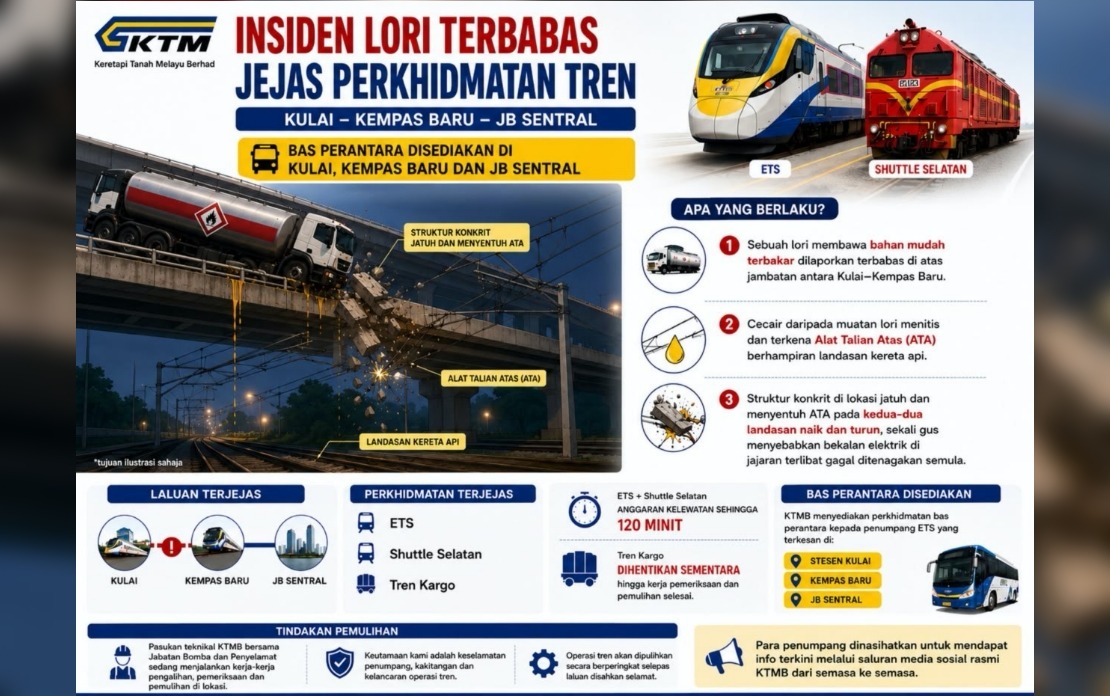
A transportation disruption unfolded in Johor Bahru on August 5 when a lorry carrying flammable liquid skidded near railway infrastructure, severing electrical power to the Kulai–Kempas rail corridor and halting both Shuttle Selatan and Electric Train Service (ETS) operations. The incident highlights the vulnerability of Malaysia's rail network to roadside accidents and the cascading effects such incidents can have on commuter services, particularly in the densely trafficked southern corridor connecting Johor Bahru to outlying residential areas.
Keretapi Tanah Melayu Berhad (KTMB), the national rail operator, announced the disruption through official channels, explaining that the accident had compromised the power supply infrastructure essential for train movements along this critical route. The operator immediately mobilised recovery efforts, with cleanup operations and repair work commencing to restore electrical connectivity and resume normal train schedules. The incident underscores ongoing challenges facing Malaysia's rail operations, where external factors—particularly vehicle accidents at level crossings and adjacent areas—continue to pose operational risks.
To mitigate passenger inconvenience, KTMB activated contingency protocols by deploying shuttle bus services at three key stations: Kulai, Kempas Baru, and JB Sentral. This response mechanism, while helpful, inevitably reduces service efficiency compared to direct rail travel, as passengers face transfer delays and extended journey times. For Shuttle Selatan commuters, the operator recommended switching to alternative transportation modes entirely, acknowledging that bus substitutes would be inadequate for that service tier.
The authority's acknowledgment of passenger impact extended to financial concessions. KTMB announced fare adjustments for those affected by the disruption, a gesture reflecting growing pressure on transport operators to compensate customers when service failures occur. This policy, while customer-friendly, also reflects the competitive landscape where rail operators must maintain ridership confidence amid frequent operational challenges.
By 10:37 pm on the day of the incident, specific trains remained significantly delayed. ETS9449 was running 32 minutes behind schedule, while ETS9533 faced a more severe 55-minute delay. However, KTMB cautioned that these delays could fluctuate depending on real-time operational conditions, signalling uncertainty about restoration timelines. Such unpredictability frustrates commuters planning their journeys, particularly evening travelers heading home or returning to offices.
The incident reveals systemic vulnerabilities in how rail corridors interface with road networks in Malaysia. The Kulai–Kempas route serves as a crucial connector for residential areas in southern Johor and the broader Iskandar Malaysia economic region. Disruptions on this line create ripple effects throughout the transport ecosystem, diverting traffic to already congested roads and potentially affecting regional economic productivity when workers experience extended travel times.
For Malaysian rail commuters, such incidents have become disturbingly familiar. The Shuttle Selatan and ETS services are relied upon by thousands daily for connecting Johor Bahru's urban core with satellite townships and industrial zones. When external accidents interrupt these services, the burden shifts back to road transport, undermining the broader policy objective of transitioning Malaysians toward public rail travel as an environmentally sustainable and efficient alternative.
KTMB's apology and offer of assistance through station staff reflected standard crisis communication protocol, yet such measures often feel reactive rather than preventive. The operator has repeatedly emphasised railway safety following various incidents, yet accidents continue. This suggests that systemic improvements—better signage at rail-adjacent roads, enhanced traffic management at vulnerable points, or stricter enforcement of hazardous materials transportation regulations—may require coordinated intervention beyond KTMB's immediate authority.
The flammable liquid cargo adds another dimension to this incident. The transportation of hazardous materials near railway infrastructure, while unavoidable in Malaysia's integrated logistics ecosystem, presents compounded risk. Had the lorry collision caused liquid spillage or fire near electrical infrastructure, consequences could have escalated significantly. This incident might prompt regulators to examine whether routing protocols for hazardous goods transportation adequately account for proximity to critical rail infrastructure.
For the broader Southeast Asian context, Malaysia's rail challenges mirror regional patterns where rapidly developing economies struggle to manage growing vehicular traffic while maintaining aging or expanding rail networks. Countries across the region face similar coordination challenges between road and rail authorities, competing infrastructure investments, and incidents that periodically expose system fragility.
Looking ahead, the incident reinforces the urgency of modernising Malaysia's rail infrastructure and safety protocols. Automatic power isolation systems, better accident warning mechanisms, and improved emergency response coordination could reduce recovery times when incidents occur. Meanwhile, commuters and businesses relying on Shuttle Selatan and ETS services must brace for continued periodic disruptions until such systemic improvements materialise.
KTMB's handling of passenger communication appears reasonably transparent, with specific delay information and alternative arrangements clearly communicated. However, the underlying issue remains: Malaysia's transport sector continues wrestling with integration challenges between road and rail networks. Resolving this requires not merely operational responses to individual incidents, but strategic infrastructure planning that prevents such disruptions from occurring in the first place.

