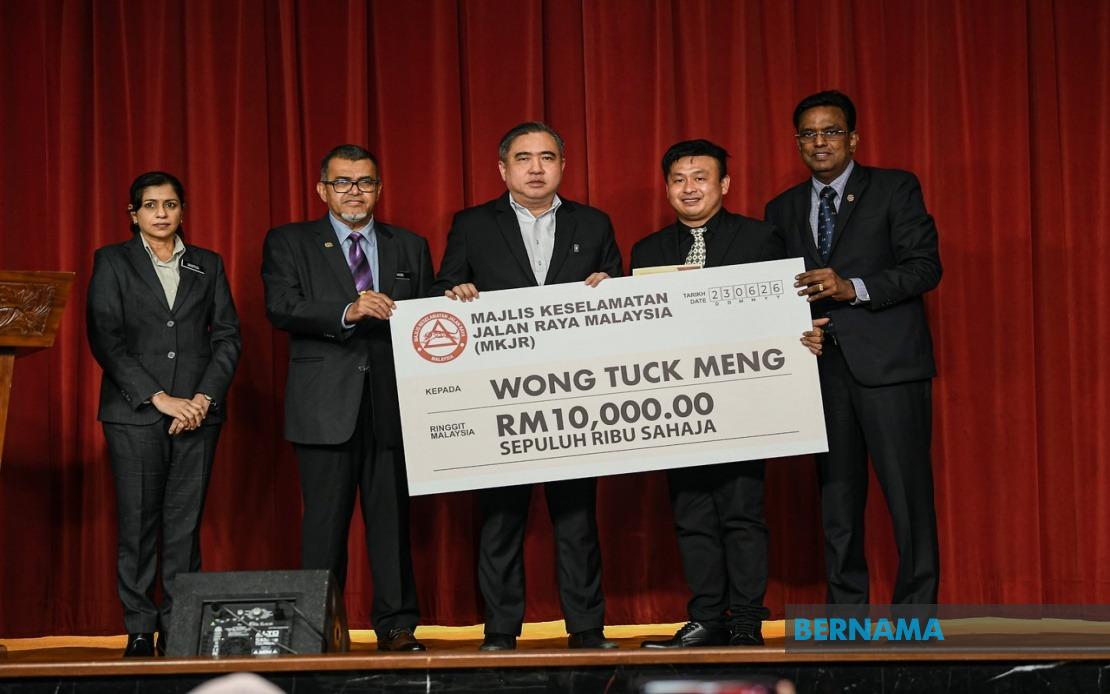
Wong Tak Ming, a lorry driver whose composed thinking prevented a potential disaster on one of Malaysia's busiest highways, was honoured today by Transport Minister Anthony Loke at a special appreciation ceremony held at Parliament. The recognition came in the form of a Special Certificate of Appreciation and a monetary award of RM10,000, funded through the Malaysian Road Safety Council (MKJR), acknowledging his instrumental role in safeguarding 21 passengers aboard an express bus during a critical incident near the Menora Tunnel in Perak on June 15.
The incident unfolded when an express bus travelling from Kedah towards Kuala Lumpur encountered a severe technical malfunction along a downhill section adjacent to the Menora Tunnel. As the vehicle lost braking capacity and began accelerating uncontrollably down the slope, it collided with the rear of Wong's lorry. Rather than panic or attempt to flee, Wong demonstrated exceptional situational awareness and safety instincts by immediately using his own vehicle as a means to decelerate the stricken bus. He then manoeuvred his lorry closer to the roadside guardrail, effectively creating a physical barrier that brought both vehicles to a controlled halt before the situation could deteriorate into a multi-vehicle pile-up or a catastrophic crash.
During remarks at the Parliament building ceremony, Loke praised Wong's extraordinary courage and presence of mind, characterising his response as that of a genuine hero who placed the safety of strangers above his own well-being. "His swift action prevented what could have been a tragic accident and saved many lives," the minister stated, emphasising that Wong's decision to intervene came despite the considerable personal risk involved. The acknowledgement was particularly significant coming from Malaysia's transport leadership, signalling that the government recognises and values acts of public-spirited heroism on the nation's roads.
When asked about his motivations during the ceremony, Wong offered a humble and straightforward explanation that underscored his instinctive, rather than calculated, response to the emergency. He explained that his primary concern at the moment of impact was preventing fatalities and buying precious seconds for other drivers ahead to recognise the danger and move clear of the trajectory. The existence of distance between his lorry and the approaching bus meant that he had a critical window to sound his horn loudly, alerting motorists in front to the oncoming hazard. This dual-pronged approach—physically intervening with his vehicle while simultaneously giving auditory warning to others—demonstrated both tactical thinking and genuine concern for the broader safety of all road users.
The Dewan Rakyat further underscored the significance of Wong's actions by formally expressing parliamentary appreciation for his bravery. Deputy Speaker Datuk Dr Ramli Mohd Nor conveyed the gratitude of the entire legislature following Transport Minister Loke's tabling of the Road Transport (Amendment) Bill 2025 for its second reading. This parliamentary recognition reflected a broader institutional acknowledgement that road safety depends not merely on legislation and enforcement, but also on the voluntary, courageous interventions of ordinary citizens who prioritise collective welfare.
The incident gained considerable traction on social media platforms, with video footage of the dramatic event circulating widely and garnering extensive praise from the Malaysian public. This organic social media narrative proved instrumental in bringing Wong's actions to the attention of government officials and transport authorities. The viral nature of the footage demonstrates how digital platforms can serve as a mechanism for recognising and celebrating positive behaviour on Malaysian roads, potentially inspiring other drivers to cultivate similar safety consciousness and community responsibility.
From a road safety perspective, the incident at Menora Tunnel highlights the persistent vulnerabilities associated with long-distance express bus operations on Malaysia's highway network. The technical failure that precipitated the emergency underscores the critical importance of rigorous vehicle maintenance protocols and regular mechanical inspections, particularly for coaches operating on routes with significant elevation changes where brake system failure poses exponential dangers. The Menora Tunnel stretch, being a downhill gradient section, represents a particularly high-risk area where brake failure becomes catastrophic more quickly than on level terrain.
Wong's actions also illustrate an underappreciated dimension of road safety: the role of attentive, quick-thinking other motorists in preventing escalation of emergencies. Rather than treat the incident as someone else's problem, Wong recognised his capacity to intervene meaningfully and acted decisively. This contrasts with situations where drivers witness an emergency unfold but assume responsibility lies elsewhere, allowing preventable tragedies to occur. His willingness to risk his own vehicle and person to protect strangers reflects a road culture oriented towards mutual protection rather than individual self-interest.
The monetary recognition of RM10,000 and the formal certificate, while important symbolic gestures, also represent official sanction for road safety heroism. By publicly rewarding such behaviour, the government signals that it values and encourages citizens to intervene when they witness emergencies, provided they can do so safely. This normalisation of public-spirited action may gradually shift Malaysian road culture towards greater collective responsibility for safety outcomes, moving beyond a purely regulatory compliance model.
The incident also raises questions about express bus industry standards and whether current regulations adequately mandate maintenance protocols that would prevent the type of technical failure that occurred on June 15. The Road Transport (Amendment) Bill 2025, introduced in Parliament during the same ceremony honouring Wong, may address such gaps. Future enhancements to bus operator licensing requirements, mandatory brake system redundancy, and driver training in emergency procedures could reduce the likelihood of similar incidents requiring heroic intervention from passing motorists.
Wong's recognition arrives at a moment when Malaysia continues to grapple with road safety challenges across its highway network. The celebration of his actions serves dual purposes: acknowledging individual heroism while simultaneously prompting broader systemic reflection on infrastructure, vehicle standards, and driver training. As the nation works towards improving transport safety outcomes, stories like Wong's remind policymakers and the public that genuine safety improvements require both institutional measures and the cultivation of a culture where ordinary citizens feel empowered and motivated to protect one another on shared roads.