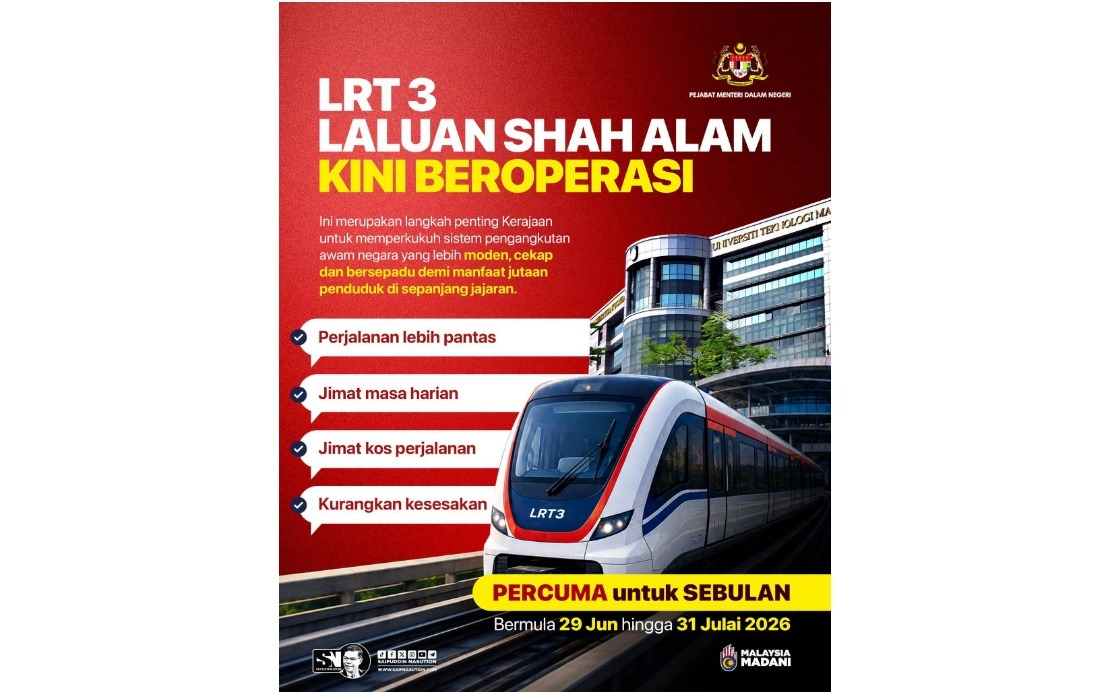
The launch of the Shah Alam Line LRT3 marks a significant milestone in Malaysia's urban mobility transformation, with Home Minister Datuk Seri Saifuddin Nasution Ismail positioning the new rapid transit corridor as concrete evidence of the government's broader infrastructure vision. Speaking on the line's inaugural operations, Saifuddin emphasised that the project exemplifies the administration's determination to build a public transport network that is not merely functional but genuinely competitive with private vehicle use for the millions who commute daily across the Klang Valley.
The timing of the line's opening reflects careful government planning to address chronic congestion patterns in one of Malaysia's most congested transport corridors. For decades, the Klang Valley has struggled with traffic volumes that exceed road capacity, creating bottlenecks that consume productive hours and increase household transport expenditures. By introducing an alternative transport mode that directly serves major employment and educational hubs along the designated alignment, planners aim to shift travel behaviour among a critical mass of commuters who have long depended on personal vehicles or existing bus services.
Saifuddin's articulation of the LRT3's benefits extends beyond simple journey convenience. He highlighted the multiplier effects that improved public transport generates: reduced traffic pressure on key corridors, shorter commute times that increase worker productivity, and lower daily transport costs that directly benefit household budgets. These outcomes matter particularly for lower and middle-income workers who spend disproportionate shares of earnings on commuting, and for students whose attendance reliability depends on predictable, affordable transit options. The line's integration with existing Prasarana feeder bus services creates a comprehensive network that captures short-distance trips that might otherwise occur by private transport.
The decision to offer completely free fares during a one-month promotional period, announced by Prime Minister Datuk Seri Anwar Ibrahim at the launch ceremony, represents an aggressive demand-generation strategy. This approach acknowledges a fundamental challenge in public transport expansion: habit formation requires actual experience. Many potential users have never tested the new service, harbour uncertainties about journey times or comfort standards, or simply lack sufficient familiarity with transit-oriented travel to make informed choices. By eliminating the price barrier, the government removes a key obstacle to trial adoption and enables residents across Shah Alam, Klang, Subang and surrounding areas to conduct genuine comparative analysis of transit versus private vehicles.
The psychological dimension of this free-fare initiative should not be underestimated. First-time users who experience reliable, timely, and comfortable service during the promotional month frequently maintain transit usage after fares begin. Commuters who achieve successful transfers between LRT services and feeder buses discover that integrated transport networks genuinely reduce total journey times compared to previous car-dependent patterns. Parents accompanying children on the new line become comfortable with the system's accessibility features. These individual positive experiences accumulate into sustained behaviour change at the population level.
From a broader policy perspective, the LRT3 launch illustrates a strategic shift in how the MADANI Government prioritises urban development investments. Rather than concentrating resources exclusively in central Kuala Lumpur or high-income districts, the new line deliberately extends rapid transit capacity into predominantly middle-class residential areas and secondary commercial districts. This geographic distribution approach acknowledges that the majority of commuters live outside the city centre and that transport accessibility in suburban zones directly influences quality of life for millions of ordinary Malaysians.
The integration with existing Prasarana bus networks during the free-travel period deserves particular attention. Many transport systems fail to achieve their potential because individual components remain disconnected, forcing users to navigate confusing transfer procedures or accept extended journey times. By explicitly promoting coordinated bus-rail usage and covering both modes under the free promotion, planners signal that seamless multimodal journeys are the system design objective, not an afterthought. This creates opportunities to capture trip-making that previous single-mode systems handled inefficiently.
For residents who have organised their lives around private vehicle dependence, Saifuddin's direct appeal to "leave your car behind for a while" represents an invitation to reconceptualise daily mobility patterns. This language choice is significant because it acknowledges the psychological attachment many Malaysians maintain toward personal vehicles while reframing the LRT3 not as a downgrade but as an opportunity for experimentation. The implicit guarantee that "you'll want to ride it again" expresses confidence that service quality will persuade continued usage without requiring government subsidy or regulation.
The economic implications for the Klang Valley extend beyond individual commuter savings. Reduced traffic congestion on critical corridors like Federal Highway, Middle Ring Road 2, and the North-South Expressway generates economy-wide efficiency gains through improved freight movement, reduced vehicle wear, and decreased fuel consumption. Commercial districts along the LRT3 alignment may experience increased pedestrian traffic and customer accessibility, benefiting retail establishments and service providers. These secondary effects justify government investment in public transport as economic development strategy, not merely social welfare provision.
The success of the free-fare promotional period will likely influence future transport policy decisions across Malaysia. High ridership during the trial phase would provide compelling evidence for expanding similar initiatives to other new transit lines or existing underutilised services. Conversely, if usage levels disappoint, the government gains diagnostic information about demand barriers that pricing alone cannot overcome. These insights will prove invaluable as Malaysia continues expanding its rapid transit networks in the coming decade.
Looking ahead, the transition from free to paid service at August 1 represents a critical test of the campaign's effectiveness. Fares must be structured affordably enough to retain users attracted during the promotional month while generating adequate revenue for system maintenance and eventual expansion. The government faces genuine tension between social accessibility objectives and financial sustainability requirements. How this balance is ultimately struck will signal whether the MADANI administration views public transport as a core public service deserving substantial ongoing subsidy or as a utility that must operate closer to cost recovery.

