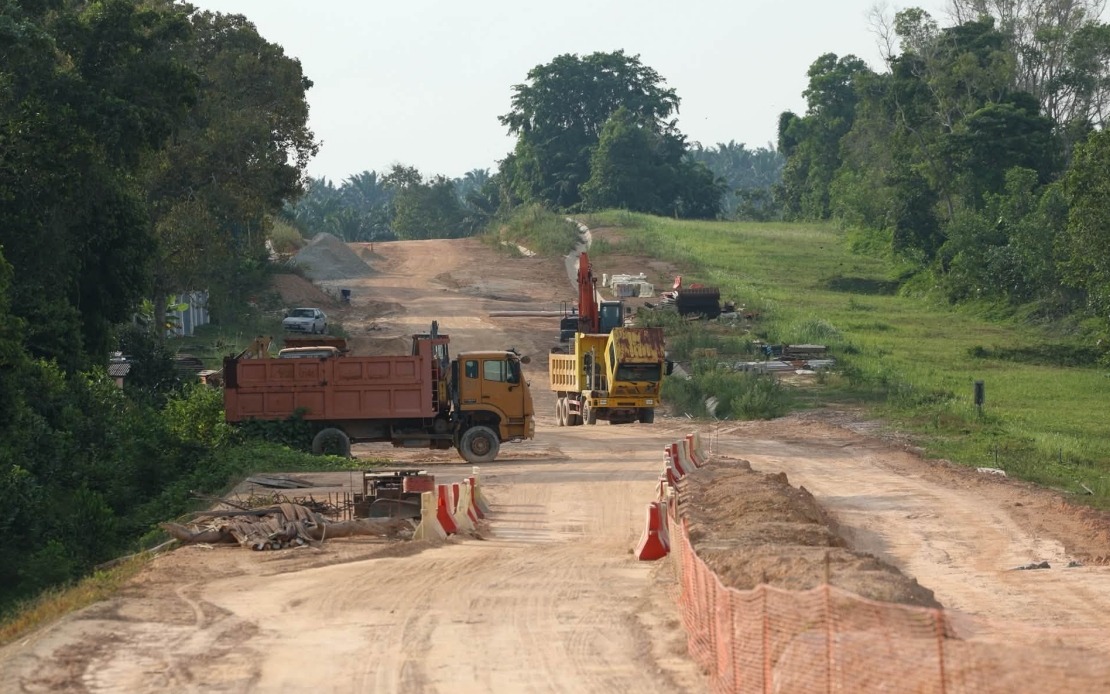
Construction of a major new road corridor stretching from Lukut through Kampung Sirusa, Kampung Paya and Kampung Bagan Pinang in Port Dickson has surpassed the halfway mark, with the Works Ministry reporting that the RM81.92 million infrastructure initiative is tracking significantly faster than originally planned. The 60.57 per cent completion rate represents a decisive pace that has enabled the project team to recover more than six weeks against the contracted timeline, a reflection of coordinated execution that bodes well for delivery by the August 10, 2027 deadline.
The 10-kilometre arterial route represents a substantial investment in Selangor's regional transport fabric, designed in accordance with Public Works Department specifications to accommodate comprehensive supporting infrastructure. Beyond the roadway itself, the project encompasses slope stabilisation works, modern drainage and sewerage systems, structural elements and utility installations that collectively aim to create a durable transport corridor meeting contemporary standards. This holistic engineering approach distinguishes the initiative from simpler resurfacing exercises, requiring careful orchestration of multiple construction disciplines across what has been described as challenging terrain.
Deputy Works Minister Datuk Seri Dr Ahmad Maslan's recent site inspection underscored the government's close monitoring of implementation progress. The ministerial visit served as both a validation checkpoint and a problem-solving mechanism, enabling officials to address field-level challenges that might otherwise accumulate into schedule delays or specification variances. Such high-level oversight during a project's execution phase signals commitment to maintaining quality standards and contractual compliance, particularly important for infrastructure works where design fidelity directly influences operational longevity.
For Port Dickson residents and businesses, the completion of this corridor will fundamentally reshape local mobility patterns. The road engineering will facilitate substantially faster transit times between currently dispersed settlements, reducing travel friction that has historically constrained social interaction and economic exchange. Safety improvements inherent in modern road design—better sight lines, improved drainage to prevent flooding hazards, and standardised geometric specifications—promise to lower accident rates compared to existing informal routes that many residents currently depend upon.
The project's broader strategic value extends well beyond convenience metrics. Port Dickson has long struggled with transport fragmentation that has hindered integrated economic development across the district. This new north-south corridor will knit together communities previously isolated by topography and limited connectivity, creating a continuous transport network that encourages movement of both people and goods. The Works Ministry explicitly framed the initiative as economically transformative, predicting that improved accessibility will attract commercial investment and expand market reach for local producers seeking to serve broader consumer bases.
Public services delivery stands to gain significantly from enhanced connectivity. Schools and clinics serving Port Dickson's scattered population will become more accessible to outlying areas, reducing the effective distance that residents must travel for education and healthcare. Tourist attractions, which represent an underutilised economic asset in Port Dickson, will benefit from improved visitor accessibility and circulation patterns. The cumulative effect will be a measurable improvement in service accessibility metrics across health, education and leisure sectors.
The project's financing structure through the Federal Government's development allocation and implementation partnership between the Ministry of Rural and Regional Development and the State Public Works Department reflects the integrated governance model increasingly characteristic of major Malaysian infrastructure initiatives. This vertical alignment between federal resources and state-level execution capacity aims to combine financial commitment with locally-grounded delivery expertise. For Southeast Asian observers, this model demonstrates how centre-periphery relationships can function productively when properly structured with clear mandates and oversight mechanisms.
The acceleration against the original schedule merits particular analytical attention in the context of Malaysian infrastructure delivery challenges. Over-runs have plagued numerous major projects, both within Malaysia and across the region, frequently reflecting under-estimation of site conditions, labour supply constraints or specification complexities. That this Port Dickson project is instead running ahead suggests effective pre-construction planning, adequate resource mobilisation and disciplined site management. The achievement warrants examination as a potential template for similar regional development initiatives.
Looking toward completion in 2027, the project will enter a critical phase where finishing elements—surface treatments, safety installations, landscaping and associated amenities—determine the actual user experience. Early schedule recovery, while encouraging, must be sustained through proper sequencing of these final components. The demonstrated capacity to date suggests confidence is warranted, though infrastructure projects remain vulnerable to unforeseen conditions that can emerge during later construction phases.
For Port Dickson's development trajectory, this road project represents a foundational investment upon which further economic clustering can build. The Ministry's emphasis on anticipated job creation and private investment attraction reflects the understanding that public infrastructure functions as a catalyst rather than a terminal economic stimulus. Businesses considering relocation or expansion decisions will have markedly improved assessment of Port Dickson's accessibility, potentially tilting investment calculus toward the district. The timing of accelerated completion could thus yield compounding benefits as the improved corridor becomes operational earlier than originally forecast, expanding the window for private sector response and investment initiation.

