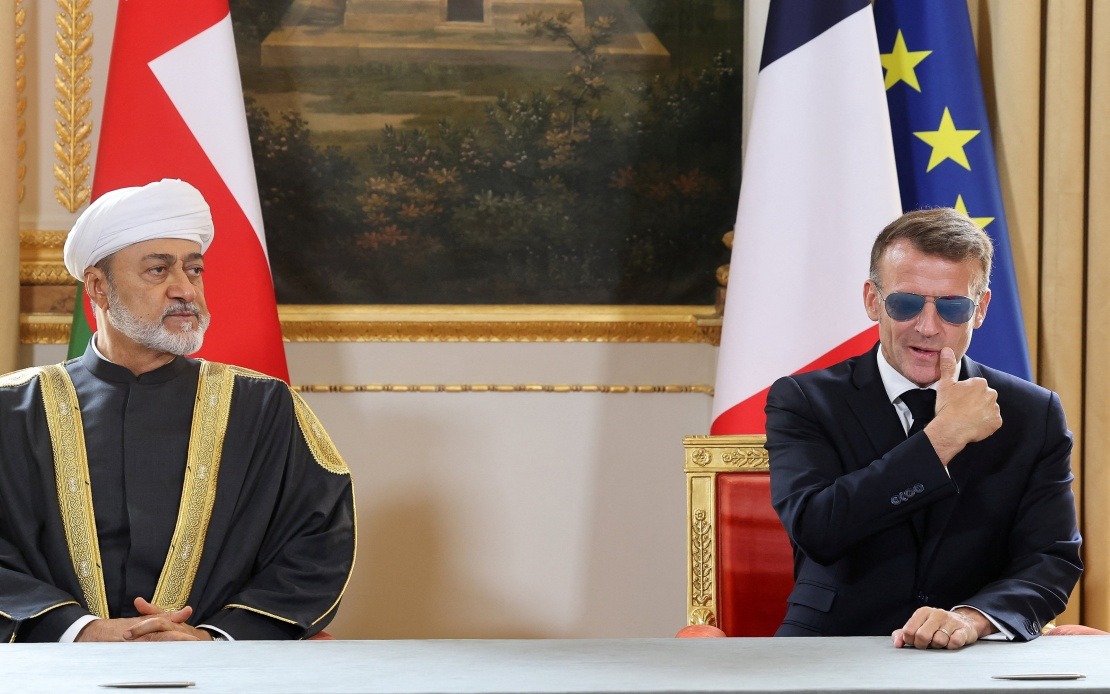
French President Emmanuel Macron's decision to wear aviator sunglasses during his meeting with Sultan Haitham bin Tariq of Oman on Monday has once again thrust the accessory into the spotlight, nearly half a year after the eyewear became an unlikely symbol of international intrigue and humour. The French leader wore the distinctive shades while receiving the Omani ruler outside the Élysée Palace, maintaining them throughout their subsequent bilateral discussions, an act that French media sources close to the presidency attributed to an ongoing eye condition rather than any fashion preference.
The medical explanation offered by Macron's inner circle provides context for what has become an unexpectedly persistent wardrobe item in the French president's public appearances. According to officials, Macron experienced a minor eye inflammation in January that necessitated the use of protective eyewear for approximately two weeks. The condition, while seemingly routine and common among many individuals, has acquired an outsized cultural significance due to the president's profile and the intense media scrutiny that accompanies his every move. The reappearance of the sunglasses, months after the initial medical episode appeared to have resolved, suggests either a recurrence of the inflammation or the president's continued caution regarding eye health.
The sunglasses first achieved international prominence during Macron's appearance at the World Economic Forum in Davos earlier this year, where the accessory transcended its practical purpose to become a subject of global commentary and jest. The eyewear drew particular mockery from United States President Donald Trump, who did not refrain from publicly commenting on the French leader's distinctive appearance. In France itself, the response was considerably more lighthearted, with citizens and media outlets drawing comparisons between Macron and the character Tom Cruise portrayed in the Mission: Impossible film franchise, a cultural reference that underscored the somewhat theatrical nature of the moment.
The impact of Macron's sunglasses on commercial interests has proven remarkable, demonstrating the peculiar intersections between political visibility and consumer demand in the modern media age. Henry Jullien, a French luxury eyewear manufacturer, reported a substantial increase in customer inquiries following the Davos incident, with consumers seeking to purchase the specific model worn by the French president. The company has capitalised on this unexpected publicity windfall by continuing to feature Macron in its promotional materials, leveraging the image of a world leader to drive sales—a marketing approach that would be difficult to engineer through conventional advertising channels.
For Southeast Asian observers, the episode offers insight into how Western political figures navigate the balance between personal health management and public perception in an era of constant visual documentation. The incident highlights the particular pressures faced by high-profile leaders whose most mundane decisions regarding personal wellness can transform into subjects of international commentary and cultural discourse. In the context of Malaysian and regional politics, where leaders equally face intense media scrutiny and social media amplification of their public appearances, the Macron sunglasses saga demonstrates how difficult it has become to maintain privacy around medical matters when one occupies a position of such visibility.
The continued reappearance of the sunglasses also raises questions about the nature of political communication and image management in contemporary governance. Whether Macron's decision to wear the aviators to meet Sultan Haitham bin Tariq represented a pragmatic medical necessity or a calculated choice to maintain consistency with an image that has acquired a certain familiarity remains a matter of interpretation. The ambiguity itself is perhaps instructive, suggesting that in the modern political arena, the line between authentic personal circumstances and deliberate image projection has become increasingly blurred and difficult to discern.
From a broader diplomatic perspective, the meeting between Macron and the Sultan of Oman carries significance beyond the eyewear controversy, representing engagement between France and a strategically important Gulf nation. Oman, under the leadership of Sultan Haitham bin Tariq who assumed power in 2020, has positioned itself as a mediator in regional disputes and maintains distinctive foreign policy independence within the Arabian Peninsula. France's bilateral relationship with Oman encompasses trade, defence cooperation, and cultural exchange, areas where direct high-level engagement such as this presidential meeting serves to reinforce diplomatic ties and explore avenues for expanded cooperation.
The luxury eyewear industry's response to the Macron phenomenon underscores broader trends in how consumer markets respond to celebrity and political visibility. Henry Jullien's decision to capitalise on the unexpected exposure through continued promotional association with the French president represents a savvy understanding of contemporary marketing dynamics, where authenticity and chance association can prove more valuable than expensive traditional advertising campaigns. For Malaysian luxury goods manufacturers and retailers, the episode offers lessons in how political visibility can be harnessed, whether intentionally or incidentally, to drive brand awareness and consumer interest.
Looking ahead, the question remains whether Macron's sunglasses will continue to generate international commentary or gradually fade into the background as the novelty diminishes. What seems certain is that the accessory has transcended its original purpose as medical equipment to become a recognisable symbol associated with the French president's image. Whether future appearances with the sunglasses will be interpreted primarily through a medical lens or continue to attract cultural commentary and commercial interest remains to be seen, but the Oman meeting suggests that the eyewear's journey through the international consciousness is far from concluded.

