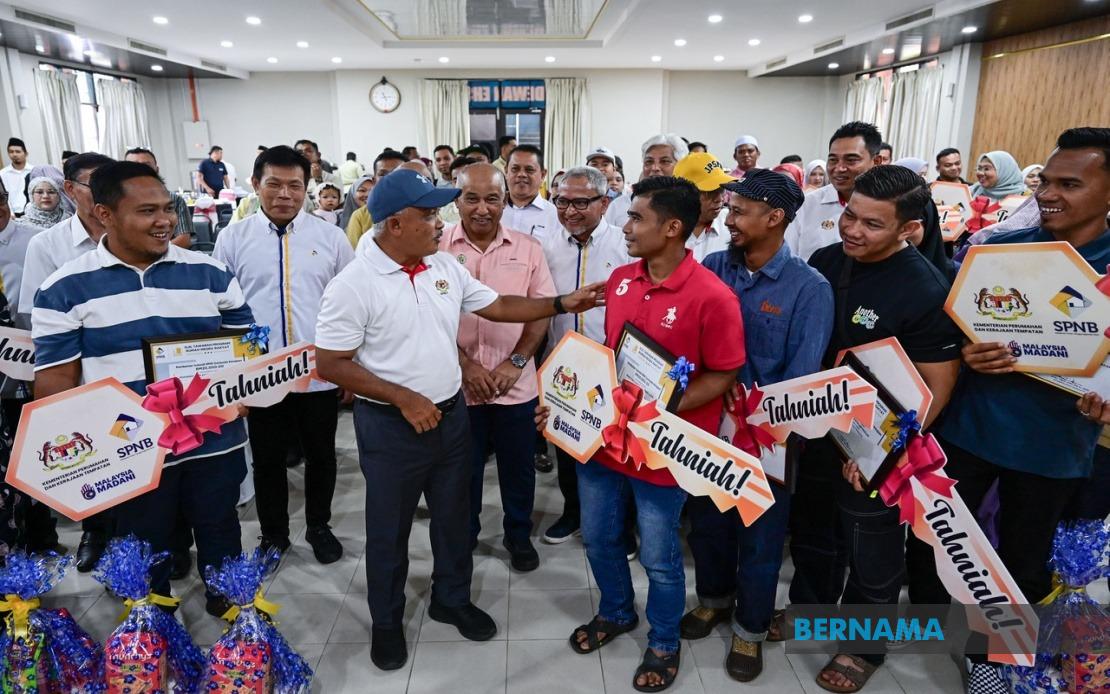
In a milestone moment for affordable housing delivery in East Coast Malaysia, fifty families in the Kuala Terengganu and Kuala Nerus parliamentary constituencies received assistance through the Rumah Mesra Rakyat (RMR) programme on June 28. The distribution comprised thirty completed homes ready for immediate occupation alongside twenty offer letters authorising the construction of additional residential units. The ceremony, conducted at Dewan Ehsan in Felda Wilayah Timur, underscores the administration's strategic focus on expanding homeownership among Malaysia's lower-income demographics.
The RMR initiative, administered by Syarikat Perumahan Negara Berhad (SPNB) under the Housing and Local Government Ministry (KPKT), targets a specific demographic—landowners without adequate housing—thereby combining asset ownership with improved living standards. According to Datuk Dr M. Noor Azman Taib, the ministry's secretary-general, this approach transcends conventional housing assistance by positioning homeownership as a pathway to enhanced family stability and community development. The programme recognises that secure, dignified housing forms the foundation upon which families build economic resilience and social participation.
National targets reveal the programme's expanding scope. Under the 2026 Budget allocation, the government intends to construct 6,545 RMR units across Malaysia. Progress to date shows 3,900 units either completed or under active development—comprising 2,478 finished dwellings already handed to families and 1,422 units in various construction phases. These figures demonstrate consistent momentum, though the gap between completed units and those still under construction suggests potential acceleration will be necessary to meet ambitious yearly targets. The delivery timeline becomes particularly significant for states like Terengganu, where housing demand among lower-income households remains substantial.
Terengganu's allocation reflects regional prioritisation. The state has received funding to implement 680 RMR units valued at RM46.67 million in total costs. By May of the current year, the programme had delivered 246 completed units to qualified recipients, with another 154 units actively under construction. This trajectory indicates Terengganu accounts for approximately ten percent of the national RMR deployment, positioning the state as a meaningful focus area for affordable housing expansion. The concentration of resources in Terengganu acknowledges both existing need and the state's economic characteristics where household incomes frequently fall within brackets eligible for subsidised housing.
Within Terengganu, implementation patterns differ between the two constituency areas receiving assistance. Kuala Terengganu parliamentary constituency hosts 34 implemented RMR units, of which eighteen have been completed and handed to families while sixteen remain under construction. Neighbouring Kuala Nerus contains 32 units with a higher completion rate—twenty-five finished dwellings and only seven pending construction. The variation in completion percentages suggests different project timelines and possibly phased development strategies tailored to local conditions and land availability. Both constituencies represent critical zones where affordable housing gaps constrain economic mobility and family welfare.
Historical context reveals the RMR programme's substantial track record. Since its establishment in 2002, the initiative has benefited more than 80,000 families nationwide, accumulating over two decades of implementation experience. This longevity contrasts sharply with newer housing schemes and demonstrates institutional capability in project delivery, beneficiary identification, and financial management. The twenty-year operational history provides confidence in programme sustainability and suggests refinements have occurred based on documented outcomes. For Malaysian policymakers evaluating housing intervention effectiveness, the RMR dataset offers measurable evidence that targeted assistance can meaningfully expand homeownership among previously excluded populations.
The policy rationale articulated by ministry officials emphasises housing's multiplier effects beyond shelter provision. Officials framed homeownership as catalysing improvements in quality of life, strengthening household economics, and building community cohesion. This conception aligns with international housing literature recognising that secure tenure and improved dwelling conditions generate positive externalities including improved health outcomes, enhanced educational performance among children, and increased labour market stability. The MADANI Government's rhetorical emphasis on these broader benefits signals sophisticated understanding that housing policy operates across multiple social and economic domains.
For Malaysian observers tracking affordability trends, the RMR programme's emphasis on landowner beneficiaries addresses a particular market gap often overlooked in conventional housing analysis. Many lower-income Malaysians own rural or semi-rural land but lack capital to construct adequate residential structures, creating situations where family members inhabit substandard dwellings despite holding property assets. The RMR targeting strategy converts dormant assets into functional housing, maximising utility from existing landownership patterns. This approach proves particularly relevant in states like Terengganu where smallholder agricultural properties and rural landholdings remain common among working-class populations.
Regional implications extend beyond Terengganu's borders. East Coast states including Kelantan, Pahang, and Terengganu experience analogous demographic and economic patterns—significant rural populations, lower average household incomes, and existing housing deficits. The RMR programme's demonstrated implementation capability in Terengganu provides a model for expansion throughout the broader region. As Southeast Asian nations grapple with urbanisation pressures and rural-urban economic disparities, Malaysia's experience with targeted affordable housing schemes offers instructive lessons. The RMR model balances direct government support with beneficiary asset utilisation, creating sustainable pathways to improved housing without generating dependency frameworks or market distortions typical of poorly designed subsidy regimes.
Government objectives articulated through this initiative reflect broader MADANI administration priorities emphasising inclusive growth and social protection. By concentrating resources on lower-income households and landowners, policymakers signal commitment to distributional equity alongside aggregate economic expansion. Housing, fundamentally, remains a barometer of government responsiveness to constituent welfare. The visible delivery of fifty completed and promised homes in a single ceremony generates tangible political capital while addressing material needs. For residents in Kuala Terengganu and Kuala Nerus, the RMR programme represents state recognition of their housing aspirations and institutional commitment to enabling homeownership regardless of income constraints.
Looking forward, the programme's trajectory depends on consistent funding, streamlined implementation processes, and sustained political commitment across electoral cycles. The 2026 Budget allocation of 6,545 units suggests continued prioritisation, though execution capacity will determine whether targets transform into delivered dwellings. For Malaysia's lower-income populations and for regional observers monitoring affordable housing innovation, the RMR programme's next phase will indicate whether targeted state intervention can durably reshape housing access patterns or whether structural economic factors will limit programme effectiveness. The Terengganu results demonstrate that institutional delivery is achievable; whether scaling proves equally effective remains the enduring question.

