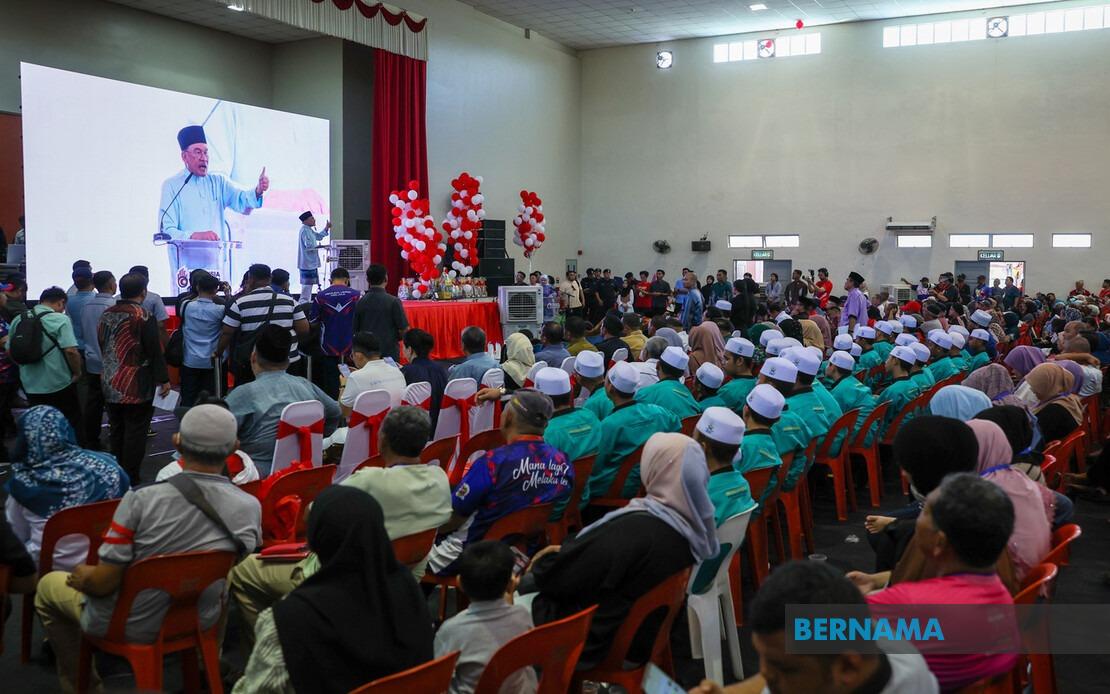
Prime Minister Datuk Seri Anwar Ibrahim has reiterated the government's pledge to distribute educational resources equitably among all communities and institution types, stating that the MADANI administration will not marginalise any segment of Malaysian society in this regard. Speaking at the Gelombang MADANI Carnival at Masjid Tanah Sports Complex in Alor Gajah, he emphasised that the recent boost in allocations for Islamic educational facilities reflects a correction of historical neglect rather than a departure from supporting vernacular education.
Anwar clarified that amplified investment in pondok schools and tahfiz institutions, many of which had languished without government backing for years, should not be interpreted as reduced commitment to Chinese and Tamil schools. He announced that dedicated funding packages for these vernacular institutions have already been finalised and will be unveiled in Kuala Lumpur within a fortnight, underlining the government's methodical approach to addressing longstanding educational disparities across different communities.
The Prime Minister contextualised this balanced resource allocation within a broader philosophical framework of preserving Malaysia's plural society. He argued that sustained intercommunal harmony depends fundamentally on ensuring that no group perceives itself as abandoned or deprioritised by the state. In his view, the threat to national stability emanates not from equitable treatment but from the corrosive effects of perceived discrimination and neglect, which breed suspicion and sectarian tension—dynamics that have destabilised plural societies elsewhere.
Drawing on Islamic theological concepts, Anwar referenced the notion of 'ummatan wasatan', or the balanced community mentioned in Surah Al-Baqarah, as the philosophical underpinning for the government's educational strategy. He argued that this principle extends beyond religious conduct to encompass institutional management, environmental stewardship, and ethical governance. By this logic, a truly balanced nation exhibits integrity, tackles corruption, manages resources efficiently, and respects environmental limits—standards by which other societies might measure themselves.
Anwar's remarks carry particular significance for Southeast Asia's ethnically heterogeneous societies, where education funding decisions frequently become flashpoints for communal grievance. Malaysia's experience of managing multiple education systems—national, Chinese, Tamil, Islamic, and international—presents a model of simultaneous funding that other pluralistic democracies in the region observe closely. The government's public commitment to transparent timelines for vernacular school announcements appears designed to preempt the interpretation that Islamic education prioritisation signals a shift in national priorities.
The Prime Minister outlined the trajectory of support for Islamic educational institutions since the Unity Government's formation in 2022. After a period when such assistance had been discontinued, the administration reinstated funding in 2023 and has expanded allocations through 2024. This progression reflects both a deliberate policy decision and perhaps an acknowledgement that certain constituencies felt their educational institutions had been systematically overlooked. By framing this as restoration rather than privileging, Anwar positions the government as correcting a historical imbalance.
One substantive announcement at the Alor Gajah event was the allocation of RM1.29 million distributed among thirteen Islamic educational institutions across Melaka state. Recipients included Madrasah Tahfiz Al-Quran Wal Qiraat Kota Melaka, which received RM250,000, and Sekolah Rendah Arab JAIM Pernu, allocated RM200,000. The remaining institutions received smaller tranches, with amounts ranging down to RM100,000. These funds are earmarked specifically for infrastructure upgrades rather than operational subsidies, suggesting the government's focus on improving physical facilities and learning environments.
A particularly noteworthy component of Anwar's remarks centred on modernising Islamic educational content and delivery. He highlighted initiatives to introduce artificial intelligence and computer training within pondok schools, addressing a critical gap between these institutions and better-resourced national and vernacular schools. Without such technological integration, he argued, Islamic educational institutions risk becoming educationally marginalised despite receiving funding, perpetuating a two-tier system in which students from different school types exit with divergent digital literacy and contemporary skills.
The event itself served as a platform for demonstrating government commitment to Melaka, with the attendance of the Prime Minister's wife Datuk Seri Dr Wan Azizah Wan Ismail, Melaka Chief Minister Datuk Seri Ab Rauf Yusoh, and Deputy Higher Education Minister Adam Adli Abdul Halim. This high-level representation underscores the political importance the administration attaches to education policy messaging and suggests that educational equity will remain a prominent theme in government communications.
For Malaysian policymakers and educational administrators, Anwar's remarks establish clear parameters for resource allocation: funds should flow based on identified gaps and historical underinvestment rather than communal preference. This principle, if consistently applied, would require regular audits of funding disparities across school types and transparent methodologies for allocating new resources. It also creates measurable commitments—the promised announcement regarding vernacular school allocations becomes a barometer against which subsequent government action will be judged.
The timing of these statements is noteworthy given that educational policy remains contentious across Malaysian politics. Different political coalitions have at various points emphasised different educational streams, and shifts in funding priorities often trigger swift political response. By publicly committing to vernacular school announcements and linking Islamic institutional support to correcting historical underinvestment, Anwar attempts to establish a narrative framework within which such spending decisions appear politically neutral rather than communally partisan.
Looking forward, the success of this balanced approach will depend on consistent execution. The two-week timeline for announcing vernacular school allocations provides a concrete deadline against which government credibility will be measured. Additionally, the depth of funding for Chinese and Tamil schools relative to Islamic institutions will inevitably be scrutinised by stakeholders who perceive any disparity as evidence of shifting priorities. The government's ability to explain resource allocation decisions transparently and withstand accusations of bias from multiple directions will test the sustainability of its education equity framework.

