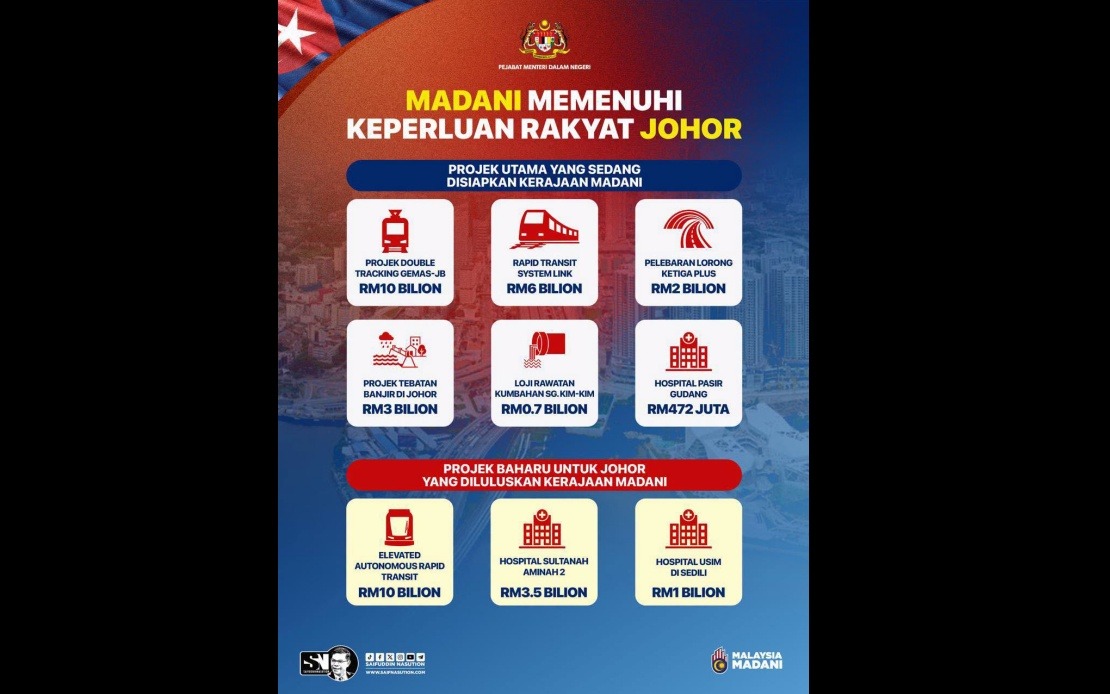
The MADANI Government remains steadfast in its resolve to deliver broad-based and sustainable development across Malaysia's states, with Johor positioned as a key beneficiary of this nationwide strategy. Pakatan Harapan secretary-general Datuk Seri Saifuddin Nasution Ismail, speaking in Johor Bahru, underscored that Prime Minister Datuk Seri Anwar Ibrahim's administration views development as a holistic endeavour designed to enhance living standards for all Malaysians. This commitment extends beyond mere fiscal allocation to encompass tangible improvements in connectivity, healthcare delivery, environmental resilience, and economic opportunity across every corner of the federation.
The government's development philosophy rests on four foundational pillars that address Malaysia's most pressing infrastructure and social needs. Investment in transportation networks forms a centrepiece of this agenda, with the conviction that improved mobility generates cascading benefits throughout communities and regional economies. Public health infrastructure receives parallel emphasis, reflecting recognition that accessible, quality healthcare is indivisible from national development. Equally, flood mitigation receives substantial attention—a priority that resonates powerfully in Johor and other flood-prone regions where climate variability poses genuine risks to homes, livelihoods, and economic activity. This integrated approach signals that the MADANI Government views development not as a single-dimensional pursuit of growth metrics, but as a symphony of interventions addressing interconnected challenges.
Johor's trajectory under the current administration exemplifies this multifaceted development model. The Gemas-Johor Bahru Electrified Double Tracking Project represents a substantial commitment to rail modernisation, enhancing freight and passenger capacity while reducing transportation costs and environmental impact. The Rapid Transit System (RTS) Link directly addresses urban mobility constraints, particularly in the Johor Bahru metropolitan region, where congestion has long constrained economic productivity and quality of life. Simultaneously, the third lane widening of the PLUS Highway addresses critical highway bottlenecks that affect both local commerce and cross-border regional trade. Together, these transport initiatives constitute a transformative package for one of Malaysia's most economically dynamic states.
Water security and public health infrastructure equally feature prominently in Johor's development slate. The Johor flood mitigation project directly protects communities and productive assets from increasingly severe weather events—a priority sharpened by the state's recurring vulnerability to inundation. The Sungai Kim Kim Sewage Treatment Plant addresses water quality concerns that affect both public health and environmental sustainability in the region. These investments signal that infrastructure development in contemporary Malaysia encompasses not only high-visibility projects but also unglamorous yet essential systems that safeguard environmental health and community wellbeing.
The government's recent approval of additional flagship projects amplifies this commitment further. The Elevated Autonomous Rapid Transit system represents a forward-thinking investment in smart urban transport, positioning Johor as a testbed for innovative mobility solutions that may eventually serve other Malaysian cities. Sultanah Aminah Hospital 2 and USIM Hospital in Sedili directly expand healthcare capacity in growing population centres, addressing the perennial challenge of equitable health service distribution across Malaysia's geography. These announcements demonstrate that development momentum is accelerating rather than plateauing, with the pipeline of future projects ensuring sustained investment and employment generation.
Crucially, Saifuddin Nasution's articulation of development philosophy emphasises that infrastructure and investment outlays represent merely the mechanism through which genuine development occurs. The real measure of development success, he stressed, materialises in concrete improvements to citizens' lived experience. Job creation through project implementation generates immediate household income while building human capital and skills. More efficient transportation systems translate into time savings and reduced logistical costs for businesses and commuters alike. Expanded and upgraded healthcare facilities shrink waiting times, improve treatment outcomes, and reduce the financial stress of medical emergencies on ordinary families. These are not abstract metrics but tangible dimensions of development that register directly in people's daily lives and long-term prospects.
For Malaysian readers, particularly those in Johor and comparable growth regions, these developments carry significant implications. The scale of infrastructure investment signals that the federal government views regional development not as a zero-sum competition between states but as a coordinated national endeavour. Johor's prominence in this development pipeline reflects both the state's economic significance as a major industrial and commercial centre and the political imperative to demonstrate equitable distribution of federal resources. The emphasis on public transportation, healthcare, and disaster resilience suggests a governing philosophy that prioritises essential services over vanity projects—an approach that should yield sustainable returns and broadly distributed benefits rather than concentrated elite advantages.
The broader Southeast Asian context adds further resonance to this development narrative. As regional economies grapple with infrastructure deficits, climate vulnerability, and rapid urbanisation, Malaysia's integrated approach to transport, health, and environmental resilience offers instructive lessons. The emphasis on electrified rail, autonomous rapid transit systems, and flood mitigation reflects adaptation to contemporary economic and environmental imperatives. For Malaysian businesses and investors, this development pipeline creates opportunities across construction, manufacturing, services, and technology sectors. For regional observers, it demonstrates a commitment to positioning Malaysia as a forward-facing economy capable of balancing growth ambitions with livability and sustainability imperatives.
The long-term success of the MADANI Government's development agenda will ultimately be measured not by the impressiveness of project announcements but by whether these investments meaningfully reshape opportunity structures and quality of life outcomes. The focus on inclusive development—ensuring that prosperity reaches all citizens rather than concentrating in particular regions or demographic segments—represents a significant departure from more narrowly targeted approaches. Implementation quality, timely project completion, and rigorous attention to operational efficiency will determine whether these ambitious plans translate into the tangible community benefits that Saifuddin Nasution promised. For Johor and other Malaysian states, the next phase involves translating this governmental commitment into projects that demonstrably improve connectivity, healthcare access, environmental protection, and economic opportunity for ordinary Malaysians.

