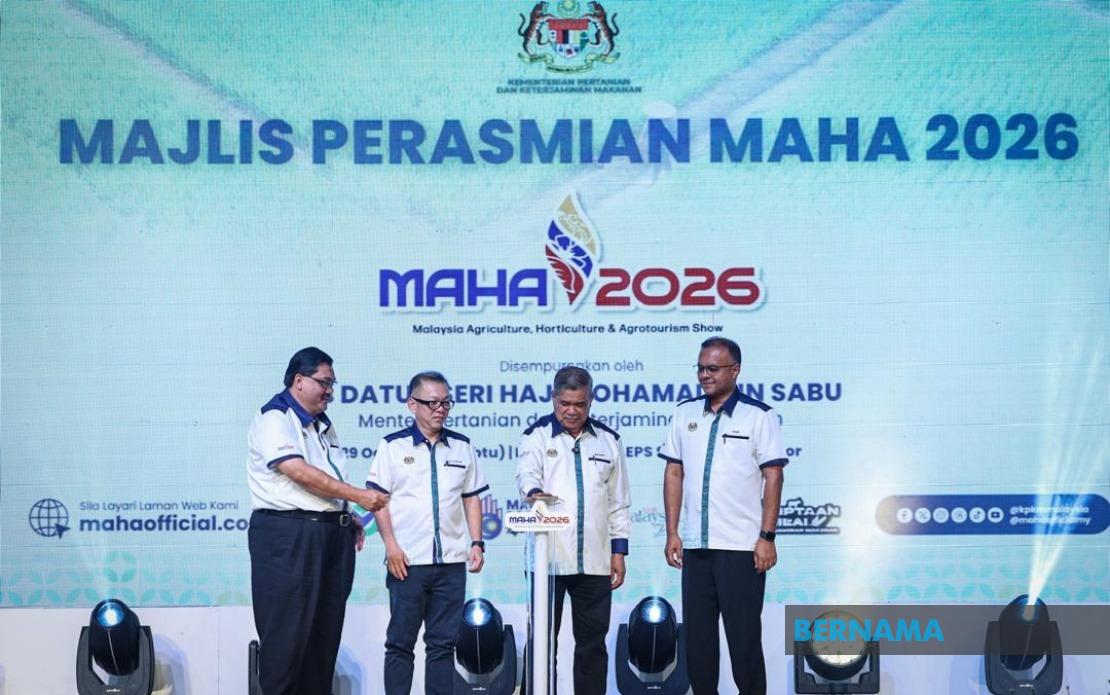
MAHA 2026, opening its doors at the Malaysia Agro Exposition Park Serdang (MAEPS) this week, represents far more than a routine industry showcase. According to Agriculture and Food Security Minister Datuk Seri Mohamad Sabu, the biennial gathering signals a fundamental shift in how Malaysia approaches its agricultural future, with sustainability at the centre of a reimagined national strategy. Speaking at the event's opening ceremony on Thursday, Mohamad underscored that the nation's farming sector must abandon old patterns and embrace environmental responsibility as a non-negotiable imperative.
The minister's framing of MAHA 2026 as a turning point reflects mounting pressure on Malaysia to reconcile agricultural productivity with climate imperatives. Sustainable farming practices, he emphasized, offer dual benefits: they help slash the country's carbon footprint while addressing the intensifying effects of global warming. More pragmatically, greener practices strengthen the commercial appeal of Malaysian produce, making it more competitive both domestically and in international markets increasingly sensitive to environmental credentials. By tethering sustainability to economic advantage, Mohamad sought to convince farmers and agribusiness operators that environmental stewardship and profitability are complementary rather than competing goals.
At MAEPS through September 6, the expo will showcase concrete manifestations of sustainable agriculture across multiple domains. Exhibitors and participating entities are spotlighting innovations in energy efficiency, systematic approaches to waste reduction and food loss prevention, the phase-out of single-use plastics throughout supply chains, regenerative farming techniques that restore soil health, and circular economy principles embedded in recycling initiatives. These are not peripheral concerns but central themes that organisers have woven throughout the event's programming, signalling a sector-wide recalibration. With approximately 2,000 exhibitors and projections exceeding four million visitors, MAHA 2026 commands sufficient scale and visibility to influence industry norms and consumer expectations alike.
Parallel to environmental objectives, Mohamad revived the philosophical foundations of Malaysia's Green Book Policy, a blueprint authored in 1974 under the late Tun Abdul Razak's administration. That framework sought to curtail reliance on imported foodstuffs while moderating consumer price pressures by boosting domestic production capacity. More than five decades later, this doctrine retains relevance—perhaps even heightened relevance given regional supply chain volatility and inflationary pressures on household budgets. The minister called on Malaysians to reinvigorate collective commitment to self-sufficiency, recognising that food security remains intertwined with economic stability and national resilience. Reviving this narrative around a 50-year-old policy signals that foundational goals of agricultural policy remain unmet, inviting both reflection on past implementation gaps and renewed determination to achieve them.
To operationalise these ambitions, the government has charted modernisation pathways across fisheries and livestock production. Capital investments in upgraded fishing vessels, contemporary farm infrastructure, and high-value aquaculture ventures aim to boost productivity and quality. Technological adoption in animal feed manufacturing, coupled with rigorous biosecurity frameworks designed to contain disease outbreaks, addresses vulnerabilities that have periodically devastated livestock sectors throughout Southeast Asia. These measures reflect a maturation of agricultural policy beyond simple expansion toward efficiency and risk mitigation. The integration of biosecurity into development strategy acknowledges hard-earned lessons from regional disease incidents that have periodically disrupted supply chains and incurred substantial economic losses.
Internationalisation constitutes another pillar of MAHA 2026's strategic positioning. Delegations from 14 countries are participating in the event, creating platforms for forging cooperative arrangements and formalising bilateral or multilateral agreements. Mohamad, however, adopted a notably sceptical tone toward the ceremonial dimension of such collaborations. He stressed that memoranda of understanding, while symbolically significant, must translate into demonstrable outcomes—not merely ink on paper. This pragmatic insistence reflects frustration, common across developing nations, that international commitments frequently atrophy post-signature, yielding little tangible economic benefit to participating parties. The minister's expectation that agreements yield expanded export opportunities and attract investment capital for domestic agritech entrepreneurs and established businesses alike suggests a determination to leverage diplomatic platforms for concrete commercial gain.
The innovation ecosystem constitutes an emerging focus within Malaysia's agricultural strategy. Mohamad specifically highlighted agritech start-ups and emerging entrepreneurs as constituencies meriting investment inflows from both local and international venture capital sources. This emphasis acknowledges that technological disruption and novel business models increasingly drive sectoral transformation. Early-stage companies focusing on precision agriculture, data analytics, controlled environment farming, and supply chain optimisation represent the vanguard of modernisation. By explicitly promoting their participation in MAHA 2026 and facilitating investment connections, the ministry signals recognition that traditional large-scale operators, whilst important, cannot single-handedly deliver the transformations required. Start-ups bring agility, innovation appetite, and digital fluency that incumbents occasionally lack.
The scale of MAHA 2026 underscores agriculture's continued centrality to Malaysia's economic and social fabric. Assembling nearly 2,000 exhibitors and anticipated visitor numbers exceeding four million positions the event among Southeast Asia's most consequential sectoral gatherings. Such magnitude reflects agriculture's significance not merely as an economic sector but as a cultural touchstone and livelihood anchor for millions of Malaysians. The expo functions simultaneously as marketplace, knowledge platform, policy stage, and national conversation venue about agriculture's future orientation. This multifaceted role distinguishes major agricultural expos from narrower industry conferences, vesting them with broader societal importance.
For Malaysian policymakers and industry participants, MAHA 2026 encapsulates a strategic inflection point. The convergence of climate imperatives, global trade shifts favoring environmentally conscious production, domestic food security concerns, and technological disruption has created conditions where incremental adjustments no longer suffice. Mohamad's framing of the event as heralding a new chapter implicitly acknowledges that the sector's existing trajectory is inadequate. Whether MAHA 2026 proves the catalyst for substantive transformation or merely another staging ground for familiar pledges remains contingent on translating ministerial rhetoric and exhibitor innovations into durable institutional change. For regional observers monitoring Malaysia's agricultural evolution, the coming weeks will offer revealing indicators of the nation's commitment to articulated priorities. Success demands not simply innovation adoption or policy announcements, but structural reorientation reaching farmers in rice fields and aquaculture ponds, supply chain operators managing logistics networks, and consumers making purchasing decisions shaped by environmental consciousness and food security anxieties.

