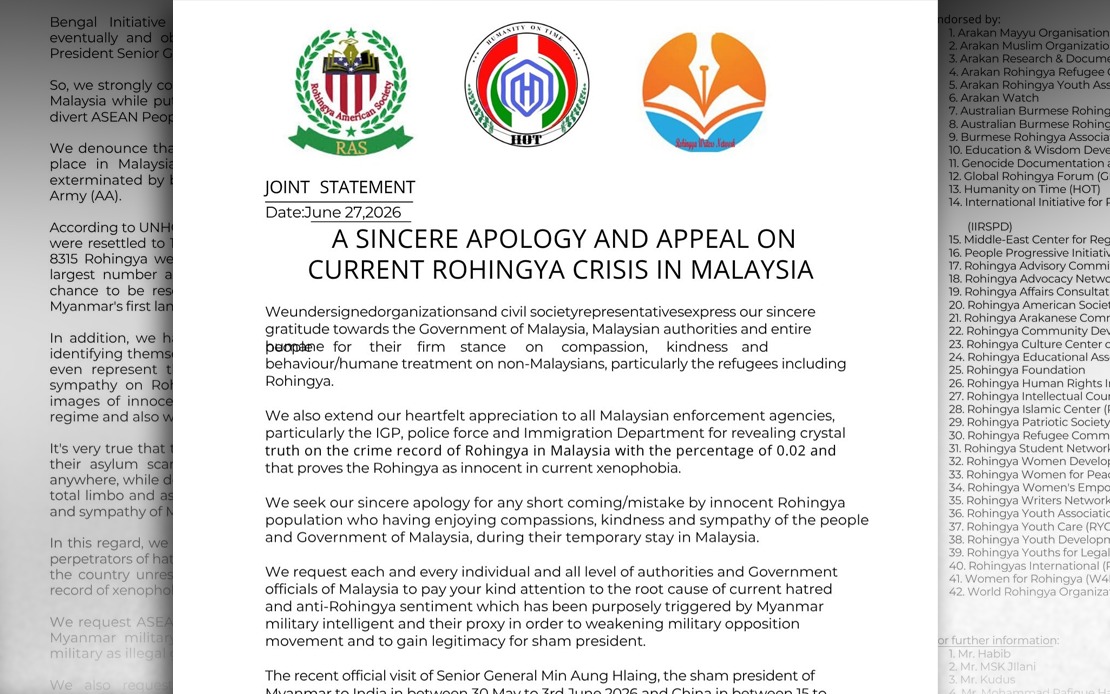
Malaysian Humanitarian Aid and Relief (MAHAR) has expressed satisfaction with an apology issued by 40 Rohingya non-governmental organisations, characterising the gesture as a meaningful acknowledgment of responsibility from the community. However, the organisation has used the moment to outline a more comprehensive vision for humanitarian engagement that extends well beyond conventional relief work, signalling growing expectations for how aid groups should operate within Malaysia's complex social landscape.
At the heart of MAHAR's message is a fundamental redefinition of humanitarian responsibility. Rather than limiting their activities to distributing food parcels and constructing temporary shelters—the traditional pillars of refugee assistance—the organisation contends that NGOs must become educators and cultural ambassadors. This approach recognises that sustained integration of refugee populations depends not merely on meeting material needs but on fostering mutual understanding and respect across deep divides in values, legal systems, and lived experience.
The appeal for Rohingya NGOs to strengthen community education initiatives reflects a pragmatic understanding of Malaysian social dynamics. Refugee populations living in Malaysia navigate a complex web of local customs and legal frameworks that differ substantially from their home contexts. MAHAR's position suggests that gaps in awareness about Malaysian law, social expectations, and cultural norms can create friction points between refugee communities and their neighbours, undermining long-term coexistence. By positioning NGOs as bridges that facilitate this understanding, the organisation implicitly acknowledges that successful humanitarian work now requires managing not just material poverty but cultural and legal literacy.
Equally significant is MAHAR's emphasis on intensifying international advocacy to address the root causes of the Rohingya crisis. This call recognises a critical gap in Malaysia's humanitarian response: while domestic NGOs provide essential services to those who have already fled persecution, relatively fewer resources flow toward confronting the systemic persecution that drives displacement. MAHAR's position aligns with broader international consensus that sustainable solutions require not only assisting displaced populations but also creating conditions that might eventually allow safe repatriation. For Malaysian activists and policymakers, this represents a reminder that generosity to refugees is incomplete without sustained pressure on the governments responsible for their displacement.
Jismi Johari, MAHAR's president, has articulated a framework for understanding community safety concerns that reflects sophisticated political thinking. Rather than dismissing safety worries as xenophobic or unfounded, he has legitimised them as legitimate concerns worthy of serious engagement. This move is strategically important because it creates space for dialogue between refugee advocates and those who fear or distrust newcomer populations. By acknowledging that safety matters for both refugee and host communities, Johari has positioned humanitarian work not as charity extended from a position of moral superiority, but as a reciprocal responsibility that benefits all residents.
Simultaneously, MAHAR has pushed back against blanket condemnation of refugee populations. The statement warning against generalisation—the principle that entire communities should not be judged by the actions of isolated individuals—addresses a persistent challenge in refugee integration. Negative incidents involving any member of a refugee population often trigger broader suspicion of entire ethnic or religious groups, undermining social cohesion and making life more difficult for law-abiding refugees. MAHAR's emphasis on fairness in judgment recognises that stereotyping operates in both directions and erodes the foundation for peaceful coexistence.
The framing of this position carries implications for Malaysian society's capacity to host vulnerable populations. As regional displacement pressures intensify due to conflicts in Myanmar, Afghanistan, and Palestine, Malaysia's approach to integrating existing refugee communities will shape its ability and willingness to provide sanctuary in the future. If local communities perceive that refugee populations are unresponsive to integration efforts or dismissive of Malaysian values, political pressure to restrict refugee intake could intensify. Conversely, evidence of genuine community engagement and mutual respect strengthens the social compact that underpins asylum provision.
MAHAR's framework also reflects evolving global practice in humanitarian response. Contemporary aid organisations increasingly recognise that sustainable development requires addressing not only immediate needs but also underlying social, legal, and political conditions. This evolution acknowledges that food and shelter, while essential, do not automatically create stable, cohesive communities. The organisation's emphasis on education, advocacy, and mutual respect suggests maturation in how Malaysia's humanitarian sector approaches its responsibilities.
The apology from 40 Rohingya NGOs that prompted this statement represents an important accountability moment, though the specific incidents that triggered the apology remain somewhat opaque from available reporting. What is clear is that MAHAR has seized the opportunity to establish clearer expectations for how NGOs should operate. These expectations—encompassing civic education, cultural integration, safety concerns, and persistent international advocacy—establish a comprehensive agenda that holds refugee-led and refugee-focused organisations accountable for outcomes beyond traditional service delivery metrics.
Moving forward, the dialogue MAHAR has initiated will likely influence how other Malaysian institutions approach refugee integration. Government agencies, private sector stakeholders, and civil society organisations may increasingly expect that humanitarian work incorporates these broader dimensions. For refugee communities themselves, the message is that acceptance in Malaysia requires not just compliance but active participation in building understanding and respect across community lines. The organisation's emphasis on justice, safety, and dignity as overarching principles suggests that meaningful integration serves the interests of all stakeholders, creating conditions where both refugees and host communities can coexist with greater security and mutual regard.

