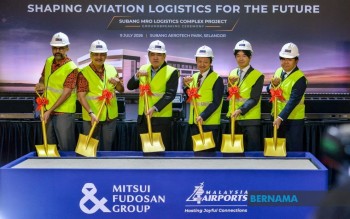
Malaysia Airports Holdings Bhd (MAHB) and Japan's Mitsui Fudosan Group have joined forces on a RM80 million development project to establish a dedicated air cargo logistics complex at Subang Airport, marking a significant expansion in the country's air freight infrastructure. The partnership, which held its groundbreaking ceremony on Thursday, reflects a growing recognition that Malaysia's aviation hubs require modern, purpose-built facilities to compete regionally and globally for cargo business and aerospace sector growth.
Under the joint venture structure, MAHB will retain a 30 per cent ownership stake while Mitsui Fudosan assumes control with 70 per cent, creating a clear operational framework where the Japanese multinational brings its extensive experience in developing and managing logistics facilities. The entity driving the project, MFMA Industrial Sdn Bhd, represents a collaborative approach that pairs MAHB's strategic ownership of airport land and infrastructure with a partner possessing proven expertise in complex aviation logistics environments.
Transport Minister Anthony Loke Siew Fook outlined the rationale for bringing in Mitsui Fudosan, emphasizing that the arrangement aligns with MAHB's broader asset monetization strategy. By leveraging airport land holdings through partnerships with experienced logistics developers, the government-linked company can accelerate infrastructure improvements while distributing financial risk. Loke specifically highlighted Mitsui Fudosan's track record in Japan, where the company has successfully constructed and operated similar facilities at Haneda Airport, Tokyo's major aviation hub.
The facility will be situated within Subang Aerotech Park, an industrial zone explicitly designed to accommodate aviation and aerospace-related enterprises. This geographical concentration reflects Malaysian aviation policy's push to create specialized clusters where complementary businesses can operate synergistically, from maintenance and repair operations to cargo handling and logistics support. The complex will serve as an additional revenue stream for MAHB beyond traditional airport passenger and landing fees, diversifying the company's income sources in an increasingly competitive aviation landscape.
Subang Airport, despite its age and limited passenger capacity, has retained strategic importance in Malaysia's aviation infrastructure network, particularly for cargo operations and specialized aircraft services. The airport has traditionally served regional freight carriers and provides a testing ground for MAHB's asset development initiatives without the disruption challenges that come with major overhauls at busier international terminals like Kuala Lumpur International Airport. This makes Subang an ideal location for pioneering new commercial models in airport logistics.
Mitsui Fudosan's involvement signals growing Japanese interest in Malaysia's logistics and aviation sectors. The Tokyo-headquartered conglomerate operates across real estate development, retail, and logistics throughout Asia-Pacific, positioning it as a valuable bridge between Malaysian airport operators and international best practices in facility management. Their experience at Haneda—one of Asia's most technologically advanced and efficiently operated airports—provides a template that MAHB can adapt to Subang's operational environment.
The RM80 million investment represents moderate-scale infrastructure development compared to Malaysia's mega-projects, but its significance lies in addressing specific sectoral needs. Modern air cargo facilities require specialized handling equipment, sophisticated tracking systems, and climate-controlled environments to accommodate temperature-sensitive shipments such as pharmaceuticals and perishables. These requirements have become increasingly stringent as regional supply chains grow more complex and time-sensitive, particularly post-pandemic when air freight premiums incentivized investments in cargo infrastructure.
For Southeast Asian logistics operators and international freight forwarders, the Subang complex represents an additional node in Malaysia's air cargo network. Kuala Lumpur International Airport remains the region's primary cargo hub, but adding capacity at secondary airports distributes handling operations and reduces congestion while offering operators flexibility in routing shipments through Malaysia. This redundancy enhances Malaysia's competitiveness against Singapore's Changi Airport and Bangkok's Suvarnabhumi, both of which have invested heavily in cargo infrastructure over recent years.
The partnership model employed here—a minority stake held by the airport operator paired with majority control by a specialized logistics developer—differs from purely government-controlled or fully privatized approaches. This hybrid structure allows MAHB to participate in upside gains while transferring operational responsibility to an entity with genuine expertise and financial incentive to optimize facility performance. For investors and operators evaluating Malaysia's commitment to aviation infrastructure modernization, the arrangement demonstrates a pragmatic willingness to collaborate with foreign expertise rather than insisting on local control.
The Subang MRO Logistics Complex Project also signals MAHB's recognition that future airport revenues depend less on passenger volume growth than on developing specialized, high-margin services. Maintenance, repair, and overhaul operations for aircraft represent valuable business segments where Malaysia can compete regionally, particularly as Southeast Asian airlines age their fleets and require regular servicing. By pairing MRO capabilities with integrated logistics facilities, MAHB creates a complete ecosystem for aerospace businesses.
Looking ahead, this venture will likely influence MAHB's approach to other underutilized airport assets throughout Malaysia. If the Subang complex proves operationally and financially successful, similar partnerships could be extended to other airports within the MAHB network, including Penang, Johor Bahru, and Kota Kinabalu, each of which possesses land suitable for logistics development. The partnership template also demonstrates how Malaysia can attract foreign investment into infrastructure without requiring full asset control, a approach relevant beyond aviation to ports, industrial parks, and transportation hubs.

