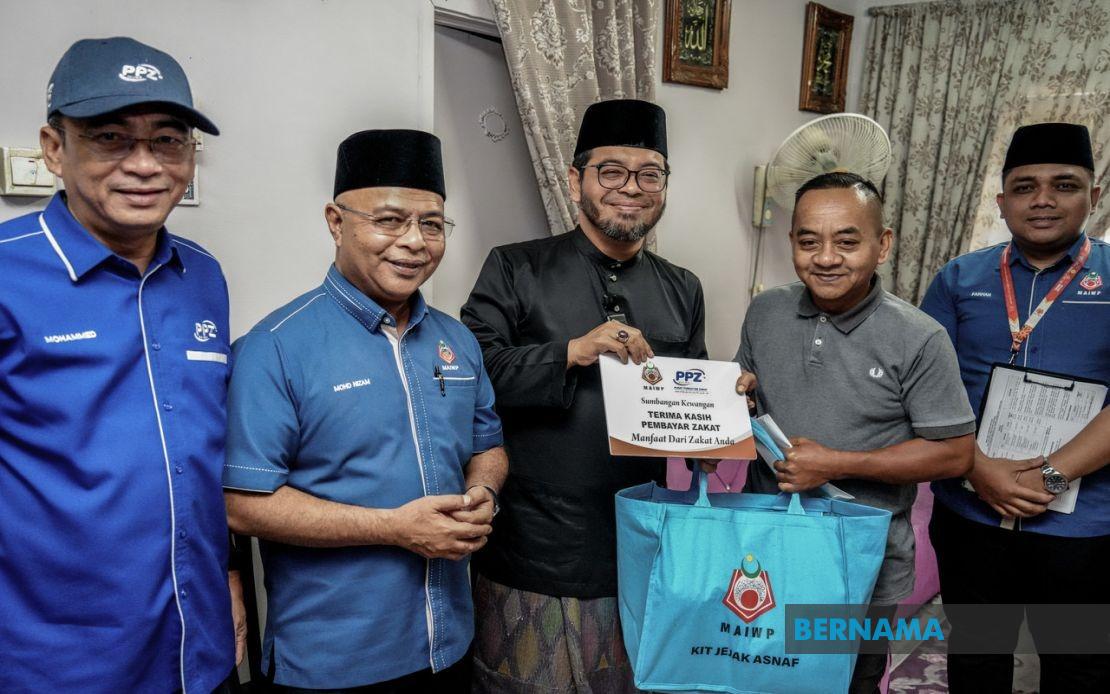
The Federal Territories Islamic Religious Council (MAIWP) has undertaken a hands-on initiative to support families facing acute hardship, beginning with a widow who recently lost her husband and is now caring for five children ranging in age from six to fifteen years old. The tragic loss occurred early this month, leaving the family without a primary income earner and forcing difficult adjustments to their daily lives. Through direct engagement with the affected household, MAIWP has structured a comprehensive assistance package encompassing monthly living allowances, rental support, and educational subsidies designed to stabilise the family's immediate circumstances.
Senator Datuk Dr Zulkifli Hasan, serving as Minister in the Prime Minister's Department (Religious Affairs), has emphasised that MAIWP's approach of conducting site visits and conducting personal assessments forms an essential component of effective welfare delivery. This ground-level engagement allows the council to move beyond standard bureaucratic procedures and grasp the genuine complexities facing aid recipients, ensuring that assistance distributed actually addresses pressing needs rather than operating according to standardised templates. The minister underscored this philosophy during remarks made to reporters following his inspection of the families receiving support.
Beyond the widow's household, MAIWP has expanded its reach to encompass multiple family structures dealing with distinct but overlapping economic pressures. One beneficiary household consists of a married couple with eight school-age children, where the father maintains employment with Kuala Lumpur City Hall (DBKL) as a driver while his wife remains home managing the household. Despite stable employment, the family's substantial size strains their capacity to address both routine healthcare expenses and educational costs. The council has responded by providing monthly assistance covering medical necessities such as diapers and diabetic supplies, alongside support for mobility equipment like wheelchairs and scholarship assistance for schooling purposes.
A third family receiving assistance comprises a divorced single mother who has raised three school-age children independently since separating in 2018. Her circumstances illustrate the persistent vulnerabilities many women face following marriage dissolution, as her solo responsibility for both income generation and childcare leaves minimal financial room for unexpected expenses. MAIWP's intervention includes regular cost-of-living transfers coupled with essential provisions covering basic necessities, school-related expenses, and educational materials—assistance that permits her children to remain enrolled despite the family's constrained budget.
The targeting of assistance toward education represents a deliberate policy focus within MAIWP's broader welfare strategy. Each family in the council's support network receives dedicated schooling aid, reflecting an institutional understanding that educational continuity during periods of family crisis prevents intergenerational poverty cycles. By subsidising school fees, uniforms, and learning materials, MAIWP addresses both immediate household cash flow pressures and longer-term social mobility objectives, recognising that children who remain in education despite family hardship retain better economic prospects into adulthood.
Minister Zulkifli's characterisation of these initiatives as part of broader community support mechanisms reflects MAIWP's expansion beyond strictly religious functions into comprehensive social welfare provision. The council frames its financial distributions not merely as charitable acts but as strategic investments in community stability and institutional legitimacy. By demonstrating tangible responsiveness to household vulnerability, MAIWP reinforces public confidence in Islamic institutions' capacity to address contemporary social challenges, differentiating faith-based welfare provision from government-administered assistance.
The cumulative financial commitment underlying these interventions becomes apparent when examining MAIWP's historical disbursement patterns. As of August 12, 2026, the council had distributed RM699.57 million cumulatively through its assistance programmes, a substantial figure reflecting years of consistent resource allocation toward vulnerable populations across the Federal Territories. This magnitude suggests that MAIWP operates as a significant welfare provider within Malaysia's mixed ecosystem of government, non-governmental, and faith-based social support systems.
For Malaysian readers and policymakers, MAIWP's operational model offers several instructive dimensions. The emphasis on personal assessment and customised assistance packages contrasts with more standardised, formulaic approaches to welfare administration, suggesting that intensive engagement with beneficiaries—though resource-intensive—may yield more effective outcomes. Additionally, the council's focus on vulnerable family structures including single mothers and widows addresses demographic cohorts that sometimes fall through gaps in mainstream social protection programmes, indicating that religious institutions occupy practical niches within Malaysia's welfare architecture.
The visible engagement of a senior minister in promoting and monitoring these assistance programmes underscores their political salience within Malaysia's Islamic governance structures. By directly associating the Religious Affairs portfolio with tangible family welfare outcomes, the government positions religious administration as responsive to contemporary socioeconomic pressures rather than confined to doctrinal matters. This strategic positioning becomes particularly significant as Malaysia navigates debates regarding the proper scope and social legitimacy of Islamic institutional authority within a pluralistic society.
Moving forward, the sustainability and scalability of MAIWP's approach warrant examination. While targeted, personalised assistance produces positive outcomes for individual families, questions persist regarding whether this model can accommodate growing demand amid Malaysia's evolving economic landscape. Policymakers across Southeast Asia observing these arrangements may draw insights regarding how faith-based organisations can complement state welfare systems, particularly in contexts where government resources remain constrained and community-level institutions command significant social trust and institutional capacity.

