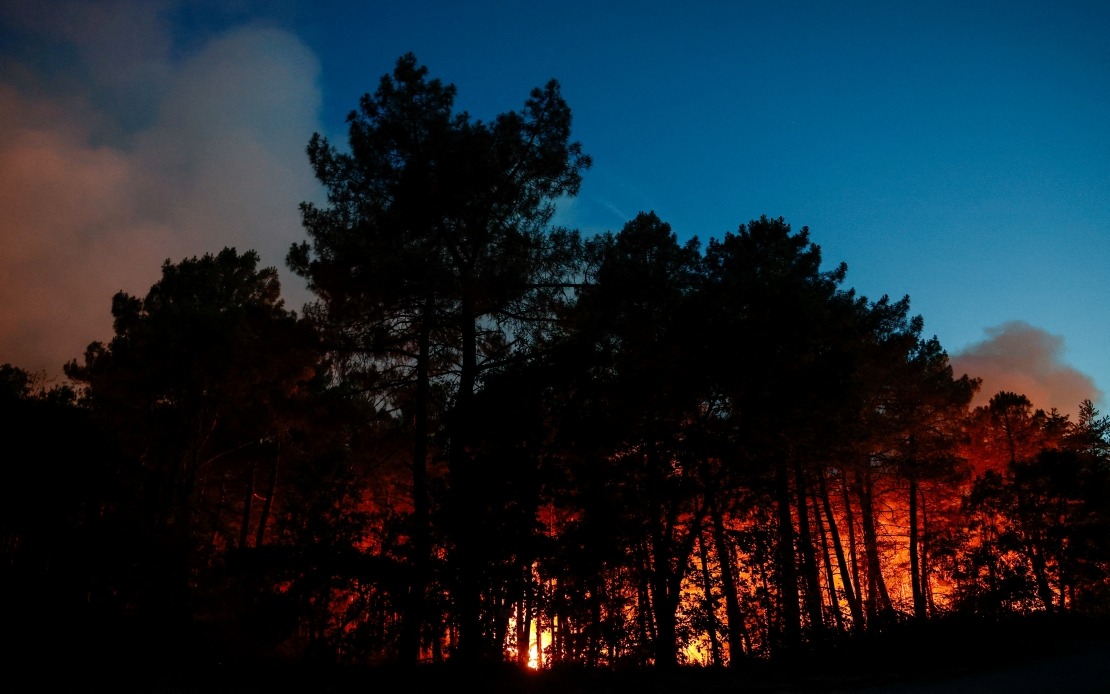
A sprawling wildfire consuming the iconic Fontainebleau forest region south of Paris has mobilized approximately 400 firefighters in a desperate containment effort, underscoring the escalating threat posed by Europe's sweltering temperatures to even historically protected landscapes. The blaze, which ignited late Sunday evening near a motorway, has already ravaged approximately 800 hectares of woodland, marking one of the most significant fire emergencies to strike northern France in recent memory.
The scale and intensity of the conflagration has necessitated extraordinary measures to combat the advancing flames. Beyond ground-based firefighting teams, authorities have deployed two water-bombing aircraft that draw their supply directly from the Seine river, a critical tactical advantage given the remote terrain and vegetation density characterizing the forest. The Seine-et-Marne department coordinated these aerial operations to target the fire's most aggressive perimeters and protect populated areas adjacent to the woodland.
What makes this incident particularly alarming is the suspicion that the fire may not have been entirely accidental. Laurent Nuñez, France's Interior Minister, visited the scene and assessed the evidence with evident concern, noting that multiple separate fire outbreaks emerging within a mere 1,000-metre radius strongly suggest deliberate ignition. This clustering pattern defies the typical characteristics of naturally-sparked wildfires and prompted the gendarmerie to formally open a criminal investigation into potential arson. The possibility of intentional firesetting carries profound implications for both emergency response strategy and security concerns across France's forest regions.
The Fontainebleau forest holds exceptional cultural and ecological significance across Western Europe. Beyond its status as one of the continent's largest continuous woodland expanses, the forest serves as home to the historic Château de Fontainebleau, a former royal residence with centuries of architectural and cultural importance. The destruction of substantial forest acreage threatens not only the immediate ecosystem but also tourism infrastructure and the cultural heritage intrinsically linked to this nationally cherished landscape.
The human toll reflects the fire's ferocity and proximity to inhabited settlements. More than 1,000 residents and tourists were evacuated from surrounding communities as the flames advanced toward residential zones. The mayor of Le Vaudoué, a village bordering the forest, provided stark testimony to the emergency's intensity when describing to BFM TV how residents witnessed what he characterized as a wall of flames moving with terrifying speed toward the village's perimeter houses. Such vivid descriptions underscore how quickly wildfire can transition from a remote forestry crisis into a direct threat to civilian safety and property.
French government officials have characterized the situation as exceptional and extraordinary, signalling that the response magnitude exceeds standard wildfire protocols. Maud Bregeon, the French government spokeswoman, emphasized that every available resource capable of contributing to fire suppression has been mobilized across the affected region. Her acknowledgment that fires of this particular scale have been uncommon in northern France suggests a potential shift in environmental conditions or risk profiles affecting the region.
The Fontainebleau fire cannot be viewed in isolation from the broader climatic pressures currently besieging France. The nation is simultaneously battling multiple fire outbreaks across various departments as a third heatwave in the same calendar year creates desperately dry conditions and temperatures far exceeding seasonal norms. These successive temperature spikes have parched vegetation and lowered the ignition threshold across vast forested territories, creating conditions where even modest sparks can develop into catastrophic infernos.
The meteorological severity permeating France at this moment is reflected in the unprecedented alert levels issued by the national weather service. Météo-France placed 37 departments under its most severe heat alert classification at the beginning of the week, a coverage indicating that exceptional temperatures are affecting a substantial portion of the country. This widespread heat alert system effectively signals to emergency services and civilian populations that conditions remain dangerous and that additional fire outbreaks remain probable across multiple regions.
For readers in Malaysia and Southeast Asia, the Fontainebleau incident offers crucial perspective on wildfire management and climate adaptation in developed nations. Europe's generally cooler climates have historically provided natural protection against large-scale uncontrolled fires, yet recent patterns suggest this protective buffer is eroding. Southeast Asian nations, already experiencing regular wildfire seasons amplified by monsoon disruptions and deforestation pressures, face mounting risks that may accelerate if global temperature trends continue. The French government's mobilization of hundreds of firefighting personnel and aerial resources demonstrates resource-intensive response capabilities that contrast sharply with the constrained capacities typical in developing regional economies.
The potential arson investigation dimension also carries regional resonance. While large-scale deliberate firesetting remains relatively uncommon in developed Western nations, several Southeast Asian countries have grappled with evidence suggesting intentional forest burning linked to land-use disputes, agricultural clearing, or resource competition. Should the French investigation confirm deliberate ignition, it would indicate that even wealthy nations with sophisticated law enforcement infrastructure must contend with the criminality dimension of wildfire causation.
The fire's impact on the Fontainebleau Château and surrounding heritage infrastructure remains an ongoing concern. Cultural heritage preservation and tourism-dependent economies represent shared vulnerabilities across Europe and much of Southeast Asia. A major loss affecting this internationally recognized historical site could serve as sobering precedent regarding the potential consequences of inadequate climate adaptation and prevention measures affecting iconic landscapes throughout the world.

