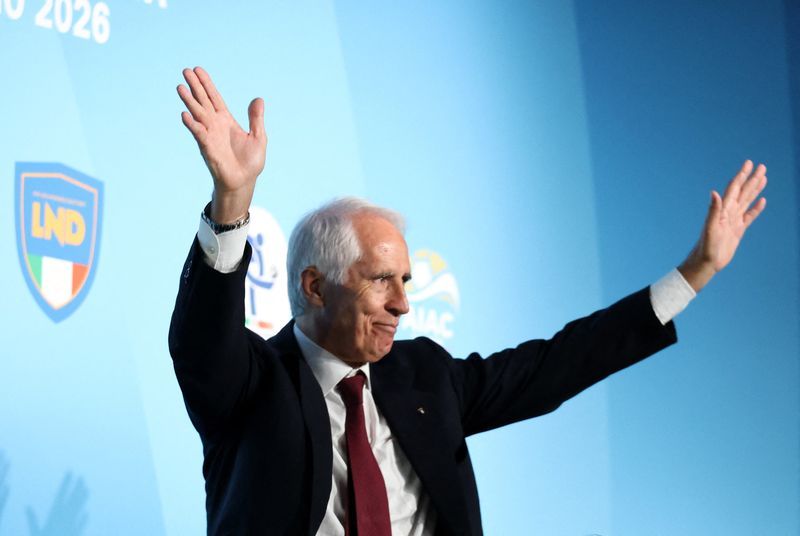
Giovanni Malago has assumed leadership of Italian football at a moment of profound institutional crisis, winning the Italian Football Federation presidency with a commanding 68.58% vote at Monday's assembly in Rome. The 67-year-old businessman arrives with a mandate to restore the Azzurri to their former heights following a catastrophic World Cup qualification campaign that ended with a playoff elimination by Bosnia & Herzegovina in April and has left the sport's governing structures at their weakest point in four decades.
Malago's background offers some reassurance to a federation desperately seeking administrative competence and steady direction. He recently completed his role overseeing the Milano Cortina Winter Olympics in February, an event widely praised for its organisational efficiency and smooth execution despite the complexities of hosting a major international competition. His previous tenure as head of the Italian National Olympic Committee has given him extensive experience navigating the politics and practical challenges of managing elite sporting institutions across multiple disciplines.
The new federation president defeated Giancarlo Abete in the election, taking over from Gabriele Gravina, who resigned amid the chaos and recriminations that engulfed Italian football following the Bosnia & Herzegovina defeat. The national team's failure to qualify for Qatar 2022 capped a period of systemic deterioration within Italian football that extends far beyond World Cup elimination. Italy's clubs subsequently suffered humiliating exits from the major European competitions, a rare occurrence for a nation with the sport's richest historical pedigree and strongest domestic league. This cascade of failures has prompted genuine soul-searching within the federation about whether the fundamental structures supporting Italian football development and competition have become obsolete.
Acknowledging the weight of expectation, Malago emphasised his understanding of the scale of the challenge. Speaking after his election, he noted that expectations surrounding his tenure were extraordinarily high both among the public and within federation structures themselves, yet he framed this pressure as an opportunity rather than an obstacle. His comments betrayed an awareness that Italian football supporters and politicians view the current situation with genuine alarm, having witnessed the country slip from its position as one of global football's dominant forces into comparative irrelevance on the world stage. For a nation that has won four World Cups and claimed numerous continental honours, this trajectory represents a rupture from historical expectations.
Malago's immediate priorities centre on four critical areas. The federation must appoint a new men's national team coach following Gennaro Gattuso's resignation in the wake of the Bosnia & Herzegovina defeat. Youth development systems require comprehensive modernisation, a concern that prominent figures including former striker Roberto Baggio have publicly raised repeatedly. The federation must simultaneously begin detailed preparations for co-hosting the 2032 European Championship alongside Turkey, a major tournament that will offer an opportunity for Italy to demonstrate its return to competitive form. These tasks must occur while also addressing deeper questions about whether Italy's domestic structures for player development have become unfit for contemporary demands.
Malago's vision for the federation transcends administrative management of existing programmes. In pre-election remarks, he articulated an ambition for the Italian Football Federation to function not merely as an administrative body but as a source of inspiration and cultural leadership within Italian society. He argued that Italian football's historical legacy should not become a source of nostalgic yearning but rather a foundation upon which to build future success. This reframing of the federation's role suggests he recognises that institutional confidence has been deeply eroded and that restoring public belief in the organisation's competence must precede any turnaround in competitive results.
The structural problems confronting Italian football extend considerably beyond the immediate context of World Cup qualification failure. Roberto Baggio's warnings about the obsolescence of youth development pathways reflected a growing consensus that Italian football's academy systems had failed to evolve in line with contemporary training methodologies and competitive demands. The nation that once produced seemingly inexhaustible supplies of technically gifted defenders and midfielders has found itself unable to match the player development infrastructure that countries like France, Spain, and Germany have established. These systemic inadequacies accumulated over years before finally manifesting catastrophically in World Cup qualification campaigns.
For the previous federation president Gravina, the end of his tenure brought a moment of candour when confronted with the magnitude of the institution's failures. During the assembly proceedings, the 72-year-old acknowledged that he should have departed his position considerably earlier, a concession that underscores the depth of institutional dysfunction that accumulated during his leadership. Gravina's departure was effectively forced by public and political pressure rather than representing a voluntary recognition of his limitations, a distinction that reflects the dramatic loss of confidence in federation leadership.
Malago's call for unity and collective commitment, expressed through his statement that he cannot accomplish transformation alone but that cooperation can achieve everything, signals an awareness that the federation's reconstruction requires buy-in from multiple stakeholders. Italian football encompasses not only the national team and federation apparatus but also the domestic league structure, individual clubs, youth development academies, and the broader sporting and political establishment. Creating alignment among these disparate interests will prove essential for implementing any comprehensive modernisation programme.
The implications for Southeast Asian football observers extend beyond mere sporting interest. Italy's difficulties illustrate how quickly historical dominance can erode when structural investment and systematic development fail to evolve. For Malaysia and neighbouring countries seeking to improve their own international football standing, the Italian example demonstrates both the consequences of institutional stagnation and the importance of sustained commitment to youth development and long-term planning. The question of whether Malago and the federation can execute genuine transformation will unfold over the coming years, with the 2032 European Championship providing a crucial test of whether Italian football has genuinely embarked upon renewal.

