Malaysia's renewable energy sector has reached a critical milestone, with installed capacity climbing to nearly 32 per cent as of June, according to Deputy Prime Minister Datuk Seri Fadillah Yusof. The announcement comes at an opportune moment for Southeast Asia's third-largest economy, which has committed to ambitious clean energy targets as part of its broader strategy to decarbonise its electricity system while maintaining economic competitiveness. This progress demonstrates that Malaysia's energy infrastructure is pivoting toward sustainability at a measurable pace, with the government positioning itself to exceed its 2030 renewable energy goal of 35 per cent.
The achievement reflects consistent advancement in Malaysia's energy transition agenda, which is underpinned by the National Energy Transition Roadmap (NETR). This strategic framework, endorsed by the government, charts a course toward progressively higher renewable energy penetration at each milestone—35 per cent by 2030 and the ambitious target of 70 per cent by 2050. The fact that the country had already secured 31 per cent capacity by December 2025 suggests momentum is building, though it also underscores the challenge of sustaining such expansion rates as deployment becomes more complex and grid integration demands grow more sophisticated.
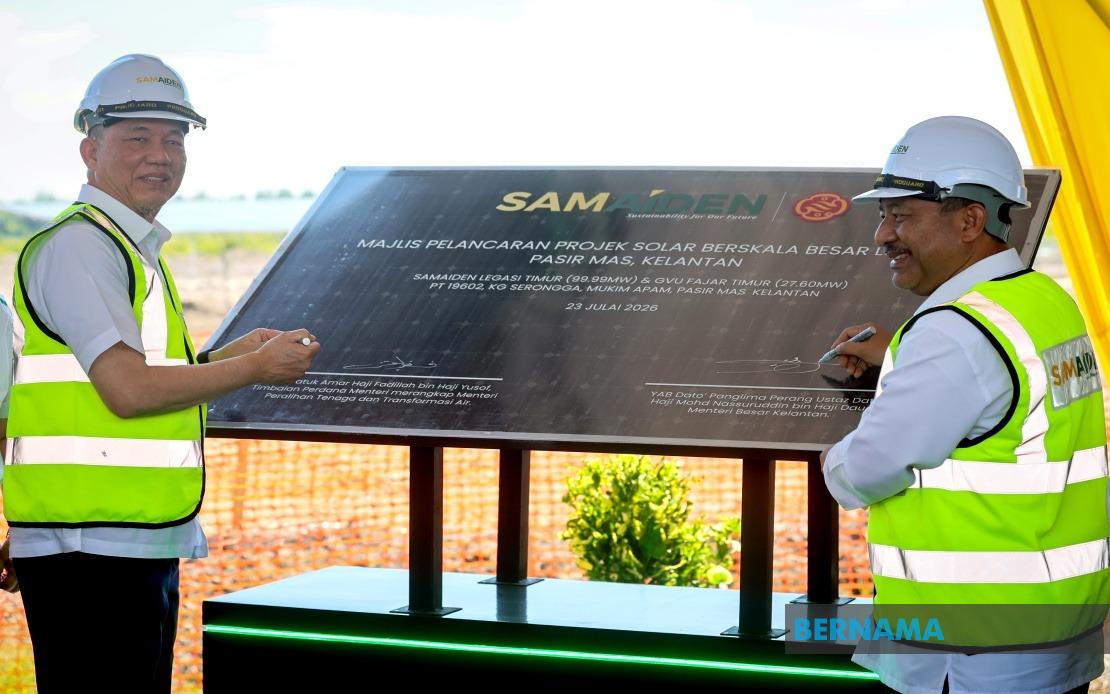
For Malaysian policymakers and investors, the framing of energy transition as a strategic necessity—rather than an optional environmental gesture—carries significant weight. Fadillah, who holds the dual ministerial role of Energy Transition and Water Transformation (PETRA), articulated this imperative at the launch of the Large-Scale Solar Project (LSS5) in Pasir Mas, Kelantan. He emphasised that the transition serves multiple national interests: securing energy supplies against global volatility, bolstering economic resilience, magnetising high-value foreign investment, and fulfilling Malaysia's international climate commitments. This framing resonates with Southeast Asian concerns about energy independence and the geopolitical dimensions of the global energy shift.
Balancing three competing priorities—energy security, cost affordability, and environmental sustainability—remains the government's declared approach. Rather than pursuing renewable energy at any cost, Malaysian officials are signalling that the transition must remain fiscally prudent and reliable. This messaging appears designed to assuage concerns among industrial users and lower-income households that rapid electrification could inflate electricity tariffs or compromise grid stability. The emphasis on affordability and security suggests that policymakers are mindful of both business competitiveness and public acceptance, factors critical to Malaysia's renewable transition succeeding where others have faced political resistance.
The LSS5 project itself serves as a tangible demonstration of this transition's reality. Located in Kampung Serongga in Kelantan, the large-scale solar initiative represents collaborative effort between federal and state governments alongside private sector actors. Such public-private partnerships have become essential to scaling renewable capacity, as governments alone typically lack the capital and operational expertise required to meet ambitious deployment timelines. The project's launch signals investor confidence in Malaysia's policy environment and regulatory stability, variables that often determine whether capital flows toward renewable projects or seeks opportunities elsewhere in the region.
Kelantan's role in Malaysia's renewable expansion is particularly noteworthy. The state, historically known for agriculture and traditional industries, possesses significant untapped potential for solar development due to abundant suitable land and supportive state administration under Menteri Besar Datuk Mohd Nassuruddin Daud. The state government's positioning of renewable energy as an economic diversification vehicle—one that attracts sophisticated foreign investors while creating local employment—reflects a broader Southeast Asian trend whereby clean energy becomes intertwined with regional development and poverty alleviation objectives. Kelantan's commitment to fostering a transparent, investor-friendly ecosystem underscores that energy transition succeeds only when coupled with institutional reform and governance improvement.
Beyond utility-scale projects like LSS5, Malaysia is also promoting distributed solar generation through the Solar ATAP Programme, which incentivises rooftop installations on homes, mosques, places of worship, and commercial premises. This bottom-up approach complements top-down large-scale deployment and serves multiple functions: it builds public ownership of the energy transition, reduces transmission losses, enhances grid resilience through decentralisation, and creates opportunities for small and medium enterprises to participate in the clean energy economy. Such community-level engagement often proves decisive in sustaining long-term renewable expansion, particularly in Muslim-majority Malaysia where religious institutions can serve as trusted advocates for sustainable development.
The economic implications extend beyond electricity supply. The government explicitly acknowledges that renewable energy projects generate direct employment, stimulate local economies through supplier relationships, nurture support industries, and create spillover benefits for surrounding communities. For Kelantan specifically, renewable energy development offers pathways to attract manufacturing of solar components and batteries, sectors in which Malaysia has ambitions to become a regional hub. The ability to position oneself as a destination for green industrial investment—rather than merely hosting power generation facilities—separates transformative energy transition from marginal infrastructure expansion.
Regionally, Malaysia's renewable energy progress carries implications for Southeast Asia's energy security and climate objectives. As the Association of Southeast Asian Nations collectively works toward climate targets and energy diversification, Malaysia's demonstrated ability to scale renewable capacity provides a template for peer nations. The region's vulnerabilities to fossil fuel import dependence and climate impacts make energy transition urgent, yet institutional and financial constraints often limit deployment rates. Malaysia's explicit commitment to bridging cost and security concerns alongside decarbonisation speaks to the pragmatic approach increasingly demanded across Southeast Asia.
However, the trajectory from nearly 32 per cent to 35 per cent by 2030, and then to 70 per cent by 2050, reveals escalating technical and institutional challenges ahead. Each percentage point of renewable penetration becomes progressively harder to achieve as grid integration, energy storage, and system flexibility demands intensify. Malaysia will need to develop or import battery storage solutions, upgrade transmission infrastructure, and implement sophisticated demand-management systems. The government's roadmap appears to assume these capabilities will materialise, yet detailed implementation plans and funding mechanisms remain less visible in public discourse.
Investor confidence, as evidenced by LSS5 and other ongoing projects, suggests that Malaysia's policy environment has successfully attracted the private capital essential for renewable scaling. Yet sustainability of this momentum depends on consistent policy signals, predictable regulatory frameworks, and transparent power purchase agreements. Any political volatility or policy reversal could dampen investor enthusiasm, particularly among international players making long-term capital commitments. The government's emphasis on collaboration among federal agencies, state governments, and private sector actors acknowledges this interdependence.
Looking ahead, Malaysia's renewable energy transition remains firmly embedded within its broader economic and political objectives. Energy security, investment attraction, and climate action are presented not as competing priorities but as mutually reinforcing goals. Whether Malaysia can maintain its current deployment pace, navigate the technical complexities of high renewable penetration, and ensure that transition benefits are equitably distributed across regions and income groups will significantly shape the nation's economic trajectory and regional standing in the coming decade.

