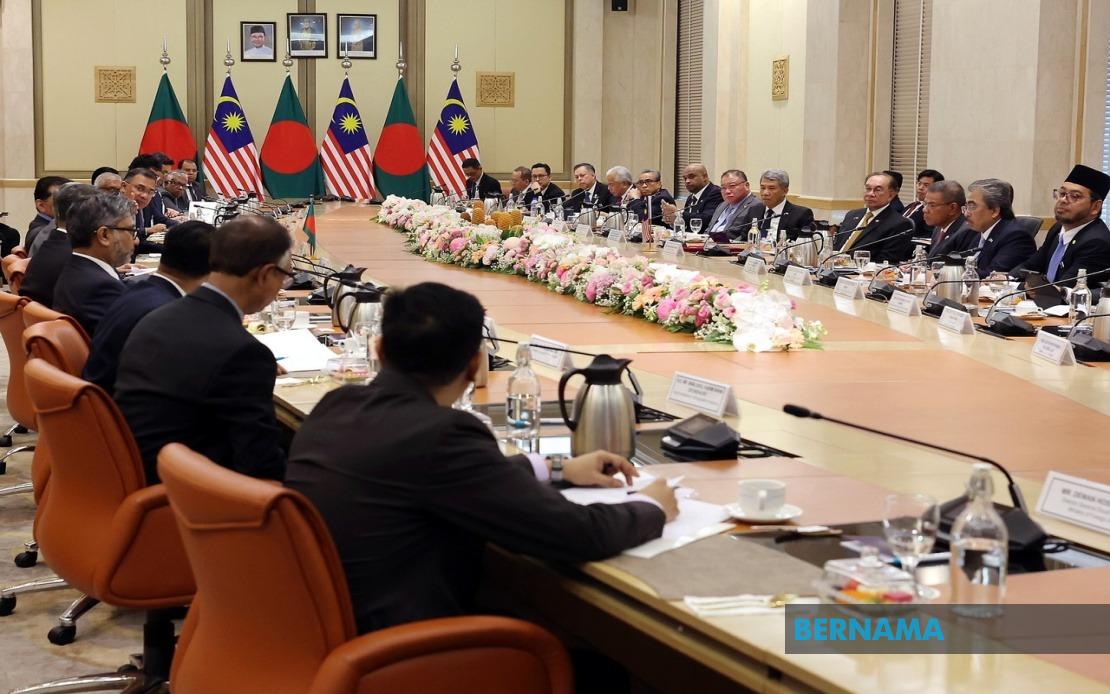
Prime Minister Datuk Seri Anwar Ibrahim has signalled that Malaysia and Bangladesh must forge deeper partnerships across frontier technologies and energy sectors, moving decisively away from historical reliance on agricultural trade. Speaking alongside visiting Bangladesh Prime Minister Tarique Rahman at a joint press conference in Putrajaya on June 22, Anwar articulated a strategic vision for bilateral engagement that prioritises artificial intelligence, semiconductors, digital infrastructure and advanced manufacturing as pillars of future prosperity.
The statement reflects a broader recognition among Southeast Asian policymakers that traditional trade patterns must evolve to maintain competitive advantage in an increasingly technology-driven global economy. While Malaysia and Bangladesh have maintained steady agricultural commerce, both nations recognise that their long-term development trajectories depend on capabilities in high-value sectors where intellectual property, technical expertise and innovation infrastructure determine outcomes rather than labour costs or commodity availability.
Anwar's emphasis on artificial intelligence represents a particularly significant strategic recalibration. AI has emerged as a transformative technology with implications spanning manufacturing, healthcare, financial services and public administration. For Malaysia, which aspires to greater technological sovereignty and reduced dependence on foreign technology providers, developing indigenous AI capabilities through regional cooperation offers a pragmatic pathway. Bangladesh, with its substantial software development sector and growing digital workforce, brings complementary strengths that could facilitate technology transfer and shared research initiatives.
The semiconductor dimension of this partnership carries particular weight in the current geopolitical environment. Malaysia already hosts significant semiconductor manufacturing operations and is a critical node in global supply chains. Bangladesh's participation in collaborative semiconductor research and development could strengthen supply chain resilience across South and Southeast Asia whilst diversifying manufacturing hubs beyond traditional centres. This aligns with broader efforts among Indo-Pacific nations to reduce dependency on unstable supply corridors and build regional capacity.
Energy cooperation addresses immediate and long-term concerns for both nations. Malaysia possesses mature hydrocarbon sectors and renewable energy ambitions, whilst Bangladesh faces considerable energy security challenges amid rapid industrial expansion. Collaborative frameworks in clean energy technology, grid modernisation and renewable integration could facilitate knowledge sharing and infrastructure development beneficial to both economies. Such cooperation extends beyond bilateral advantage to contribute toward regional energy security and climate objectives.
The cultural cooperation memorandum and counter-terrorism research exchange reflect the multidimensional nature of contemporary bilateral relations. Whilst often overshadowed by economic narratives, these frameworks establish institutional mechanisms for sustained engagement across governance, security and civil society domains. Counter-terrorism collaboration particularly resonates given both nations' experience with transnational security challenges and their strategic interest in regional stability.
Rahman's two-day visit represents substantive diplomatic engagement at the highest level, signalling both nations' commitment to moving beyond ceremonial exchanges toward concrete institutional development. The formal signing of cooperation instruments provides legal and administrative scaffolding for implementing the strategic vision articulated in public statements. Investment promotion mechanisms and bilateral trade architecture must now evolve to accommodate emerging sector priorities.
For Malaysia, deepening ties with Bangladesh assumes heightened importance as regional balance shifts. Bangladesh has emerged as a dynamic economic actor with growing technological capabilities and demographic dividends. Establishing partnership frameworks now positions Malaysia advantageously as South Asian development accelerates. Conversely, Malaysia's technological maturity and infrastructural sophistication offer Bangladesh crucial templates for sectoral development.
The emphasis on research collaboration and technology partnerships distinguishes this engagement from conventional trade-focused bilateral relationships. Both nations recognise that capturing value in emerging sectors requires not merely market access but active participation in knowledge creation. This necessitates sustained investment in human capital, research institutions and enabling regulatory environments. Regional research networks linking Malaysian and Bangladeshi universities and technology firms could generate spillover benefits throughout the Indo-Pacific.
Implementation challenges remain substantial. Regulatory harmonisation across borders demands patient institutional development. Intellectual property frameworks protecting innovations developed through collaborative efforts require careful negotiation. Technology transfer mechanisms must balance commercial interests with development aspirations. Nevertheless, the strategic intent articulated by both prime ministers establishes political momentum that can sustain these efforts through inevitable procedural complexities.
The broader significance extends to Southeast Asian regionalism. Malaysia's bilateral deepening with Bangladesh demonstrates that ASEAN nations increasingly pursue substantive partnerships beyond formal multilateral forums. This reflects pragmatic recognition that strategic objectives sometimes require tailored bilateral arrangements more nimble than consensus-dependent regional institutions. Simultaneously, it reinforces the Indo-Pacific's character as an interconnected economic and technological space where South Asian, Southeast Asian and East Asian developments increasingly intertwine.
For Malaysian business communities, opportunities emerge across multiple vectors. Semiconductor firms may access Bangladeshi manufacturing and assembly capabilities. Technology companies could identify partnership opportunities in software development and digital infrastructure. Energy sector participants gain exposure to Bangladesh's renewable energy development programmes. Financial institutions find client bases for services supporting cross-border investment and trade finance in these emerging sectors.
The trajectory suggested by this engagement reflects mature bilateral relations maturing beyond conventional development paradigms. Both nations acknowledge that mutual prosperity increasingly depends on collaborative participation in technologies and industries shaping the next decade. Whether these commitments translate into sustainable institutional frameworks and genuine technology advancement remains to be determined, but the leadership's articulated vision establishes clear strategic direction for subsequent implementation efforts.
%22%2F%3E%3C%2Fpattern%3E%3C%2Fdefs%3E%3Crect%20width%3D%22100%25%22%20height%3D%22100%25%22%20fill%3D%22url(%23ph4sj74g)%22%2F%3E%3Crect%20width%3D%22100%25%22%20height%3D%22100%25%22%20fill%3D%22url(%23ph4sj74p)%22%2F%3E%3Ctext%20x%3D%2250%25%22%20y%3D%2250%25%22%20text-anchor%3D%22middle%22%20dominant-baseline%3D%22central%22%20fill%3D%22rgba(255%2C255%2C255%2C0.95)%22%20font-family%3D%22Georgia%2C%20'Times%20New%20Roman'%2C%20serif%22%20font-weight%3D%22700%22%20font-size%3D%22170%22%20letter-spacing%3D%22-0.02em%22%3EMalaysia%3C%2Ftext%3E%3C%2Fsvg%3E)
%22%2F%3E%3C%2Fpattern%3E%3C%2Fdefs%3E%3Crect%20width%3D%22100%25%22%20height%3D%22100%25%22%20fill%3D%22url(%23ph51v0dg)%22%2F%3E%3Crect%20width%3D%22100%25%22%20height%3D%22100%25%22%20fill%3D%22url(%23ph51v0dp)%22%2F%3E%3Ctext%20x%3D%2250%25%22%20y%3D%2250%25%22%20text-anchor%3D%22middle%22%20dominant-baseline%3D%22central%22%20fill%3D%22rgba(255%2C255%2C255%2C0.95)%22%20font-family%3D%22Georgia%2C%20'Times%20New%20Roman'%2C%20serif%22%20font-weight%3D%22700%22%20font-size%3D%22170%22%20letter-spacing%3D%22-0.02em%22%3EMalaysia%3C%2Ftext%3E%3C%2Fsvg%3E)