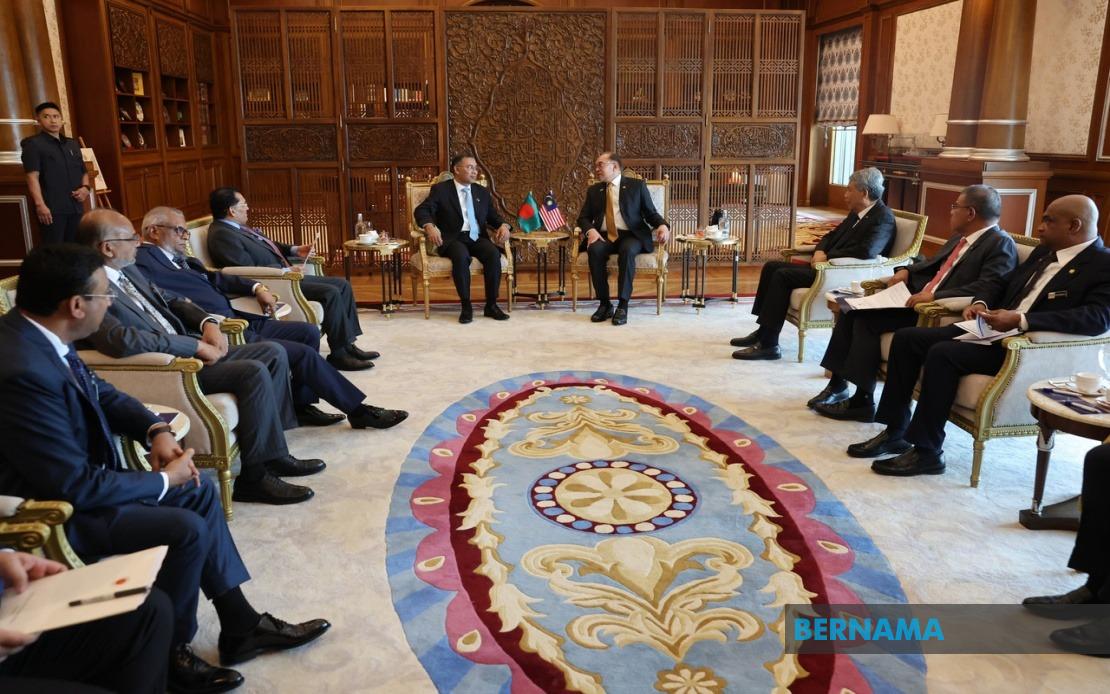
Prime Minister Datuk Seri Anwar Ibrahim has announced that Malaysia and Bangladesh will harness ASEAN institutional frameworks to forge a durable resolution to the Rohingya refugee crisis, signalling a coordinated regional approach to a humanitarian challenge that has strained resources across Southeast Asia. The commitment was articulated during bilateral talks in Putrajaya with visiting Bangladesh Prime Minister Tarique Rahman, who arrived for a two-day official visit marking his first overseas trip since taking office in February 2026.
The two leaders underscored their shared dedication to ameliorating the circumstances of hundreds of thousands of Rohingya displaced persons scattered across both nations. Anwar outlined a strategy whereby Malaysia and Bangladesh would mobilise their foreign ministers and leverage ASEAN's diplomatic architecture to pressure Myanmar into accepting the return of its stateless population. This approach reflects an acknowledgment that the issue has reached a stage where bilateral negotiations alone have proven insufficient, necessitating regional consensus and institutional weight.
Bangladesh, which hosts the overwhelming majority of Rohingya refugees—predominantly sheltering them in sprawling camps in Cox's Bazar—has borne an exceptional humanitarian burden since the 2017 military crackdown in Myanmar's Rakhine State. Prime Minister Tarique Rahman emphasised his government's profound preoccupation with the welfare of Rohingya people under Bangladesh's care, while extending gratitude toward Malaysia for its continued material and political backing in facilitating what both governments term safe, dignified, and sustainable repatriation to Myanmar. His acknowledgment of Malaysia's role underscores the interconnected nature of the crisis across the region.
Beyond the Rohingya question, the two prime ministers seized the opportunity to review the trajectory of Malaysia-Bangladesh bilateral relations and identify avenues for expanded partnership. Their discussions encompassed a comprehensive agenda spanning trade and investment, workforce mobility, semiconductor manufacturing, energy cooperation, agricultural development, and educational exchanges. This breadth suggests both governments view the relationship as extending well beyond humanitarian concerns into substantive economic collaboration.
The bilateral engagement produced tangible institutional outcomes, with both leaders witnessing the signing of a Memorandum of Understanding focused on cultural exchange. Additionally, two Exchanges of Notes were finalised: one addressing counter-terrorism research initiatives and another facilitating investment promotion and facilitation mechanisms. These instruments represent formal commitments to deepen institutional ties and create structured pathways for cooperation across multiple domains.
Trade statistics illustrate the significance of the Malaysia-Bangladesh commercial relationship within the broader Asian context. During 2025, bilateral commerce totalled RM12.18 billion, equivalent to USD2.84 billion, with Malaysian exports dominating at RM10.08 billion—USD2.35 billion—concentrated predominantly in petroleum products and refined fuels. Conversely, Malaysian imports from Bangladesh amounted to RM2.10 billion or USD0.50 billion, comprising principally textiles, apparel, and footwear products reflecting Bangladesh's comparative advantage in labour-intensive manufacturing.
Within Malaysia's trading landscape, Bangladesh occupied the position of 28th largest commercial partner globally in 2025, while simultaneously ranking as the second most significant trading partner, export destination, and import source within the South Asian region, surpassed only by India. This positioning reflects the depth of economic integration already achieved and the latent potential for further expansion, particularly in sectors identified during the bilateral talks such as semiconductors and renewable energy.
The timing of Tarique Rahman's visit carries particular significance given his recent assumption of the Bangladesh premiership. His selection of Malaysia as a destination for his inaugural official overseas visit signals the importance both governments attach to their relationship. For Malaysia, the visit represents an opportunity to reinforce its role as a voice for the region's more vulnerable populations and to demonstrate leadership on humanitarian questions that extend beyond national borders.
The resort to ASEAN mechanisms to address the Rohingya situation reflects a broader trend toward invoking regional institutions to resolve transnational crises that individual nations cannot adequately manage alone. ASEAN's established protocols, though often criticised for prioritising consensus and non-interference over rapid intervention, provide legitimate diplomatic channels through which Malaysia and Bangladesh can coordinate messaging and pressure regarding Myanmar's obligations. This approach positions the Rohingya issue within a framework of regional responsibility rather than as a bilateral concern.
For Malaysian policymakers, the emphasis on ASEAN engagement also serves domestic political purposes, demonstrating commitment to a sympathetic cause that resonates across Malaysia's diverse communities. The repatriation of Rohingya populations to Myanmar has emerged as a central objective for both Malaysia and Bangladesh, yet remains fundamentally dependent on Myanmar's willingness to facilitate returns and ensure genuine integration of returning populations. Without substantive changes in Myanmar's governance and minority protection frameworks, repatriation risks becoming merely involuntary relocation rather than genuine homecoming.
The economic dimensions of the Malaysia-Bangladesh partnership deserve scrutiny alongside humanitarian concerns. Bangladesh's growth trajectory and its emergence as a manufacturing hub position it as an increasingly valuable economic partner for Malaysia. Cooperation in semiconductors, identified during the talks, reflects both nations' aspirations to participate in technology-intensive industries. Similarly, collaboration in renewable energy addresses shared regional imperatives regarding climate change and energy security amid growing demand across Southeast Asia.
Looking forward, the success of Malaysia and Bangladesh's joint efforts on the Rohingya question will depend substantially on their capacity to translate bilateral commitment into coordinated ASEAN action capable of influencing Myanmar. The framework established through this visit—combining diplomatic engagement at multiple levels, economic interdependence, and institutional cooperation—represents a comprehensive approach to managing a crisis that shows no signs of spontaneous resolution absent determined regional intervention.