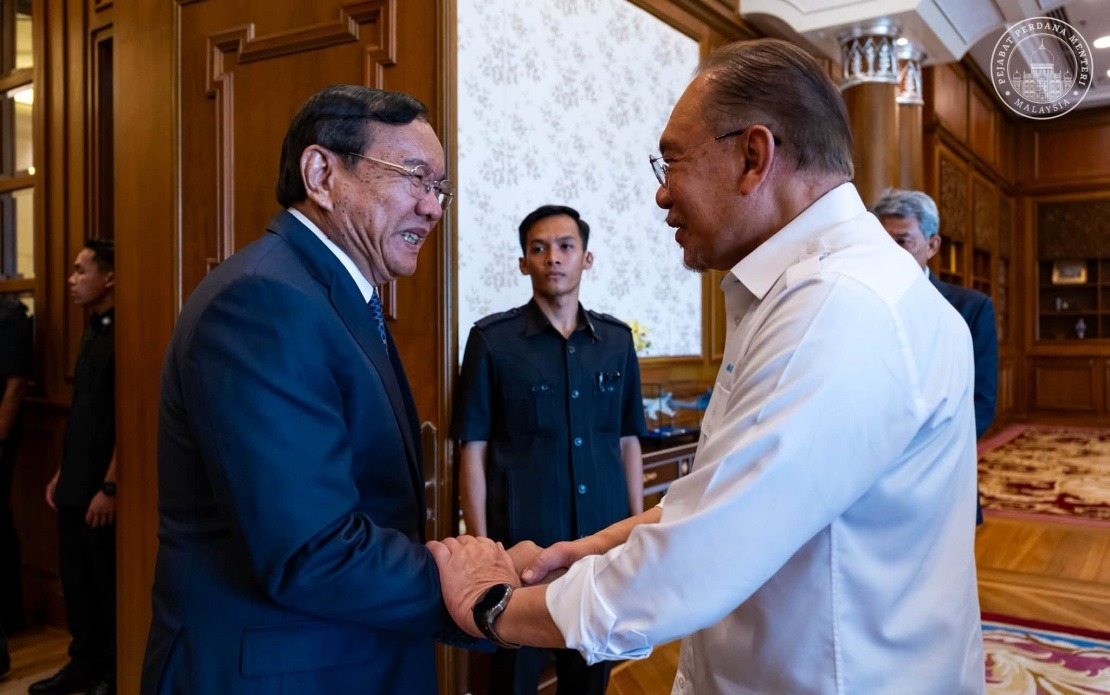
Malaysia and Cambodia are moving to deepen their bilateral relationship across a broad range of economic and strategic sectors, according to Prime Minister Datuk Seri Anwar Ibrahim. The renewed commitment emerged during discussions with visiting Cambodian Deputy Prime Minister and Minister of Foreign Affairs and International Cooperation Prak Sokhonn, who arrived in Malaysia on August 3 for a two-day official engagement that represents a significant moment in the countries' shared diplomatic trajectory.
The scope of bilateral cooperation has expanded considerably beyond traditional partnerships. Both nations have identified the digital economy and artificial intelligence as priority areas where mutual advancement is possible, reflecting the region's broader pivot towards technological innovation. Alongside these emerging sectors, the halal industry represents a distinctive area where Malaysia's established expertise and certification frameworks can complement Cambodia's growing interest in halal-compliant production and export. Food security, a persistent challenge across Southeast Asia, has also been elevated to a strategic cooperation priority, acknowledging the interconnected nature of regional food systems and the vulnerability of individual economies to global supply chain disruptions.
The conversation between the two leaders also addressed cross-border security concerns, a persistent regional issue that demands coordinated action. Criminal networks operating across the Malaysia-Cambodia border have long posed challenges to law enforcement authorities on both sides, making enhanced cooperation mechanisms and information sharing essential components of the bilateral agenda. This security dimension underscores that modern strategic partnerships must address not only economic opportunity but also the shared imperative of maintaining stability and protecting citizens from transnational criminal enterprises.
Human capital development emerged as another pillar of the renewed partnership framework. Both Malaysia and Cambodia recognize that sustainable economic growth depends fundamentally on investing in people, skills development, and educational exchange. This commitment likely encompasses vocational training programs, student exchanges, and knowledge transfer initiatives that would benefit professionals and researchers in both countries. Such people-to-people connections often produce the most durable foundations for long-term bilateral relationships, transcending the formal government-to-government interactions that generate headlines.
The timing of Prak Sokhonn's visit carries particular significance, as it precedes the Third Malaysia-Cambodia Joint Commission for Bilateral Cooperation meeting scheduled for August 4. This formal mechanism provides an institutionalized platform for detailed negotiations on specific cooperative projects, resource allocation, and implementation timelines. The joint commission format reflects a maturity in bilateral relations, moving beyond aspirational statements to concrete mechanisms for translating political will into tangible outcomes that benefit citizens in both countries.
Looking ahead, both nations are clearly conscious of approaching a symbolic milestone that will command regional attention. The 70th anniversary of Malaysia-Cambodia diplomatic relations in 2027 provides a natural inflection point for evaluating the depth and durability of the partnership. By establishing ambitious cooperation frameworks now, both governments are positioning themselves to mark this anniversary with substantive achievements rather than ceremonial rhetoric. The advance preparation suggests serious commitment to converting this moment into a platform for regional prominence.
As ASEAN member states, Malaysia and Cambodia operate within a broader multilateral context that shapes their bilateral relationship. Both countries share responsibility for advancing the ASEAN Community Vision 2045, an ambitious framework intended to deliver greater regional integration, prosperity, and resilience. Their bilateral cooperation can be understood partly as a building block for these larger regional objectives, with successful Malaysia-Cambodia partnerships potentially serving as models for other bilateral relationships within the association. The emphasis on ASEAN unity and community building reflects recognition that no single member state can achieve sustainable development in isolation from its neighbours.
Prime Minister Anwar's public commitment to strengthening Malaysia-Cambodia relations carries weight given Malaysia's regional standing and diplomatic influence. His explicit statement that bilateral ties would continue to strengthen signals to investors, business communities, and civil society organizations that government support exists for expanded cross-border collaboration. Such high-level endorsement can unlock practical cooperation that might otherwise remain constrained by bureaucratic inertia or institutional reluctance.
The breadth of identified cooperation areas suggests that officials have conducted careful assessments of complementary strengths and mutual needs. The digital economy and AI sectors appeal to both countries' aspirations for technological advancement and competitive positioning in the regional and global economy. The halal industry focus recognizes Malaysia's certification and branding leadership while acknowledging Cambodia's manufacturing capabilities and growing Muslim consumer markets. These are not arbitrary selections but reflect strategic thinking about where cooperation can generate tangible benefits.
For Malaysian stakeholders, this partnership expansion opens practical opportunities. Malaysian companies in food production, digital services, halal certification, and education services may find expanded market access or partnership possibilities in Cambodia. Conversely, Cambodian suppliers and service providers gain access to Malaysian distribution networks and expertise. Business communities in both countries have incentive to monitor the implementation of agreements emerging from the joint commission meeting, as these will determine whether diplomatic rhetoric translates into commercial reality.
The security cooperation dimension also merits scrutiny from a Malaysian perspective. Cross-border criminal activity affects communities in both countries and strains law enforcement resources. More effective cooperation in intelligence sharing, joint operations, and border management can reduce trafficking and organized crime that ultimately harms ordinary citizens. This aspect of the partnership, though less glamorous than digital economy initiatives, may prove most consequential for citizen security and social stability.
The Cambodia visit represents Malaysia's proactive diplomacy in Southeast Asia, demonstrating willingness to invest in bilateral relationships even as regional attention focuses on ASEAN mechanisms and major power competition. By hosting high-level Cambodian officials and committing to expanded cooperation frameworks, Malaysia reinforces its position as a reliable regional partner and signals openness to deepening ties with neighbours across multiple dimensions. This approach contributes to the stable, rules-based regional environment that benefits all ASEAN members.

