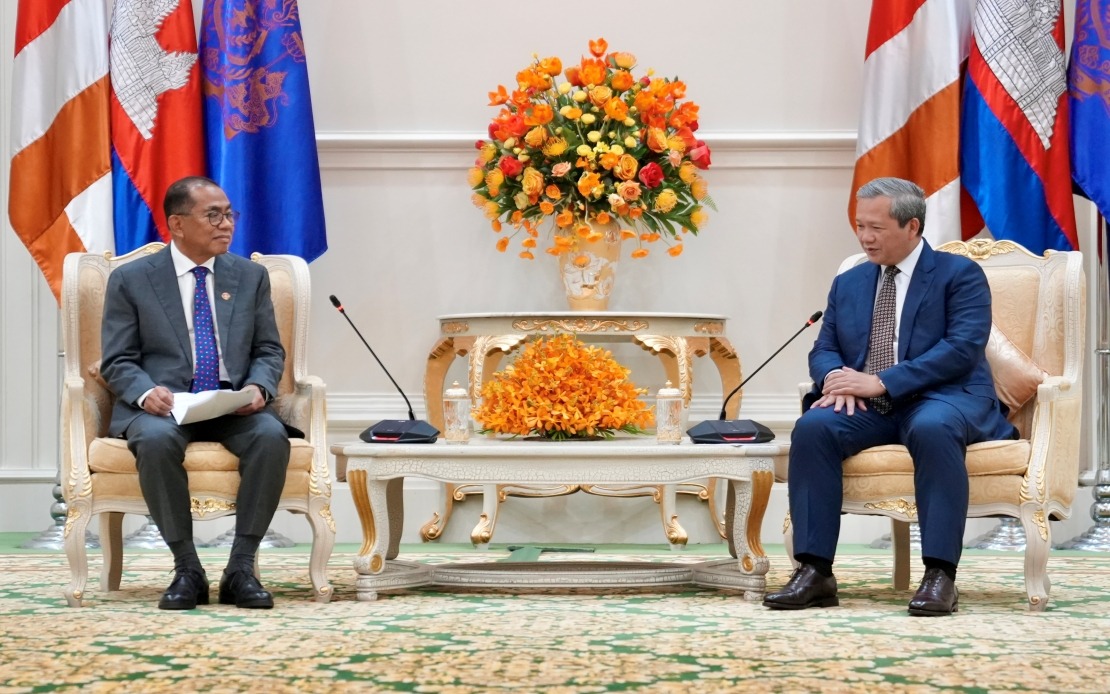
Malaysia and Cambodia are moving closer on defence and security matters, with both nations pledging to deepen their military partnership as part of broader efforts to bolster ASEAN's collective strength in an increasingly complex geopolitical environment. During a working visit to Phnom Penh, Defence Minister Datuk Seri Mohamed Khaled Nordin engaged with senior Cambodian leadership to advance shared interests in regional stability and security cooperation, marking an important phase in relations between the two Southeast Asian neighbours.
The centrepiece of Mohamed Khaled's engagement was advancing the Malaysia-Cambodia Defence Cooperation Memorandum of Understanding, a bilateral framework that has reached its final stages of negotiation. This agreement represents more than procedural bureaucracy; it codifies a commitment to systematically expand military-to-military ties across multiple domains. The Defence Minister expressed confidence that the MoU would be formally signed during the upcoming ASEAN Defence Ministers' Meeting in the Philippines, providing an institutional foundation for defence collaboration that extends well beyond traditional military exercises.
Beyond the immediate bilateral relationship, both countries emphasised their commitment to ASEAN centrality in addressing regional security challenges. Mohamed Khaled and his Cambodian counterparts, Deputy Prime Minister and Defence Minister General Tea Seiha, discussed how the organisation's dialogue mechanisms and regional frameworks remain essential tools for managing security threats. This conversation carries particular weight given ongoing tensions in Southeast Asia, where traditional security concerns coexist with emerging challenges from great power competition and transnational threats.
The Cambodia-Thailand border situation featured prominently in discussions, reflecting Malaysia's continuing interest in regional peace processes even after stepping down as ASEAN Chair. Mohamed Khaled expressed hope that the ceasefire between Cambodia and Thailand would endure, underscoring Malaysia's role as a stabilising voice in regional disputes. The country's support for the ASEAN Observer Team mechanism signals its belief that multilateral monitoring and dialogue remain preferable to unilateral military posturing or unresolved tensions that could destabilise the broader region.
A particularly noteworthy dimension of the cooperation framework involves emerging defence technologies and non-traditional security domains. Malaysia and Cambodia have committed to exploring collaboration in jungle warfare training, defence industry cooperation, artificial intelligence applications, and drone technology. These areas reflect recognition that modern security challenges transcend conventional military threats, requiring states to develop capabilities in domains that will define 21st-century defence requirements. For Malaysia, such partnerships with Cambodia provide opportunities to strengthen regional technological cooperation while building interoperability among ASEAN forces.
The South China Sea Code of Conduct negotiations also occupied space in bilateral talks, with both nations underscoring its importance for maintaining peace and a rules-based order in Southeast Asian waters. Malaysia's emphasis on finalising this instrument reflects the country's broader strategic interest in institutionalising constraints on great power behaviour in the region. While progress has been incremental, Malaysia views Cambodia's continued commitment to this process as significant, particularly given the latter's complex relationships with major powers.
Mohammad Khaled's Cambodia visit formed part of a broader regional diplomatic push that included a working visit to Vietnam on August 5 and 6. Meetings with Vietnamese Prime Minister Le Minh Hung and Defence Minister General Phan Van Giang extended Malaysia's defence diplomacy across key ASEAN partners simultaneously. This sequencing reflects a strategic approach to relationship-building, allowing Malaysia to reinforce messages about regional stability and ASEAN cooperation across multiple bilateral channels in concentrated timeframes.
The Ministry of Defence has framed these missions as implementation of the Third Pillar of Malaysia's National Defence Strategy, specifically the Credible Partnerships dimension. This positioning indicates that bilateral defence diplomacy has moved from ad hoc engagement to structured strategic implementation. The inclusion of Admiral Tan Sri Zulhelmy Ithnain, Chief of the Royal Malaysian Navy, alongside other senior defence officials underscores the seriousness with which Malaysia approaches these partnerships and the inter-service coordination involved in defence diplomacy.
Looking forward, Mohamed Khaled highlighted the significance of the approaching 70th anniversary of Malaysia-Cambodia diplomatic relations in 2027. By strengthening defence ties now, both countries are positioning themselves to mark this milestone with a mature institutional framework underpinning cooperation. For Malaysia, the strategic calculation involves building reliable defence partnerships with smaller ASEAN members that share interests in maintaining regional stability without being drawn excessively into great power competition.
The broader context for these bilateral advances involves Malaysia's effort to maintain a balanced position in a region where major powers increasingly exert influence over Southeast Asian security affairs. By deepening ties with Cambodia through formalised defence cooperation, Malaysia signals commitment to an ASEAN-centric approach to regional security rather than deferring to external actors. This approach, while sometimes appearing modest compared to more assertive regional strategies, reflects Malaysian thinking about how medium powers can exercise influence through institutional building and consensus-formation rather than military posturing.
For Malaysian defence planners, cooperation with Cambodia also carries practical dimensions. Shared environmental challenges, maritime security threats, and transnational crime require coordinated responses that bilateral agreements facilitate. The emphasis on jungle warfare training, for instance, reflects terrain and operational realities common to both nations' defence concerns, making such cooperation both strategically relevant and mutually beneficial rather than imposed by external strategic frameworks.
The timing of these engagements, occurring as Malaysia and other ASEAN states navigate competing pressures from global powers, suggests that regional states are consciously investing in intra-ASEAN ties as a counterbalance. By strengthening the institutional architecture of defence cooperation within Southeast Asia, nations like Malaysia and Cambodia can preserve greater strategic autonomy. This represents a subtle but important evolution in how ASEAN members approach their collective resilience, moving beyond rhetorical commitment to ASEAN centrality toward concrete defence mechanisms that make it functionally meaningful.

