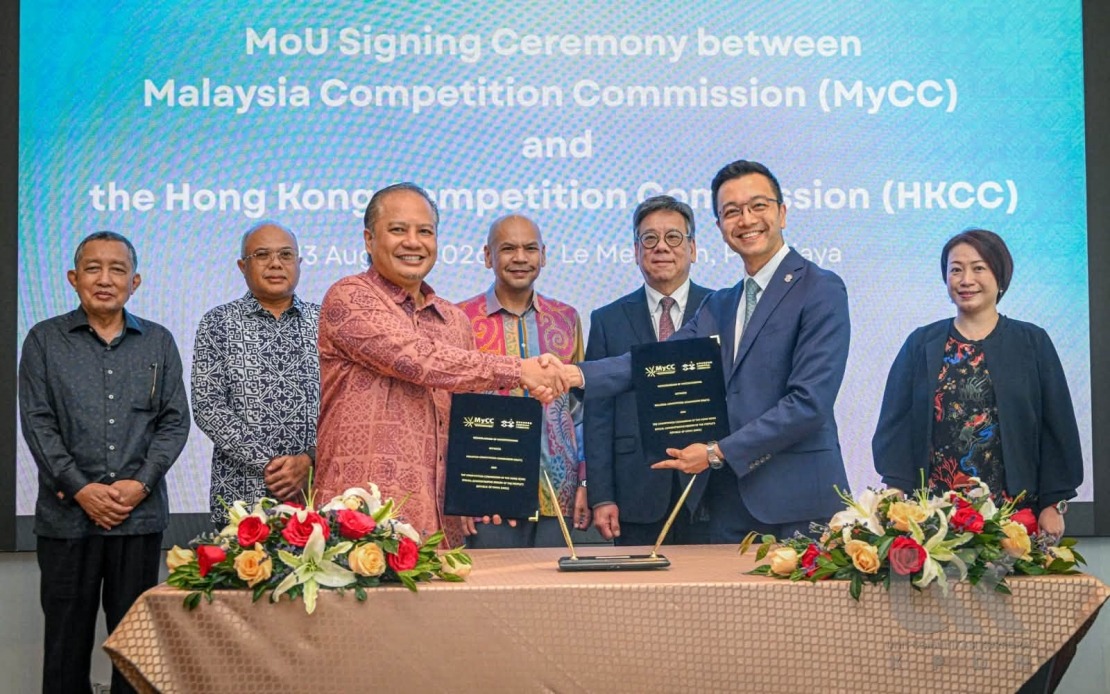
Malaysia and Hong Kong have formalized their commitment to enhanced cooperation on competition law matters through a fresh Memorandum of Understanding signed by the Malaysia Competition Commission and the Hong Kong Competition Commission. The agreement, signed on 13 August, establishes a framework for the two jurisdictions to work together on competition policy coordination, harmonization of legal frameworks, and joint enforcement strategies affecting their respective markets and the wider region.
Domestic Trade and Cost of Living Minister Datuk Armizan Mohd Ali characterized the accord as part of a deliberate strategy to build Malaysia's international standing in antitrust regulation. The arrangement with Hong Kong becomes the fourth bilateral competition agreement that MyCC has concluded, following similar arrangements with the Türkiye Competition Authority, Korea Fair Trade Commission, and Philippine Competition Commission. This progression reflects MyCC's growing institutional maturity and its recognition as a credible enforcement partner within Asia and beyond.
The pact responds to a critical reality in modern commerce: anticompetitive conduct increasingly transcends national boundaries. Cartels operating across Southeast Asia, abuse of dominance by multinational corporations, and merger activities with regional implications all demand coordinated responses. By formalizing cooperation with Hong Kong—a major regional financial centre and trading hub—Malaysia positions itself to address these complex enforcement challenges more effectively. The Hong Kong market's sophistication and economic significance make it a natural partner for MyCC's continued development.
Minister Armizan emphasized that the agreement underscores the government's broader philosophy regarding fair competition. His remarks highlighted how the ministry views competition policy not merely as a domestic regulatory matter but as an essential pillar of Malaysia's international economic engagement. In an era where supply chains span continents and digital platforms operate globally, the rationale for cross-border regulatory cooperation has become self-evident to policymakers. However, translating that recognition into operational frameworks remains challenging, making formal agreements like this one a tangible achievement.
The MoU encompasses several practical cooperation mechanisms that will give the partnership substance beyond ceremonial declarations. Both authorities have committed to systematic exchange of information about significant developments in their respective competition regimes, including legislative reforms, enforcement priorities, and case developments. This intelligence-sharing capability allows each regulator to anticipate and adapt to shifts in regional competitive dynamics. For Malaysian businesses operating in Hong Kong, and Hong Kong entities active in Malaysia, this coordination could lead to more consistent enforcement standards and clearer expectations.
Training and capacity-building form another pillar of the arrangement. Through workshops, technical seminars, and secondment programmes, MyCC officers will gain exposure to Hong Kong's enforcement methodologies and investigative techniques, while their counterparts learn from Malaysia's experience navigating a complex, multi-level economy with significant digital commerce and small-to-medium enterprise participation. Such exchanges generate institutional learning that transcends what any single authority could develop in isolation. Officer secondments, in particular, create personal relationships and deeper mutual understanding between enforcement teams—factors that prove invaluable when navigating sensitive cross-border investigations.
Research collaboration represents a less visible but equally important component. As both jurisdictions grapple with novel competition questions—including those arising from digital platforms, emerging market consolidation, and supply chain resilience—joint research projects can pool expertise and generate insights applicable across the region. Hong Kong's experience with financial sector competition oversight and Malaysia's developing expertise in digital market dynamics complement each other productively.
The agreement specifically contemplates bilateral enforcement cooperation on cross-border competition violations and also provides a mechanism for MyCC and HKCC to coordinate with third-party jurisdictions when investigations require broader international engagement. This architecture proves particularly valuable for addressing conduct involving Malaysian, Hong Kong, and international actors simultaneously. Rather than operating in isolation, the two authorities can now formally coordinate strategy, share evidence within agreed confidentiality protocols, and present aligned enforcement messages to affected businesses.
For Malaysia's competition ecosystem, this arrangement signals institutional momentum. MyCC's succession of international agreements demonstrates that the commission has earned recognition as a competent, professional enforcer capable of navigating complex international legal frameworks. This standing matters for Malaysia's attractiveness to foreign investment and for the credibility of domestic enforcement decisions. When multinationals know that MyCC coordinates with respected peers like Hong Kong's regulator, they are more likely to take compliance seriously across their Malaysian operations.
The timing of the MoU also reflects broader regional trends toward formalization of economic governance. Southeast Asia increasingly embraces structured institutional cooperation frameworks rather than ad hoc diplomatic arrangements. As trade intensifies among ASEAN members and major external partners, competition authorities recognize their role in preventing disputes and maintaining market confidence. Malaysia's active participation in this trend positions it as a serious regional player in economic governance.
Minister Armizan's closing remarks about KPDN's commitment to deepening ties with other regional and international competition bodies suggest this MoU represents one waypoint in a longer journey. The stated objective—sharpening enforcement capacity, building institutional strength, and maintaining a dynamic competitive environment—reflects a sophisticated understanding of how competition policy serves broader economic objectives. For Malaysian consumers and businesses, the practical payoff comes through more consistent market oversight, faster resolution of cross-border disputes, and enforcement actions that address truly significant anticompetitive conduct rather than minor infractions.
The Malaysia-Hong Kong cooperation framework also carries subtle implications for ASEAN competition policy development. As individual member states build bilateral relationships with each other and with external partners, they accumulate experience with cooperation mechanisms that could eventually inform more ambitious regional arrangements. Hong Kong's particular value to Malaysia lies in its developed markets infrastructure and international financial connections—qualities that make it an ideal testing ground for cooperation models that might eventually expand.

