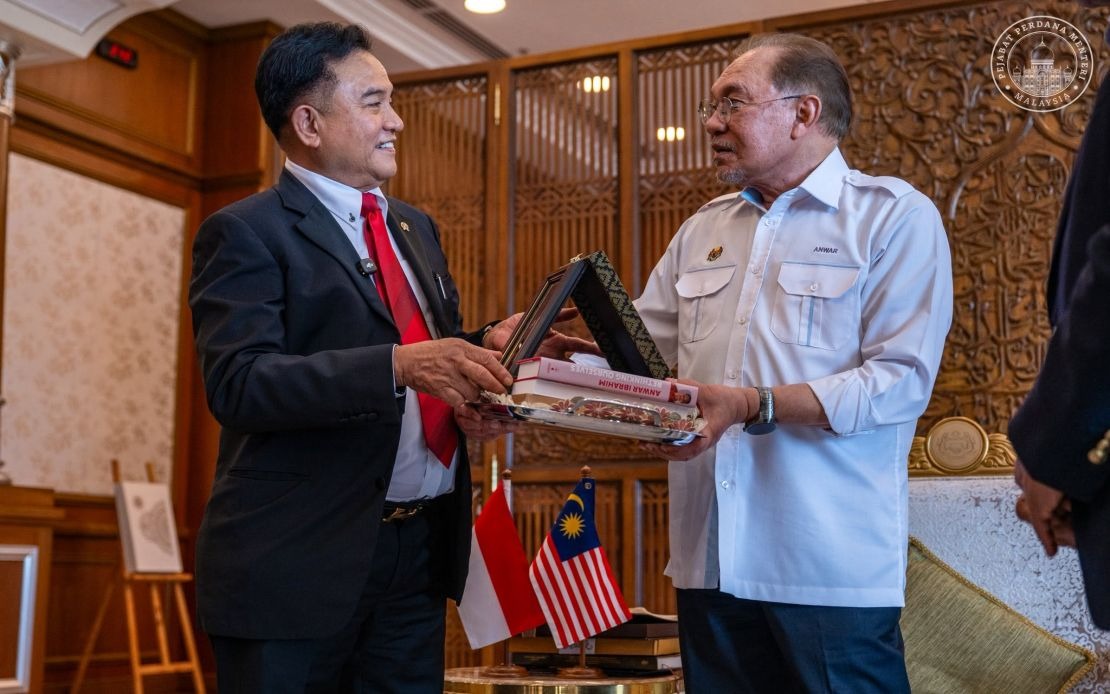
Malaysia and Indonesia have reaffirmed their commitment to deepening institutional cooperation across legislative frameworks and governance structures, according to discussions held between Prime Minister Datuk Seri Anwar Ibrahim and visiting Indonesian Coordinating Minister for Legal, Human Rights, Immigration and Correction Prof Dr Yusril Ihza Mahendra at the Prime Minister's Office in Putrajaya.
The high-level engagement reflects the two nations' recognition that robust legal and administrative harmonisation remains essential to managing the complex bilateral relationship between Southeast Asia's largest Muslim-majority democracies. As economies increasingly interlinked through trade, investment, and people-to-people movement, the alignment of legislative standards and governance practices can significantly reduce friction points and facilitate smoother cooperation on transnational issues.
Anwar, who concurrently holds the Finance Minister portfolio, emphasised that both governments recognise mutual benefit in coordinating their approaches to governance challenges. The discussion touched on multiple strategic domains beyond the formal legislative sphere, suggesting a comprehensive agenda encompassing institutional reform, regulatory coordination, and policy harmonisation across sectors that affect both populations.
The timing of the ministerial visit underscores ongoing efforts by both capitals to elevate their partnership beyond traditional diplomatic courtesies into substantive institutional frameworks. Indonesia's decision to send Yusril, who oversees critical portfolios encompassing law, human rights, immigration, and correctional systems, signals Jakarta's serious intent in advancing these cooperation mechanisms. For Malaysia, the reception of such a senior official demonstrates Kuala Lumpur's reciprocal commitment to treating these discussions as matters of substantial governmental priority.
For Malaysian observers, this development carries particular relevance given the shared challenges both nations face in strengthening rule of law, managing migration flows, and building public confidence in institutional integrity. Cross-border issues—from maritime boundaries to human trafficking networks—require coordination at the legislative and enforcement levels that can only be achieved through the kind of systematic cooperation being discussed. Enhanced alignment in these areas could yield tangible benefits for citizens of both countries navigating an increasingly complex regional landscape.
The emphasis on legislation specifically suggests both governments are exploring concrete mechanisms for policy synchronisation, whether through regular consultation forums, technical working groups, or harmonised standards in specific regulatory domains. Indonesia's vast experience managing governance across an archipelago of 17,000 islands offers lessons Malaysia might leverage, while Malaysia's sophisticated financial and administrative systems provide reference points for Indonesian reform efforts. Such bilateral learning arrangements have historically proven valuable in Southeast Asian regional cooperation.
The broader strategic implications warrant attention from policymakers across the region. As both nations grapple with challenges ranging from digital governance to corruption prevention, establishment of formal coordination channels creates opportunities for evidence-based policy transfer and shared institutional development. This approach differs markedly from ad-hoc crisis management and instead positions Malaysia and Indonesia as partners in proactive governance innovation.
Indonesia's focus on human rights, immigration, and correctional systems under Yusril's coordinating ministry touches on areas where Malaysian expertise could prove complementary. Malaysia's immigration enforcement and counterterrorism frameworks, refined through addressing distinct regional security challenges, represent potential areas for technical exchange. Similarly, Indonesia's experience with large-scale prison reform and rehabilitation programmes could inform Malaysian policy discussions.
The statement emphasising "fraternal relations" carries cultural and diplomatic resonance beyond standard diplomatic language. It reflects the deep historical, religious, and social bonds underpinning bilateral ties, suggesting that cooperation frameworks will be rooted in shared values and mutual understanding rather than merely transactional arrangements. This foundation proves crucial when negotiating sensitive areas touching on sovereignty, cultural identity, and national interest.
Business communities and civil society in both nations stand to benefit from clearer, more harmonised legal frameworks. Malaysian investors operating across Indonesia would gain from more predictable regulatory environments aligned with familiar Malaysian standards, while Indonesian enterprises expanding into Malaysia face lower compliance costs when legislative frameworks converge on key commercial and labour issues. Such practical improvements, accumulating across multiple sectors, translate into measurable economic advantages and reduced transaction costs.
The commitment to ongoing consultation formalised through this exchange suggests both governments plan establishing regular mechanisms for dialogue at ministerial and technical levels. Such institutionalised engagement prevents cooperation from depending on individual relationships or political goodwill cycles, instead embedding bilateral coordination into permanent government structures capable of surviving political transitions.
For Southeast Asia's broader regional architecture, Malaysia and Indonesia's deepening institutional partnership serves as a stabilising force. The two nations account for substantial portions of ASEAN's economic output and political influence; their commitment to cooperative governance sets a constructive tone for region-wide approaches to transnational challenges from climate change to digital governance. The success or failure of their bilateral frameworks may well influence how other regional partnerships approach similar coordination challenges in coming years.

