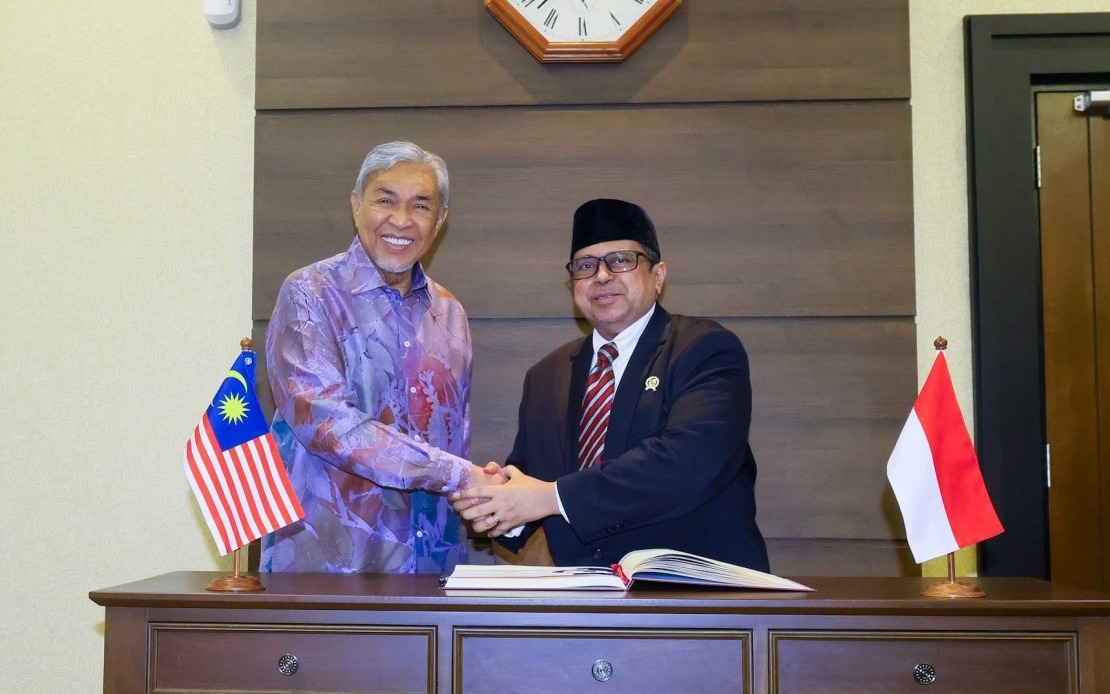
Malaysia and Indonesia are poised to significantly expand their partnership in the halal sector, moving beyond traditional bilateral ties to establish formal institutional mechanisms that will shape the future of Islamic commerce across Southeast Asia and beyond. Deputy Prime Minister Datuk Seri Dr Ahmad Zahid Hamidi revealed the ambitious collaboration framework following a meeting with Indonesia's Ambassador to Malaysia, Raden Datuk Mohammad Iman Hascarya Kusumo, and the head of Indonesia's Halal Product Assurance Organising Body (BPJPH), Dr Ahmad Haikal Hassan, at the Parliament building.
The initiative encompasses far more than halal industry development alone. Ahmad Zahid underscored that the two nations have identified multiple complementary sectors requiring coordinated advancement, including trade facilitation, rural economic development, and human capital strengthening. This multifaceted approach reflects an understanding that the halal economy cannot flourish in isolation—it requires supporting infrastructure, skilled workforces, and integrated supply chains that span multiple economic domains. By addressing these areas simultaneously, Malaysia and Indonesia signal their commitment to building a comprehensive competitive advantage in the global halal marketplace.
Central to this partnership framework is the proposed establishment of the Malaysia-Indonesia Halal Council (MIHC), a bilateral institution designed to serve as the primary coordinating body for all halal-related initiatives. Beyond this bilateral arrangement, the two countries are exploring the creation of broader regional and international structures. The envisioned ASEAN Halal Council would extend cooperation across Southeast Asia's ten member states, while the proposed World Halal Development Council would position the region as a driving force in setting global halal standards and best practices. These nested institutional levels—bilateral, regional, and international—suggest an ambitious vision to anchor halal commerce within structured, internationally recognised governance frameworks.
For Malaysian stakeholders, this development carries substantial strategic importance. As Ahmad Zahid noted in his capacity as chairman of the Malaysia Halal Industry Development Council, the historical closeness between Malaysia and Indonesia provides an organic foundation for deeper integration. Both nations have invested significantly in developing halal certification systems, processing capabilities, and supply chain infrastructure. By formalising cooperation mechanisms, they can avoid duplicative efforts, share technical expertise, and present a unified front in international negotiations over halal standards and market access.
The harmonisation of halal standards across Malaysia and Indonesia addresses a longstanding pain point for manufacturers and traders operating across both jurisdictions. Currently, differences in certification processes, ingredient approvals, and documentation requirements create friction and additional costs for businesses seeking to serve both markets simultaneously. A coordinated standards framework could dramatically reduce these barriers, making it more economical for companies to scale operations regionally. This efficiency gain would particularly benefit small and medium-sized enterprises (SMEs) that currently lack the resources to navigate multiple certification pathways.
From a trade perspective, the partnership holds implications for Malaysia's broader economic strategy. Indonesia remains one of Malaysia's largest trading partners, and the halal sector represents one of the fastest-growing segments of bilateral commerce. By creating formal structures to facilitate trade in halal-certified products—from food and beverages to cosmetics, pharmaceuticals, and textiles—both countries can capitalise on growing global Muslim consumer demand estimated to exceed $2 trillion annually. The initiative positions the Malaysia-Indonesia combination as a powerful economic bloc capable of competing with established halal suppliers in the Middle East and Europe.
The human capital dimension of this cooperation framework deserves particular attention, as it addresses a recognised bottleneck in halal industry expansion. Training programmes, technical exchanges, and knowledge-sharing initiatives between Malaysian and Indonesian institutions could accelerate capability development across the supply chain. This includes certifying auditors, product developers, quality assurance specialists, and compliance officers—roles essential to maintaining the integrity and credibility of halal certification systems. Enhanced human capital development would create employment opportunities while strengthening the entire ecosystem's technical foundation.
Rural development integration into this framework reflects an understanding that halal commerce must extend benefits beyond urban manufacturing hubs and trading centres. Many halal-certified agricultural products, livestock, and processed foods originate in rural areas across both nations. By deliberately incorporating rural development into cooperation initiatives, Malaysia and Indonesia can ensure that farming communities and smallholder producers share in the value created by halal commercialisation. This inclusive approach addresses potential equity concerns and broadens the domestic political constituency supporting halal industry investment.
The proposed World Halal Development Council represents an especially notable ambition, signalling intentions to shape global regulatory conversations at the United Nations level and within international standardisation bodies. Currently, halal standards remain fragmented, with different countries and certification bodies maintaining separate requirements. A coordinated Malaysian-Indonesian initiative to establish global standards could significantly enhance both nations' soft power and commercial influence. This would position Southeast Asia as a centre of halal expertise and authority rather than merely a supplier region dependent on external standard-setters.
However, translating these institutional frameworks into tangible commercial and regulatory outcomes will require sustained political commitment and substantial administrative capacity. Both nations must allocate resources to staffing these new councils, conducting harmonisation studies, and managing potentially complex negotiations with other ASEAN members and international partners. The success of this initiative will depend on whether Malaysia and Indonesia can move beyond ceremonial institutional creation to produce substantive policy changes that reduce trade friction and expand market opportunities.
For Malaysian consumers and businesses, this partnership offers medium-term advantages. Greater certainty regarding halal standards, reduced certification costs, and expanded market opportunities for compliant producers should eventually translate into broader product availability and potentially more competitive pricing in halal-certified categories. Additionally, Malaysia's established position as a halal leader—with established certification bodies, technical expertise, and reputation—means the country stands to gain disproportionately from any regional framework that leverages these existing strengths.
The timing of this initiative also reflects broader regional economic trends. As ASEAN nations seek greater economic integration and as global Muslim populations increasingly demand certified halal products, formalising halal sector cooperation becomes strategically logical. The partnership between Malaysia and Indonesia serves as a catalyst that could encourage other ASEAN members to strengthen their halal capabilities and participate in regional harmonisation efforts. Ultimately, this cooperation framework represents not merely bilateral advancement but an attempt to reposition Southeast Asia as a central authority in global halal commerce.

