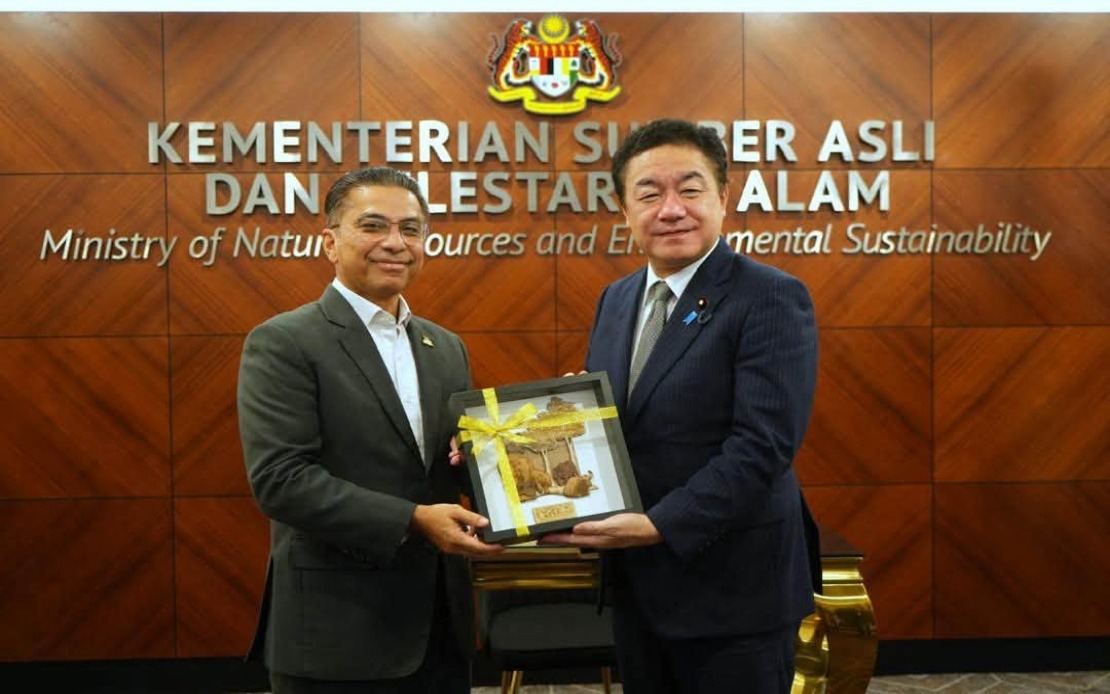
Malaysia and Japan are moving forward with deeper cooperation in rare earth elements and climate action, building on momentum from their bilateral summit six months ago. The latest engagement came through a courtesy visit by Japan's Parliamentary Vice-Minister of Economy, Trade and Industry Komori Takuo to Malaysia's Ministry of Natural Resources and Environmental Sustainability, where senior officials from both nations examined progress on shared commitments and identified new avenues for collaboration in these strategically important sectors.
The meeting, hosted by Deputy Natural Resources and Environmental Sustainability Minister Syed Ibrahim Syed Noh, took place within the broader framework of the Malaysia-Japan Comprehensive Strategic Partnership. For Malaysia, the timing reflects growing international interest in its rare earth resources at a moment when supply chain diversification away from China has become a priority for many industrialised nations. Japan, which faces its own resource constraints and depends on stable supplies of critical minerals for its advanced manufacturing sector, sees Malaysia as a reliable long-term partner capable of meeting its growing demand for processed rare earth materials.
A cornerstone of the bilateral agenda is Malaysia's unwavering commitment to a moratorium on exporting raw rare earth elements. This policy, repeatedly affirmed during the discussions, underscores Malaysia's determination to capture greater economic value by developing domestic processing capabilities and value-added manufacturing rather than selling unrefined materials. The stance reflects a broader shift in developing countries' resource policies, where simply exporting commodities is viewed as insufficient for sustainable development. By retaining processing within its borders, Malaysia can create higher-skilled jobs, develop technical expertise, and build competitive advantage in the downstream rare earth industry—an approach that aligns with Japan's own interests in securing reliable supplies of processed materials for its industries.
Japan's technical support through established channels has proven instrumental in advancing this agenda. The Japan International Cooperation Agency and the Japan Organisation for Metals and Energy Security have delivered sustained technical cooperation and technology transfer initiatives that help Malaysia strengthen its processing infrastructure and operational capabilities. Malaysia's explicit appreciation for these contributions suggests that the partnership extends well beyond ceremonial diplomacy into practical, tangible capacity-building. Such collaborations typically involve training programmes, facility upgrades, process improvements, and knowledge transfer that gradually build domestic expertise.
Beyond the minerals sector, both nations have made significant progress on climate cooperation. The finalisation of negotiations on a draft Memorandum of Cooperation for the Joint Crediting Mechanism represents a substantive achievement in international climate finance architecture. The JCM, which operates under Article 6.2 of the Paris Agreement, creates a framework for countries to cooperate on emissions reductions and generate tradeable carbon credits. For Malaysia, this mechanism offers pathways to finance climate-friendly technologies and support energy transition efforts while generating revenue from carbon markets—a dual benefit that aligns climate action with economic interests.
The expected completion of the JCM agreement by year-end carries particular significance for Malaysia's climate commitments. The country has pledged ambitious Nationally Determined Contributions under the Paris Agreement, targeting substantial emissions reductions across energy, transport, and industrial sectors. However, meeting these targets requires substantial capital investment in low-carbon technologies, renewable energy infrastructure, and industrial efficiency upgrades. By leveraging Japan's advanced green technology capabilities alongside Malaysia's sustainable resource potential, the partnership creates a synergistic arrangement where Japanese expertise meets Malaysian opportunity. Japan gains access to carbon offset projects and emerging markets for its green technologies, while Malaysia accelerates its energy transition with proven, efficient solutions.
The carbon market cooperation also reflects evolving global architecture around climate finance. Traditional climate funding through multilateral development banks has faced criticism for slow disbursement and bureaucratic complexity. Market-based mechanisms like the JCM allow direct technology transfer and investment flows that can be more rapid and responsive to national priorities. For Malaysia, participating actively in such mechanisms strengthens its negotiating position in broader climate discussions and demonstrates concrete commitment to the Paris framework, which carries diplomatic and development benefits.
The delegation composition underscores how seriously both governments view this partnership. Malaysia's team included the NRES deputy secretary-general for natural resources, multiple senior ministry officials, and representatives from the Foreign Ministry, reflecting coordination across multiple government agencies. Japan's participation by its Ambassador to Malaysia and senior METI officials signalled similar high-level commitment. This multistakeholder approach ensures that discussions translate into coordinated government action rather than remaining confined to individual ministries.
For regional observers, the Malaysia-Japan partnership on rare earth and climate issues carries broader implications. It demonstrates how mid-sized economies with complementary strengths—Malaysia's resource endowment and Japan's technological prowess—can construct mutually beneficial strategic partnerships that enhance both nations' resilience. It also reflects recognition among developed economies like Japan that building durable, equitable partnerships with developing countries on critical materials requires genuine technology transfer and capacity-building rather than extractive relationships. As global competition for critical minerals intensifies and climate transitions accelerate, such partnerships may become templates for other bilateral and regional arrangements across Southeast Asia.

