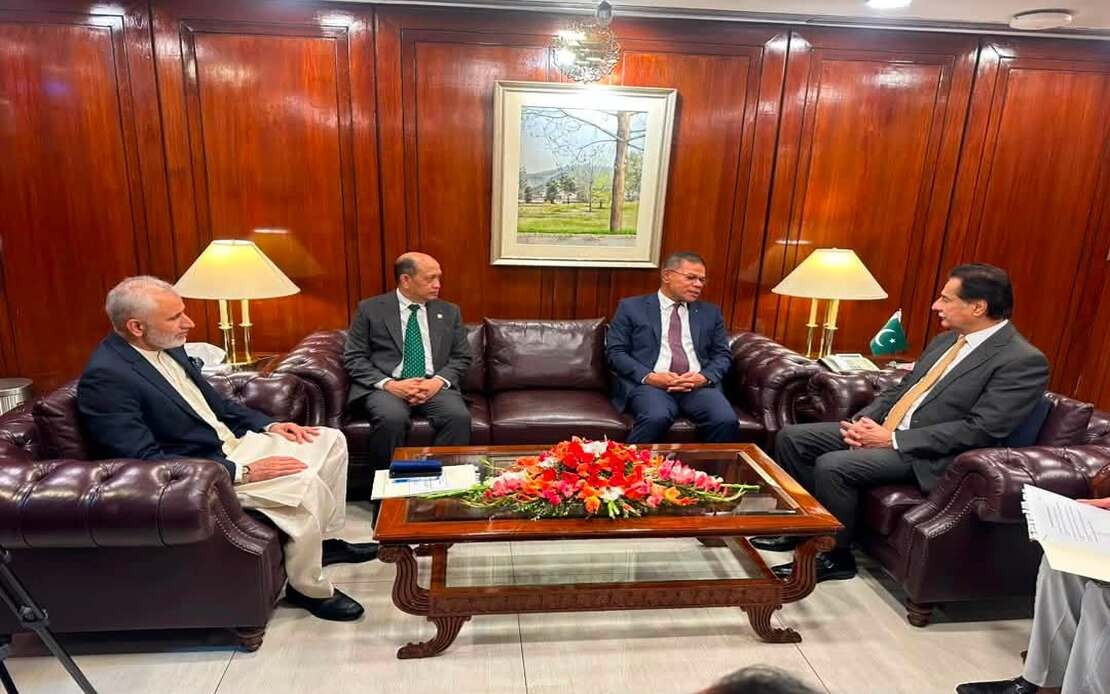
Malaysia and Pakistan have jointly stressed the primacy of dialogue and diplomatic engagement in tackling the mounting geopolitical tensions and security challenges facing the region. The emphasis emerged from substantive discussions held during the official visit to Islamabad by Home Minister Datuk Seri Saifuddin Nasution Ismail, who met with key figures in Pakistan's legislative institutions including the Speaker of the National Assembly, Sardar Ayaz Sadiq, and the chairman of the Senate, Syed Yousaf Raza Gilan.
The conversations underscored a shared philosophical approach to regional stability, with Saifuddin Nasution articulating how Malaysia has successfully leveraged the ASEAN framework to promote peaceful coexistence and constructive cooperation across Southeast Asia. This experience, honed through decades of multilateral engagement and crisis management within the ten-member association, provides a relevant model for Pakistan as it navigates its own regional dynamics and security considerations in South Asia. The exchange reflects recognition that sustainable solutions to complex geopolitical issues require sustained engagement rather than confrontation.
Beyond security matters, the bilateral discussions encompassed the deeper dimensions of the Malaysia-Pakistan relationship, which continues to be anchored in mutual trust and respect between the two Muslim-majority nations. The relationship extends beyond government channels to encompass the broader bonds connecting their respective populations, strengthened by historical, cultural and religious affinities. These people-to-people connections form the bedrock upon which official relations are constructed and provide resilience during periods of regional uncertainty.
A significant focus of the talks centred on expanding institutional linkages between the two countries' parliaments. Both nations recognise that parliamentary diplomacy serves as a vital complement to traditional bilateral relations, allowing legislators to build personal relationships, exchange best practices and deepen mutual understanding across party lines. Such exchanges operate at a different register than government-to-government negotiations, often permitting frank discussions that can facilitate informal problem-solving and generate creative approaches to shared challenges.
Saifuddin Nasution's visit included an educational component, with the Malaysian delegation touring the Parliament Museum in Islamabad. This visit provided insights into the trajectory of Pakistan's democratic institutions and constitutional development, offering perspectives on how parliamentary systems have evolved in different contexts. For Malaysian observers, understanding Pakistan's institutional frameworks and historical parliamentary experience contributes to informed dialogue and mutual appreciation of the different pathways through which democratic systems have developed and matured.
The Malaysia-Pakistan relationship carries particular significance for Southeast Asia and South Asia as a whole. As the two nations maintain constructive engagement amid broader regional complexities, their emphasis on dialogue and peaceful resolution sends an important signal to the international community about the possibility of managing differences through negotiation and mutual respect. This posture contrasts with more confrontational approaches and suggests that even nations with distinct interests can find common ground through sustained dialogue.
For Malaysia specifically, the discussions in Islamabad reinforce the country's broader commitment to regional peace and stability through multilateral mechanisms and bilateral partnerships. As a middle power with considerable diplomatic influence in Southeast Asia, Malaysia's approach of prioritising dialogue has become central to its foreign policy identity and its contributions to regional architecture. The emphasis during these talks reflects continuity with established Malaysian diplomatic principles.
The timing of Saifuddin Nasution's visit is noteworthy given the current security environment in both South Asia and globally. The frequency of high-level exchanges between Malaysia and Pakistan demonstrates commitment to maintaining robust communication channels even as external pressures and geopolitical shifts create uncertainty. Regular interactions at ministerial and parliamentary levels help ensure that bilateral relations remain resilient and that misunderstandings do not accumulate.
Looking forward, the emphasis on parliamentary diplomacy suggests both countries intend to deepen institutional connections beyond traditional foreign ministry channels. This diversification of diplomatic engagement creates multiple pathways for relationship-building and provides opportunities for sustained dialogue regardless of shifts in government or diplomatic circumstances. Parliamentary exchanges can be particularly valuable because they often transcend electoral cycles and party politics, allowing for longer-term relationship development.
The discussions also implicitly address concerns about great power competition and regional polarisation. By emphasising dialogue and constructive engagement, Malaysia and Pakistan are positioning themselves as advocates for a regional approach based on principles of non-interference, respect for sovereignty and peaceful dispute resolution. This positioning is particularly relevant for smaller and medium-sized nations seeking to maintain autonomy in their foreign policy choices despite pressures from larger powers.
The recognition of the importance of expanding bilateral ties reflects both nations' understanding that the twenty-first century regional environment demands flexible, multi-faceted partnerships. Economic cooperation, security collaboration, cultural exchange and parliamentary dialogue all contribute to building resilient relationships capable of withstanding external pressures and internal tensions. The commitment to strengthening these ties across multiple dimensions demonstrates strategic thinking about long-term bilateral relations.

