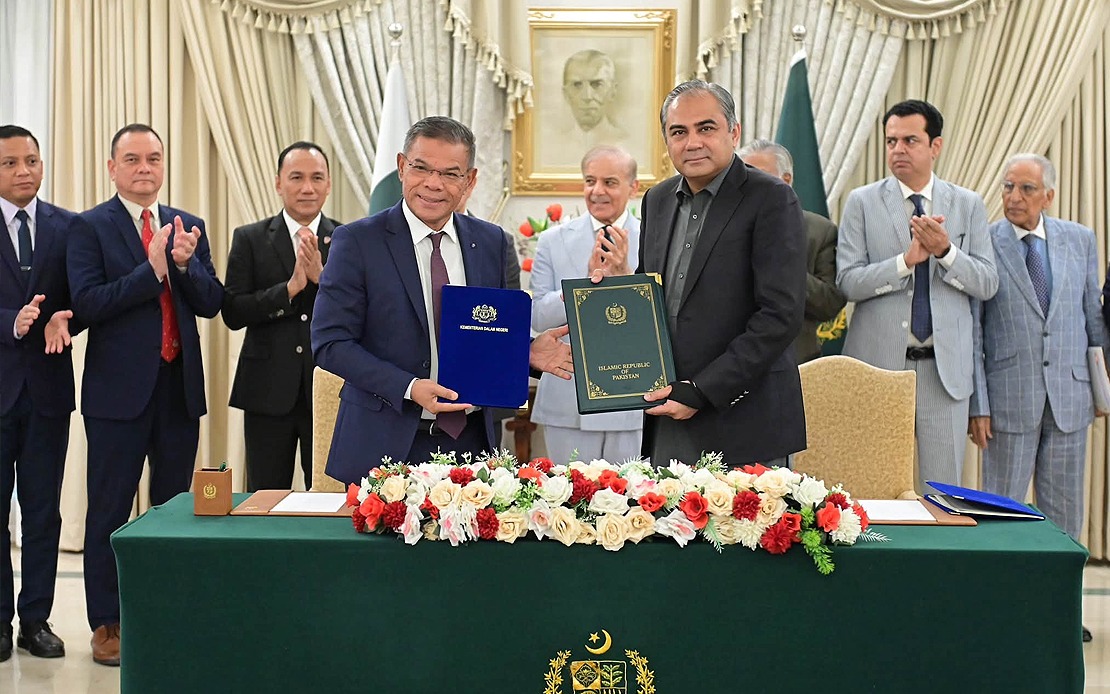
Malaysia and Pakistan have formalised a landmark agreement on prisoner transfers, with Home Minister Datuk Seri Saifuddin Nasution Ismail and Pakistan's Interior and Narcotics Control Minister Syed Mohsin Raza Naqvi signing the International Transfer of Prisoners Treaty in Islamabad. The signing ceremony, held at Pakistan's Prime Minister's Office and witnessed by Pakistan Prime Minister Muhammad Shehbaz Sharif, represents a significant deepening of institutional cooperation between the two Muslim-majority nations that share historical and cultural bonds.
The treaty emerges from an extended negotiation process spanning five rounds of talks since September 2025, indicating the complexity of establishing such legal frameworks across different penal systems and jurisdictions. Malaysia's negotiating team comprised representatives from the Home Ministry, Foreign Ministry, Attorney General's Chambers, Malaysian Prisons Department and Royal Malaysia Police, reflecting the multi-agency coordination required to harmonise prisoner management standards. The Malaysian Cabinet had formally approved the accord on May 13, clearing the final domestic hurdle before the bilateral signing could proceed.
Under the treaty's provisions, Malaysian nationals currently incarcerated in Pakistani facilities will have the opportunity to be repatriated to complete their remaining sentences within Malaysia's prison system. Conversely, Pakistani citizens serving sentences in Malaysian detention facilities may be transferred back to Pakistan to serve out their remaining sentences. This reciprocal arrangement addresses a longstanding humanitarian concern for nationals serving time abroad, where language barriers, cultural dislocation and separation from family support networks often hinder rehabilitation efforts.
Saifuddin Nasution emphasised that the treaty extends beyond mere administrative convenience, framing it as enabling prisoners to pursue rehabilitation programmes better suited to their respective cultural and social contexts. The psychological and social dimensions of incarceration are increasingly recognised in modern penology, with evidence suggesting that prisoners adapt more effectively to rehabilitation when immersed in familiar cultural environments with family visitation possibilities and community reintegration pathways. This treaty acknowledges those realities by allowing prisoners to serve sentences in settings aligned with their own societies' values and structures.
For Malaysia, the agreement carries particular significance given the country's position as a major transit hub in South Asia and broader Asia-Pacific region. The treaty strengthens Malaysia's institutional capacity to manage international criminal justice matters and reflects the country's evolving role in regional security cooperation. It also provides practical relief to Malaysian prisoners currently in Pakistani jails, a constituency that has faced documented challenges in accessing legal assistance and maintaining family connections across the significant geographic and logistical distance separating the two nations.
The bilateral relationship between Malaysia and Pakistan extends across multiple dimensions including defence, trade and people-to-people exchanges. This prisoner transfer treaty represents the legal architecture side of that relationship, institutionalising procedures that facilitate justice administration across borders. The agreement sits within a broader regional context of Southeast Asian and South Asian nations increasingly formalising prisoner transfer arrangements, recognising that cross-border criminal cases and international mobility of citizens necessitate sophisticated legal frameworks.
Pakistan itself has been actively pursuing such arrangements with multiple nations, seeking to address the substantial population of Pakistani nationals detained abroad and vice versa. The agreement with Malaysia follows similar treaties signed with other countries, reflecting Islamabad's strategic priority of formalising mechanisms that protect its citizens' welfare while administering justice. The timing of this accord also aligns with Pakistan's focus on strengthening diplomatic relationships across Asia, particularly with countries sharing religious and cultural affinity.
The treaty's approval through Malaysia's Cabinet demonstrates the domestic political consensus on international cooperation mechanisms, even where they involve sensitive areas like criminal justice administration. Home security and law enforcement cooperation increasingly requires bilateral and multilateral agreements that harmonise procedures and establish trust between institutions. This treaty exemplifies how modern nations construct frameworks for managing complex issues that transcend national borders.
For Malaysian legal practitioners and human rights advocates, the treaty opens possibilities for improving conditions for Malaysian nationals abroad while maintaining Malaysia's commitment to due process and rehabilitation principles. The agreement explicitly frames prisoner transfers as facilitating rehabilitation in culturally appropriate environments, suggesting the framework incorporates contemporary correctional philosophy emphasising offender transformation rather than purely punitive incarceration.
The signing also underscores how regional multilateralism operates across religious and geographic boundaries. Malaysia-Pakistan cooperation has deep historical roots, and this treaty represents the modern expression of those ties through institutional mechanism-building. As regional security challenges evolve and criminal networks increasingly operate across borders, such treaties become essential infrastructure for effective law enforcement and justice administration.
Looking forward, this treaty may serve as a template for similar arrangements Malaysia pursues with other nations, particularly within ASEAN where prisoner transfer agreements remain underdeveloped despite significant cross-border criminal activity. The successful negotiation and signing of the Malaysia-Pakistan accord demonstrates the feasibility of establishing such frameworks and may encourage other Southeast Asian nations to pursue comparable arrangements that strengthen regional justice cooperation while protecting their nationals abroad.

