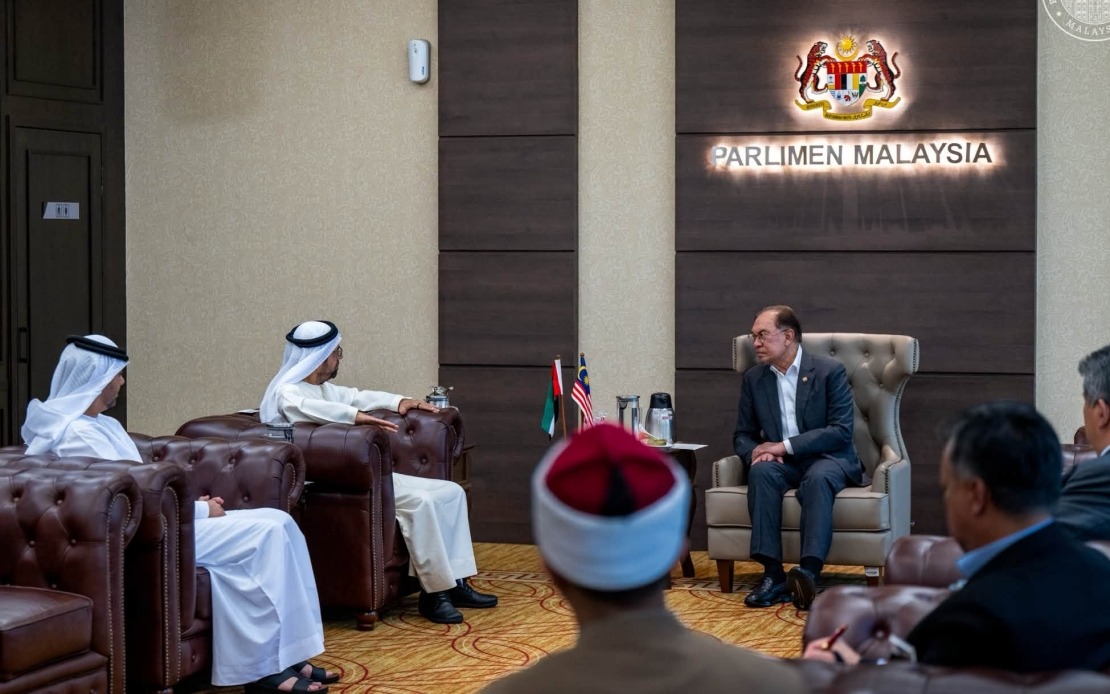
Prime Minister Datuk Seri Anwar Ibrahim has signalled Malaysia's determination to forge deeper ties with the United Arab Emirates through carefully calibrated strategic initiatives that serve both nations' interests. The undertaking came into sharper focus during a parliamentary engagement with Dr Ali Rashid Al Nuaimi, who chairs the Defence, Interior and Foreign Affairs Committee of the UAE's Federal National Council, in discussions held at the Parliament building in Kuala Lumpur.
The bilateral dialogue underscores a broader regional pattern whereby Malaysia and the UAE have increasingly aligned on matters extending beyond traditional trade frameworks. Both countries recognise that their geographic positions—Malaysia as a Southeast Asian gateway and the UAE as a Gulf nexus—create complementary opportunities for economic collaboration and geopolitical coordination. The meeting reflected a deliberate effort to move beyond ceremonial diplomatic exchanges toward substantive partnerships capable of addressing contemporary challenges.
Central to the discussion were emerging geopolitical tensions, particularly the escalating friction between the United States and Iran and its cascading effects across the broader Middle East and Indian Ocean regions. For Malaysia, these developments carry direct implications given the country's substantial maritime interests, heavy dependence on Persian Gulf energy resources, and sizeable diaspora communities across the region. The UAE, as a more proximate stakeholder in Gulf stability, brings valuable perspective and strategic leverage that Malaysia can benefit from as it navigates increasingly complex regional dynamics. By establishing regular consultative channels on such matters, both nations can better anticipate and respond to threats to their mutual interests.
A particularly noteworthy dimension of the engagement centred on artificial intelligence governance and its application within defence architectures. Anwar expressed genuine appreciation for the UAE's pioneering approach of mandating AI literacy training among ministerial and senior bureaucratic ranks. This institutional commitment reflects the Emirates' recognition that technological disruption demands responsive leadership capable of understanding and steering AI integration across government functions. For Malaysia, absorbing and adapting such best practices could significantly enhance administrative capacity and decision-making quality during a period of rapid digital transformation.
The Malaysian Prime Minister's emphasis on AI adoption signals his administration's intent to position the country competitively within the digital economy and to modernise governance infrastructure accordingly. By learning from UAE's structured approach—rather than approaching AI as purely a technical matter—Malaysia can embed technological literacy throughout its leadership hierarchy. This becomes particularly urgent given the region's competitive dynamics, where nations lagging in digital readiness risk economic and strategic disadvantage. The conversation also implicitly acknowledges that defence modernisation increasingly depends on algorithmic capability and data analytics prowess, domains where Malaysian institutions require substantial capacity building.
Beyond the immediate diplomatic courtesies, the bilateral engagement reflects Malaysia's pragmatic foreign policy positioning during an era of great power competition. The country has historically maintained balanced relationships across the broader Muslim world, the Western alliance structure, and increasingly, emerging powers. The UAE similarly pursues a diversified diplomatic strategy, balancing its proximity to Saudi Arabia and its strategic relationship with the United States against growing engagement with Asian economies and emerging markets. When two such diplomatically sophisticated nations intensify dialogue, they typically do so with clear-eyed recognition of mutual advantage.
The emphasis on mutual benefit and regional contribution signals that both governments view their partnership as contributing to broader peace and stability frameworks rather than as zero-sum competition. This contrasts with certain narratives suggesting Southeast Asian nations must choose sides in larger geopolitical confrontations. Malaysia's approach—reinforced through this UAE engagement—suggests instead that middle powers can leverage strategic partnerships to expand their agency and create space for independent policy choices.
The timing of this high-level meeting also reflects Malaysia's broader diplomatic calendar and its efforts to consolidate relationships across regions where it holds significant interests. Following recent visits and engagements with other major partners, the UAE dialogue indicates sustained commitment to deepening ties beyond the immediate Gulf or Southeast Asian neighbourhoods. For the business community, such governmental momentum typically presages expanded opportunities in sectors ranging from defence procurement to digital infrastructure development, financial services to energy cooperation.
Looking forward, the commitment to explore strategic cooperation likely encompasses specific working groups or mechanisms for ongoing dialogue at technical and ministerial levels. Both governments possess the institutional sophistication to translate high-level political commitments into concrete sectoral collaboration. Defence cooperation might involve training exchanges, equipment maintenance agreements, or intelligence sharing protocols. AI governance cooperation could spawn joint research initiatives, talent exchange programmes, or coordinated standard-setting efforts. These granular partnerships often prove more durable than ceremonial summit declarations.
For Malaysia's broader strategic position, the UAE engagement demonstrates active diplomacy aimed at building partnerships with economically dynamic, geopolitically consequential nations across multiple regions. Rather than passive reception of external pressures, such initiatives reflect Malaysian agency in shaping its operating environment. The particular focus on AI and governance modernisation additionally signals that Anwar's administration recognises technological transformation as central to national competitiveness and social resilience. By learning from the UAE's experiences and establishing structured dialogue mechanisms, Malaysia positions itself to navigate the complex intersection of technological change, regional instability, and great power competition with greater institutional readiness and strategic clarity.

