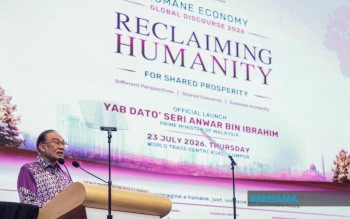
Malaysia's government will embark on crafting its 2027 fiscal blueprint next month, with the completed spending plan scheduled for parliamentary presentation in early October, according to Prime Minister Datuk Seri Anwar Ibrahim. As both the nation's chief executive and Finance Minister, Anwar outlined the timeline during remarks at a major economic conference in Kuala Lumpur, signalling the administration's commitment to a structured budgeting process well ahead of the October tabling date.
The forthcoming budget represents far more than a routine fiscal document, according to Anwar's framing of the government's approach. Rather than viewing economic expansion as an isolated objective, he emphasised that growth must serve a deeper moral purpose: creating tangible improvements in ordinary Malaysians' material circumstances and quality of life. This philosophy signals a deliberate reorientation away from purely metrics-driven policymaking toward outcomes that voters actually experience in their daily existence.
Anwar articulated his vision for the budget through a fundamental challenge to conventional economic thinking. He rejected the notion that stronger gross domestic product figures, higher consumer spending, or increased wealth accumulation constitute success in themselves. Instead, he posed a more searching set of questions that should guide fiscal decisions: does economic expansion genuinely widen opportunities for ordinary people, or does it concentrate advantages among the already privileged? This framing carries particular resonance in Malaysia, where income inequality and wage stagnation have emerged as persistent political concerns across both urban and rural constituencies.
The Prime Minister expanded his philosophical framework during his keynote address at the Humane Economy Global Discourse 2026 summit in the capital. He stressed that policymakers must consider whether growth strengthens family bonds and community cohesion or leaves households more fragile and atomised. Critically, he questioned whether development treats citizens as genuine partners in shared prosperity or merely as economic units to be deployed for production. This language suggests the government intends to recalibrate its relationship with the workforce and civil society.
Translating these principles into concrete policy, Anwar outlined what meaningful prosperity should deliver to Malaysian households. The budget will pursue measurable improvements in wage levels, employment that provides genuine fulfilment rather than mere subsistence, affordable housing that families can realistically access without generational debt, healthcare systems that do not bankrupt the sick, educational opportunities that rival global standards, and authentic social mobility allowing talent and effort to determine life trajectories. For many Malaysians struggling with cost-of-living pressures, these commitments represent the gap between theoretical economic growth and lived experience.
The Budget 2027 will incorporate several cross-cutting policy domains that collectively define Malaysia's economic trajectory. Semiconductor strategy positions the nation within high-value technology sectors, while energy transition represents both environmental imperative and economic opportunity. Digital transformation underpins productivity across the economy. However, Anwar insisted that none of these initiatives can succeed while ignoring the human dimensions and moral foundations of governance. This integration of technical economic planning with ethical considerations distinguishes his stated approach from purely technocratic models.
Sustainability represents another core principle animating the budget framework. Anwar rejected policies that outsource environmental, financial, or social costs to future generations, a particularly significant declaration given Malaysia's ongoing deforestation challenges and climate vulnerability. Intergenerational equity—ensuring that today's economic gains do not create tomorrow's crises—will apparently receive explicit budgetary consideration rather than token acknowledgement. This suggests potential conflicts with immediate development interests but reflects growing recognition of long-term risks.
Innovation policy will be examined through a distinctly social lens under this framework. Rather than celebrating technological advancement in abstract terms, the government will evaluate whether innovations expand human capabilities and potential across society or whether they deepen divides between winners and losers. This approach potentially influences research funding priorities, skills development investments, and digital infrastructure deployment decisions, pushing beyond Silicon Valley models that concentrate benefits narrowly.
For Southeast Asia's largest Muslim-majority democracy, these statements carry political significance beyond budgetary mechanics. The emphasis on dignity, security, purpose and hope in economic life taps into broader concerns about globalisation's distributional consequences and technological disruption's impact on ordinary workers. The Budget 2027 framework appears designed to demonstrate that the government can combine orthodox economic management with genuine responsiveness to citizen welfare concerns.
The timeline permitting August commencement and October tabling offers the Ministry of Finance approximately two months for formulation, significantly shorter than ideal for comprehensive policy development. This compressed schedule may reflect either political urgency or established institutional capacity to move quickly through budget cycles. The early October presentation date notably precedes year-end, allowing Parliament adequate time for scrutiny and debate before implementation.
The government's emphasis on balancing growth with human welfare addresses a recurring criticism that Malaysia's macroeconomic performance has not uniformly improved living standards for all segments of society. Whether Budget 2027 will deliver material changes in taxation, spending priorities, or regulatory frameworks remains to be seen when the document reaches Parliament. The philosophical framing Anwar articulated establishes expectations that will be tested against actual allocations and policy choices in the coming months.

