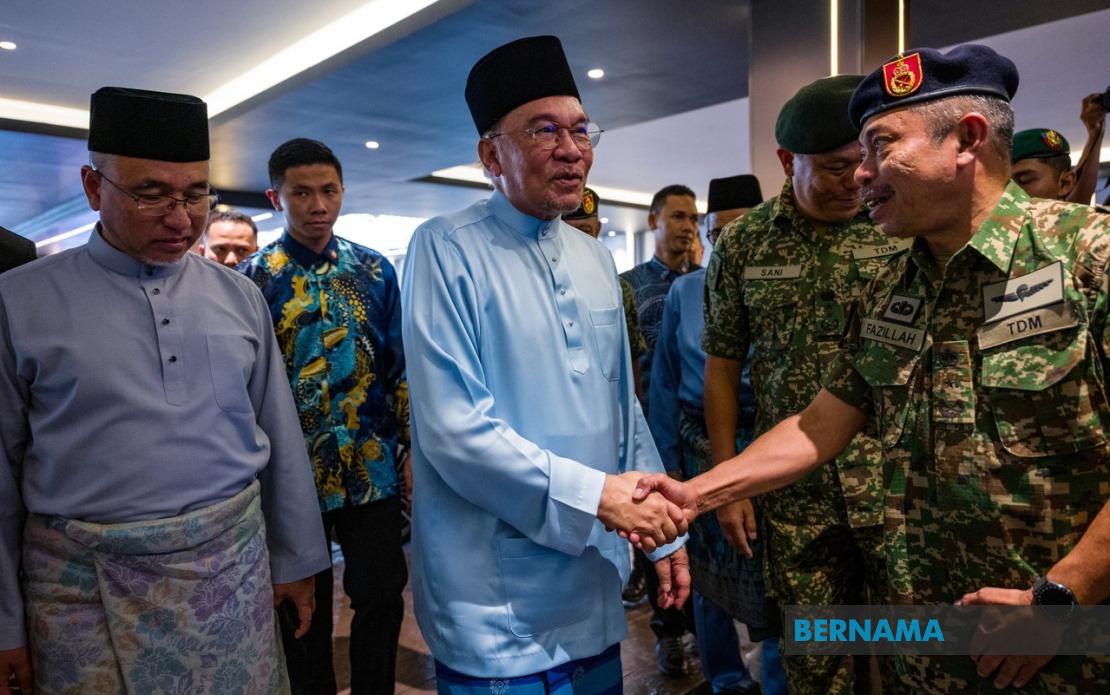
Prime Minister Datuk Seri Anwar Ibrahim has announced plans to elevate Malaysia's defence spending under Budget 2027, a policy shift that underscores the government's commitment to revitalising the Malaysian Armed Forces and addressing longstanding infrastructure and welfare gaps within the military establishment. Speaking at the Semarak Kenegaraan Programme held at Terendak Camp in Melaka, Anwar outlined a comprehensive strategy that extends beyond equipment upgrades to encompass substantive improvements to service members' living conditions and institutional capacity.
Chief of Defence Force General Tan Sri Malek Razak Sulaiman welcomed the initiative, characterising the budget increase as validation of the government's resolve to strengthen military development and operational capability. The senior military commander emphasised that the additional resources would be instrumental in advancing the MAF's long-term modernisation roadmap, formally known as the Future Force strategic development plan, which charts the institution's trajectory toward enhanced defence posture and technological sophistication.
The budgetary commitment carries significant implications for Southeast Asia's strategic environment. Malaysia, positioned at a crucial juncture of regional maritime interests and geopolitical considerations, requires a credible and capable defence apparatus to safeguard national sovereignty and contribute meaningfully to regional security arrangements. A prolonged underinvestment in military infrastructure had created vulnerabilities that this renewed fiscal commitment seeks to address, potentially elevating Malaysia's role as a stable security actor within ASEAN and beyond.
Beyond procurement of advanced military systems, the financial allocation specifically targets personnel welfare, an area that has historically received insufficient attention despite its profound impact on force morale and retention. Anwar highlighted concrete initiatives including renovation and expansion of military housing quarters, construction of a modern military hospital, and maintenance of essential utilities including water supply systems. These improvements acknowledge the reality that military effectiveness depends substantially on service members' quality of life and their families' stability.
The modernisation agenda operates within the framework of the MAF's comprehensive strategic development plan, which identifies critical capability gaps and technological requirements for the force to remain operationally relevant. This deliberate, structured approach contrasts with ad hoc spending and demonstrates institutional planning aligned with long-term national defence objectives. Equipment obsolescence and operational limitations have constrained the MAF's ability to respond to evolving security challenges, making systematic asset renewal essential for maintaining deterrent credibility.
Personnel welfare constitutes a foundational element of military effectiveness that transcends conventional hardware considerations. When service members and their families lack adequate housing, access to quality medical facilities, or reliable utilities, organisational cohesion deteriorates and retention becomes problematic. Recognition of this interconnection within military leadership circles has intensified advocacy for comprehensive welfare provisions, and the Prime Minister's explicit inclusion of these elements in Budget 2027 planning reflects receptiveness to institutional perspectives on force readiness.
Anwar, simultaneously serving as Finance Minister, has positioned defence spending increases within the broader context of fiscal responsibility and strategic prioritisation. This dual capacity suggests that the budgetary commitment represents not merely rhetorical support but a substantive allocation through the formal budget process, where defence expenditure competes with numerous other national priorities. The government's willingness to elevate military investment indicates confidence in defence modernisation as economically justifiable and strategically imperative.
A notable policy development announced at the same occasion involves expediting and simplifying promotion processes for Malaysian Armed Forces and Royal Malaysia Police personnel. By aligning advancement mechanisms with broader public service schemes, the government seeks to enhance career progression clarity and reduce bureaucratic impediments that have historically frustrated capable personnel. This structural reform complements capital investment by addressing human resource management deficiencies.
The timing of these announcements reflects broader governmental recognition that institutional confidence within the security sector requires demonstrated commitment extending beyond rhetoric. Military organisations function most effectively when assured of sustained political support and resource availability for executing assigned missions. A budgetary commitment of the magnitude articulated by Anwar provides this assurance and removes uncertainty that had constrained planning and capability development.
Regionally, Malaysia's defence investment decisions carry implications for broader security architecture and burden-sharing within ASEAN. As Southeast Asian nations confront diverse security challenges ranging from maritime domain awareness to counter-terrorism operations, individual national capabilities aggregate to collective regional capacity. Malaysian military modernisation contributes incrementally to ASEAN's overall security resilience and demonstrates commitment to meaningful participation in regional frameworks including bilateral security partnerships and multilateral defence dialogues.
The financial commitment to military hospital construction deserves particular attention, as military healthcare capacity directly enables operational effectiveness and personnel morale. A dedicated facility addressing service members' medical requirements reduces their dependence on civilian healthcare systems and enables specialised treatment protocols addressing combat-related or service-specific medical conditions. This investment acknowledges healthcare as integral to comprehensive force readiness rather than peripheral administrative function.
Implementation challenges will inevitably arise as Budget 2027 defence allocations transition from announcement to procurement execution. Malaysia's acquisition processes have historically experienced delays and cost overruns, requiring institutional discipline and transparent oversight mechanisms. Success of this modernisation initiative depends substantially on effective programme management, appropriate vendor selection, and sustained political commitment across multiple budget cycles.
Looking forward, the government's defence spending elevation establishes baseline expectations for subsequent budgets, creating momentum for continued military investment. This trajectory matters considerably in a region experiencing incremental military buildups and technological advancement among neighbouring nations. Malaysia's capacity to maintain credible defence capabilities depends on sustaining this investment commitment and translating budgetary allocations into tangible operational improvements that enhance national security posture.

