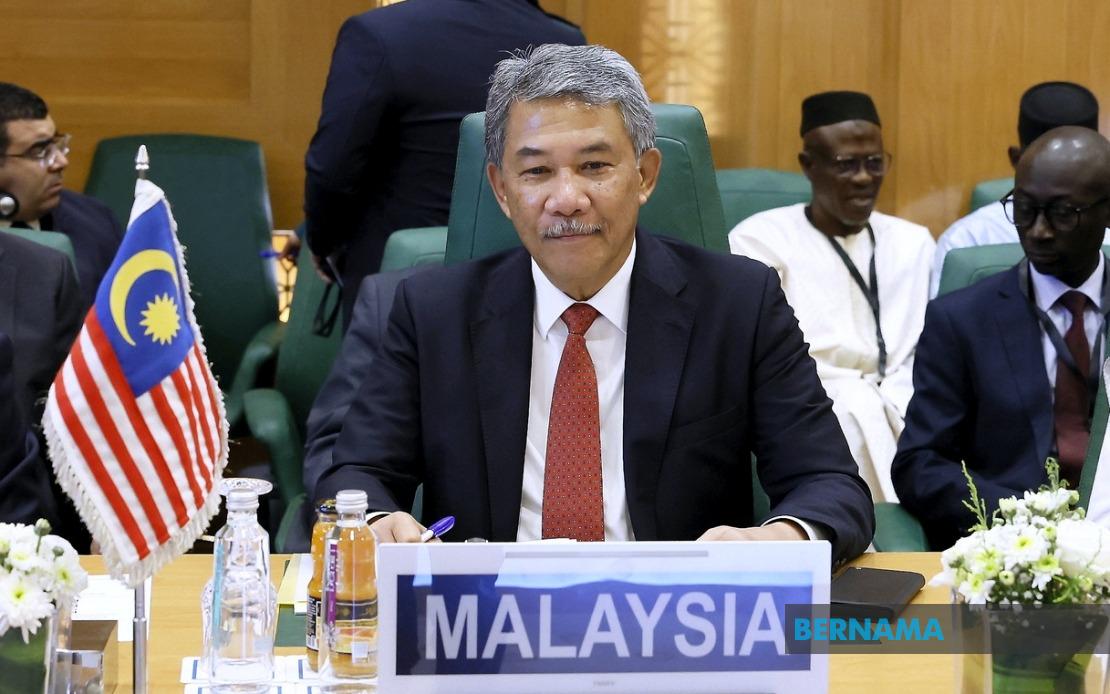
Malaysia has intensified its diplomatic pressure on the international Islamic community to take a unified stance against Israel's settlement expansion in the occupied Palestinian territories. Speaking at an Extraordinary Meeting of the OIC Council of Foreign Ministers in Jeddah on August 27, Foreign Minister Datuk Seri Mohamad Hasan delivered a forceful condemnation of Israel's US$2.3 billion settlement initiative, positioning Malaysia as a vocal advocate for Palestinian statehood and Islamic bloc solidarity on the matter.
The Malaysian foreign minister grounded his appeal in international law, specifically invoking the International Court of Justice's Advisory Opinion issued on July 19, 2024, as the legal foundation for rejecting Israeli occupation and settlement activities. Mohamad argued that OIC member states possessed both a moral obligation and a legal framework to withhold recognition and support for what he characterised as flagrant violations of international law. His emphasis on the ICJ ruling reflects a broader strategy within Malaysia's diplomacy to anchor Arab-Islamic positions in globally accepted legal instruments rather than relying solely on political rhetoric.
At the heart of Malaysia's criticism lies the so-called E1 settlement plan, which Mohamad identified as a particularly damaging component of Israel's broader expansion strategy. The E1 zone, located between Jerusalem and the Dead Sea, has become contentious because its development would effectively sever territorial connections between Palestinian population centres in the West Bank and East Jerusalem, fragmenting what remains of Palestinian-controlled territory. By drawing attention to this specific project, Malaysia highlights how individual settlement schemes serve a larger geopolitical architecture designed to render a contiguous Palestinian state geographically impossible.
The Malaysian government's language reflects deepening concern that incremental settlement expansion represents a permanent transformation of facts on the ground that negotiation cannot easily reverse. Mohamad stressed that the continuing construction of illegal settlements directly undermines the foundational premise of a two-state solution—the existence of viable, geographically coherent Palestinian territory. This framing suggests Malaysia views settlement expansion not merely as a policy dispute but as an existential threat to Palestinian self-determination itself.
Beyond settlement policy, Mohamad raised several interconnected grievances that collectively portray a systematic campaign against Palestinian presence and identity. He condemned settler violence against Palestinians in the West Bank, unlawful evictions in Jerusalem, and actions targeting the city's religious character. The inclusion of these issues alongside settlement expansion indicates Malaysia's view that Israeli actions operate across multiple registers—legal mechanisms like settlement schemes working in tandem with vigilante violence and administrative measures—to achieve the same objective of Palestinian displacement and marginalisation.
The humanitarian dimension of the conflict featured prominently in Malaysia's statement, with Mohamad drawing the OIC's attention to the catastrophic toll of the Gaza conflict. His invocation of over 70,000 deaths and widespread destruction of civilian infrastructure represents Malaysia's effort to connect settlement expansion policy to the broader pattern of violence and occupation that defines the Israeli-Palestinian conflict. The Foreign Minister's characterisation of the situation as a moral crisis testing the international order's credibility suggests Malaysia views the OIC's response as a referendum on the Islamic bloc's willingness to defend fundamental principles of international law and human rights.
Mohamad criticised the international community's repeated calls for ceasefire, humanitarian access, and civilian protection, noting that nearly three years of such appeals have yielded no substantive change in Israeli conduct. This critique reflects Malaysian frustration that diplomatic pressure and international consensus, despite their clarity and consistency, have failed to alter Israeli actions. The implicit message to OIC members is that stronger, more coordinated responses are necessary given the inadequacy of conventional diplomatic channels.
Malaysia's position on Jerusalem and Al-Aqsa Mosque carried particular weight, with Mohamad condemning the July 23 incursion by Israeli ministers and settlers into the Al-Aqsa compound as an unacceptable provocation against Islamic sanctity. His call for OIC support of Jordan's historic Hashemite Custodianship over Jerusalem's holy sites represents an attempt to anchor Islamic claims to the city in established international arrangements and legal traditions. This approach seeks to position Muslim concerns about Jerusalem not as sectarian claims but as defence of longstanding custodial rights and agreements.
The Foreign Minister also extended Malaysia's criticism to institutional dimensions, demanding that the United Nations Security Council enforce international law through protection of UNRWA's mandate. His reference to the seizure of UNRWA's Kalandia Training Centre and legislation imposing capital punishment on Palestinians illustrates how Malaysia connects multiple Israeli actions—settlement expansion, incitement, military operations, and institutional disruption—into a comprehensive critique of occupation policy. This multifaceted approach prevents the dispute from being narrowed to any single issue and instead portrays a systematic pattern requiring multifaceted international response.
Malaysia's vision for resolution centres on the two-state solution based on June 4, 1967 borders with East Jerusalem as Palestine's capital. Mohamad framed this not as a negotiable diplomatic preference but as a fundamental imperative rooted in international law and Palestinian rights. The emphasis on borders predating the 1967 war reflects Palestinian and Arab positions that refuse to accept the legitimacy of territorial acquisitions achieved through military conquest, a principle Malaysia treats as non-negotiable.
The Malaysian government's appeal to OIC cohesion carries significance for regional dynamics and Islamic bloc politics. By presenting settlement rejection as a test of OIC unity and credibility, Mohamad attempts to mobilise collective pressure that individual states might resist. For Malaysia specifically, these statements reinforce its identity as a leading voice within the Islamic world on Palestinian issues, a positioning that carries domestic political weight within Malaysia's Muslim-majority society.
The broader implication of Malaysia's Jeddah statement extends beyond immediate Palestinian issues to questions about the utility and effectiveness of international law in addressing powerful states' territorial ambitions. By anchoring Malaysian and OIC positions in the ICJ Advisory Opinion, Mohamad implicitly argues that legal instruments possess legitimacy and binding force only when supported by coordinated political will from significant state blocs. Malaysia's call for OIC members to collectively reject Israeli settlements thus represents an attempt to translate legal principle into political leverage.

