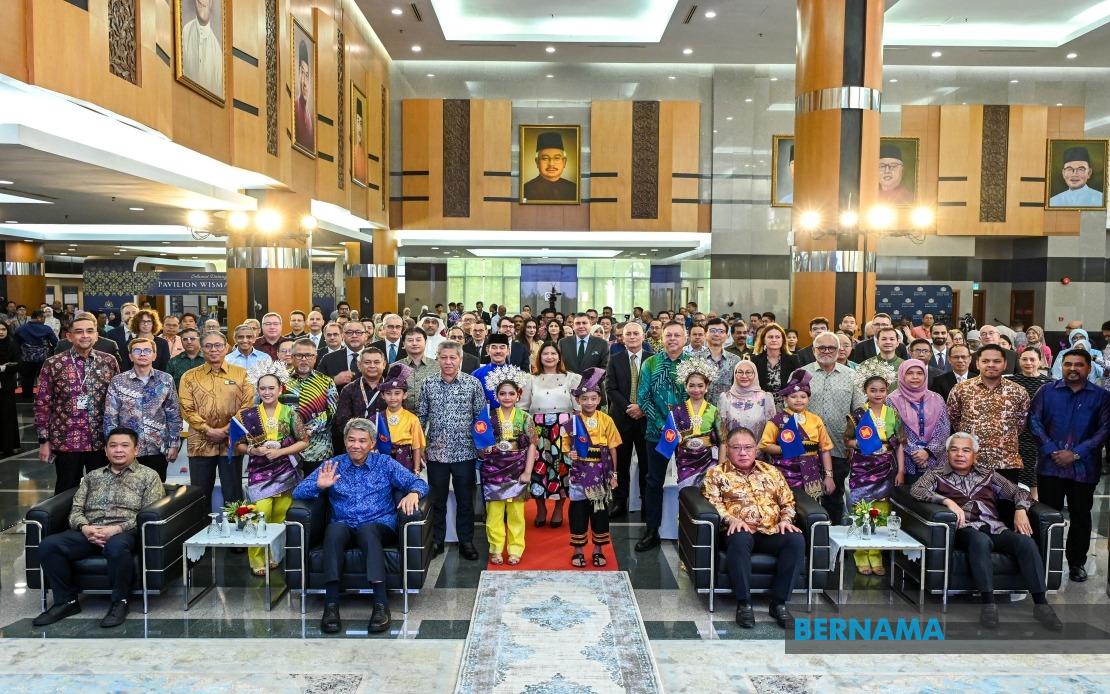
Malaysia used a gathering at its Foreign Ministry in Putrajaya on Monday to honour nearly six decades of participation in the Association of Southeast Asian Nations, underscoring the country's pivotal role in the regional organisation since its formation in 1967. The commemoration, attended by approximately 300 guests including cabinet ministers, diplomatic officials and representatives from international bodies, served as a platform to reflect on Malaysia's trajectory within the bloc and its ongoing dedication to Southeast Asian unity.
The celebration, centred on the theme "59 Years of Navigating Together", emphasised ASEAN's shared vision while consolidating the bonds that connect the ten member nations. Foreign Minister Datuk Seri Mohamad Hasan presided over the event, which also drew Tourism, Arts and Culture Minister Datuk Seri Tiong King Sing and Deputy Foreign Minister Datuk Lukanisman Awang Sauni, alongside senior officials from various government agencies.
In remarks released alongside the event, Malaysia's Foreign Ministry characterised the milestone as a defining moment for the grouping. The statement highlighted how ASEAN's architecture rests on three foundational elements—political and security cooperation, economic integration, and social and cultural exchange—each of which has evolved substantially over the past 59 years. This tripartite framework has proven resilient in managing regional tensions and fostering cooperation even as geopolitical dynamics shifted dramatically across the Indo-Pacific.
The gathering featured a multimedia presentation titled "ASEAN Journey: Navigating Our Future, Together—59 Years of Malaysia in ASEAN", which traced the country's involvement from the organisation's inception through contemporary challenges and opportunities. A ceremonial cake-cutting led by Mohamad punctuated the formal proceedings, symbolising collective celebration and shared accomplishment across the member states.
ASEAN emerged from the Bangkok Declaration, signed on August 8, 1967, by Indonesia, Malaysia, the Philippines, Singapore and Thailand—five nations determined to establish a framework for regional peace and prosperity during the Cold War. The founding members sought to insulate Southeast Asia from superpower competition through non-interference in internal affairs and consensus-based decision-making, principles that remain foundational to ASEAN's operating methodology today.
The organisation's composition has transformed dramatically over the intervening decades. Brunei's accession in 1984 expanded the grouping to six members, but subsequent enlargements proved more rapid. Vietnam's admission in 1995 marked a significant geopolitical shift, bringing a communist state into a grouping of mixed regimes. The 1997 expansion added Laos and Myanmar, while Cambodia joined two years later, bringing the membership to nine. Most recently, Timor-Leste achieved full membership at the 47th ASEAN Summit in October of the previous year, raising the total to eleven and completing ASEAN's integration of all Southeast Asian nations.
This expansion trajectory holds particular significance for Malaysia, which navigated the integration of former adversaries and ideological competitors into a framework built on mutual respect and non-interference. Malaysia's diplomatic skill in facilitating consensus among increasingly diverse members—ranging from monarchies to communist states to developing democracies—has substantially shaped ASEAN's character and effectiveness as a regional institution.
The commemoration occurs amid persistent regional challenges that test ASEAN's cohesion. Territorial disputes, maritime security concerns, economic disparities between member states, and external great power competition in the South China Sea require sustained cooperation mechanisms that ASEAN has laboriously constructed. Malaysia's continued participation signals its commitment to these frameworks even as bilateral relationships and national interests sometimes create friction within the grouping.
For Malaysian readers, the ASEAN milestone carries practical implications. The grouping shapes bilateral trade relationships through ASEAN-led regional agreements, influences security policies through the ASEAN Regional Forum and East Asia Summit, and provides a platform for Malaysia to amplify its diplomatic voice beyond what it could achieve unilaterally. Economic integration through the ASEAN Economic Community, despite persistent implementation challenges, continues reshaping Malaysian business opportunities and labour market dynamics across the region.
The emphasis on navigating together reflects an acknowledgment that Southeast Asia's future prosperity depends on collective action rather than competitive fragmentation. As the region confronts climate change, pandemic preparedness, cyber security threats, and economic volatility, ASEAN's institutional capacity to generate consensus solutions becomes increasingly valuable. Malaysia's sustained engagement underpins this collaborative architecture.
Government officials at Monday's event articulated confidence in ASEAN's continued relevance and capacity to adapt to evolving circumstances. The invocation of resilience and solidarity suggests recognition that maintaining regional unity requires deliberate effort, particularly when member states pursue divergent foreign policies or encounter domestic pressures that strain adherence to ASEAN principles.
Looking forward, Malaysia's role in ASEAN will likely remain central to the grouping's ability to navigate geopolitical competition, particularly concerning great power relationships and maritime disputes. The country's bridging position—ethnically and religiously diverse, economically developed yet regionally embedded, strategically located yet maintaining equidistance from major powers—positions it as an effective mediator and coalition-builder within ASEAN forums.

