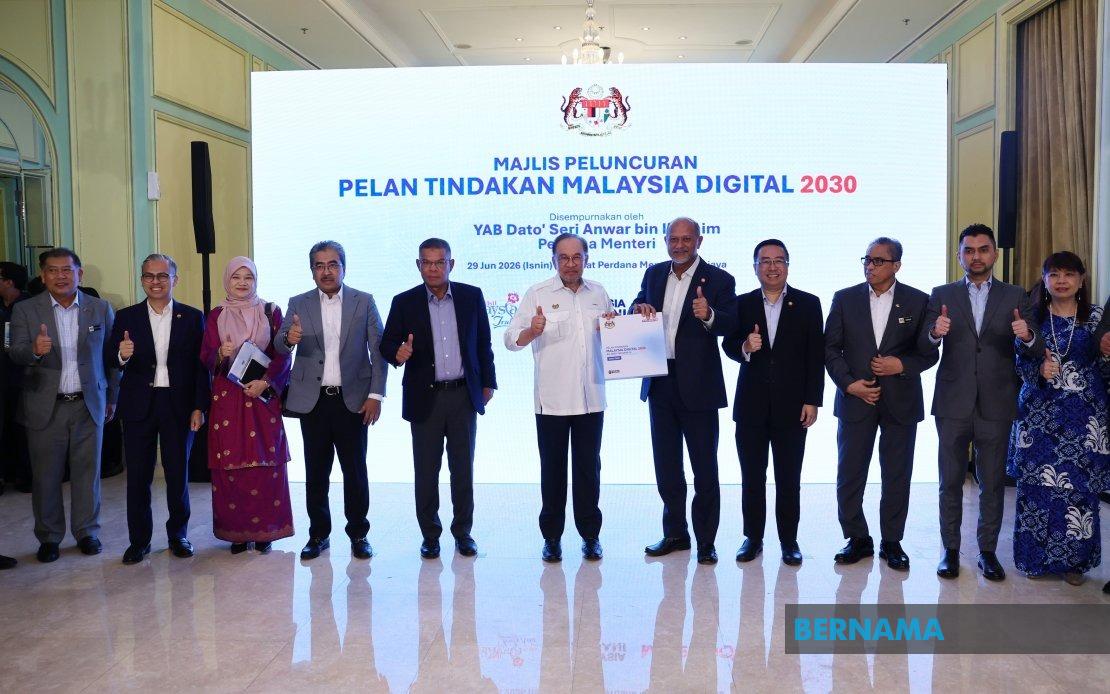
Prime Minister Datuk Seri Anwar Ibrahim has unveiled Malaysia Digital 2030 (MD2030), an ambitious national action plan that fundamentally reorients the country's technological ambitions away from importing solutions and towards generating homegrown innovation. Launched in Putrajaya on June 29, the strategy encompasses the period 2026-2030 and represents a watershed moment in how Malaysia conceptualises its role within the global digital economy. The unveiling brought together senior cabinet ministers including Digital Minister Gobind Singh Deo, Communications Minister Datuk Fahmi Fadzil, and Chief Secretary to the Government Tan Sri Shamsul Azri Abu Bakar, underscoring the whole-of-government commitment required to execute this transformation.
The initiative anchors itself around several concrete numerical objectives designed to reshape Malaysia's economic footprint. By the end of the decade, the government expects the digital economy to constitute 30 per cent of gross domestic product—a substantial increase that would position digital sectors among the nation's primary economic drivers. Equally significant is the commitment to generate 500,000 high-value digital jobs, reflecting ambitions to create quality employment rather than merely expanding workforce participation. Additionally, the public sector intends to realise RM4.5 billion in savings through digitalisation initiatives, while 95 per cent of government services are to be delivered entirely through online channels without requiring in-person transactions.
Structurally, MD2030 operates through seven interconnected strategic pillars, each assigned to a relevant minister functioning as a cluster head. This architecture ensures accountability while leveraging existing ministerial expertise and institutional capacity. Chief Secretary Shamsul Azri leads the Government pillar, which concentrates on modernising public service delivery through the establishment of GovTech Malaysia. Investment, Trade and Industry Minister Datuk Seri Johari Abdul Ghani oversees the Economy pillar, tasked with repositioning Malaysia as a regional digital innovation and trade hub. This encompasses promoting domestically created products marketed under a "Made by Malaysia" brand, expediting technology adoption across High Growth High Value sectors, and maximising the economic potential embedded in data, digital assets and intellectual property.
The Infrastructure pillar, directed by Communications Minister Fahmi, prioritises universal access to high-quality internet connectivity while simultaneously developing sustainable digital architecture encompassing data centres, cloud computing capabilities and smart city initiatives. These foundational investments prove essential for any nation aspiring to digital leadership, as without robust underlying systems, innovation remains geographically concentrated and economically inefficient. Meanwhile, Human Resources Minister Datuk Seri R. Ramanan chairs the Talent pillar, which addresses workforce readiness through comprehensive policy frameworks, flexible workforce transition mechanisms and efforts to establish Malaysia as a destination for recruiting regional and global digital professionals.
Social cohesion forms the rationale behind the Society pillar, led by Women, Family and Community Development Minister Datuk Seri Nancy Shukri. This component seeks to ensure digital transformation benefits extend across all demographic groups rather than concentrating among urban professionals. Specific initiatives include institutionalising the Malaysian Digital Inclusion Index to measure equity, empowering rural communities through targeted programmes and deploying digital solutions that address pressing social challenges. For Malaysian policymakers mindful of potential digital divides emerging along geographic and socioeconomic lines, this pillar represents acknowledgment that innovation divorced from inclusive participation risks perpetuating rather than reducing inequality.
Trust and Data Security, overseen by Digital Minister Gobind, constitutes a recognition that technological advancement divorced from robust governance creates vulnerabilities rather than opportunities. This pillar will operationalise the National Data Commission and develop the National Digital Trust and Data Security Strategy covering 2026-2030. Such emphasis reflects lessons learned across Southeast Asia regarding the reputational and operational costs incurred when digital infrastructure becomes compromised through inadequate security protocols or insufficient data protection frameworks. Minister of Science, Technology and Innovation Datuk Chang Lih Kang directs the Innovation pillar, which strengthens the pipeline linking research through commercialisation by constructing a comprehensive Research, Development, Commercialisation, Innovation and Economy ecosystem.
Implementation architecture distributes responsibility across multiple agencies functioning under the Digital Ministry's coordination. The National AI Office, GovTech Malaysia, Malaysia Digital Economy Corporation, CyberSecurity Malaysia, MyDIGITAL Corporation and Malaysia Centre for the Fourth Industrial Revolution collectively carry the operational burden of translating strategy into tangible outcomes. This multi-agency approach acknowledges that no single institution possesses sufficient expertise or authority to execute transformation of this magnitude and complexity. The distributed model also facilitates inter-agency collaboration on initiatives spanning multiple dimensions—a data security project, for instance, necessarily engages cybersecurity expertise, economic development considerations and governance frameworks simultaneously.
Digital Minister Gobind articulated the philosophical underpinning of MD2030, characterising it as evidence of Malaysia's determination to transition from technology consumer to respected digital innovation producer. He emphasised that the Digital Ministry's leadership responsibilities extend beyond pursuing economic targets to encompassing the institutional architecture enabling trust, data protection and transparent governance. This framing proves psychologically and strategically significant: it positions Malaysia not as a developing nation attempting to catch up to established technological powers, but as a deliberate actor shaping its own technological future according to domestically determined priorities and values.
The initiative directly addresses Southeast Asian competitive dynamics. Regional neighbours including Singapore, Indonesia and Thailand pursue their own artificial intelligence and digital economy strategies, creating both collaborative opportunities and competitive pressures. Malaysia's MD2030 represents an attempt to stake a credible claim as a regional innovation hub rather than remaining positioned as a secondary market for solutions developed elsewhere. The emphasis on creating intellectual property and establishing "Made by Malaysia" products reflects calculation that higher-value contributions to global digital supply chains generate superior economic returns compared to assembly or service delivery roles.
For Malaysian businesses and multinational enterprises operating within the country, MD2030 signals government intention to cultivate an ecosystem incentivising innovation-intensive activity. The commitment to developing talent pipelines, protecting intellectual property and investing in research infrastructure sends messages to investors that Malaysia intends to compete on innovation capacity rather than labour cost arbitrage alone. This represents a strategic recognition that sustainable competitive advantage in digital sectors accrues to nations demonstrating technological depth, not those offering temporary labour cost advantages easily replicated elsewhere.
The government frames MD2030 under the "Towards an AI Nation 2030" agenda, treating artificial intelligence as a transformative force permeating all societal dimensions. This encompasses not merely deploying AI tools in existing processes but reconceptualising how Malaysians work, interact with government, access services and solve problems. The vision articulated envisions a future where intelligent and autonomous systems become commonplace, data functions as a strategic national asset comparable to natural resources, and citizens thrive within technological ecosystems rather than competing against automation.
Critical observers might note that translating this strategic vision into operational reality requires sustained political commitment transcending electoral cycles, continuous investment in technical capabilities, and workforce adaptability potentially straining social cohesion. The RM4.5 billion in projected public sector savings through digitalisation assumes implementation efficiency that many government transformation initiatives have struggled to achieve. The 95 per cent target for online government service delivery demands not merely technological infrastructure but fundamental organisational redesign in often-traditional public sector institutions. Success hinges on persistent execution rather than merely compelling vision statements.
Nonetheless, MD2030 represents an important clarification of national technological ambitions at a moment when global digital competition intensifies. By articulating specific targets, distributing implementation responsibilities through established ministerial structures and positioning artificial intelligence as central to national development, the Malaysian government has created frameworks through which progress becomes measurable and accountability enforceable. Whether Malaysia ultimately achieves the status of respected AI nation depends fundamentally on implementation rigour, but the strategic intent now stands clearly articulated.

